
The short version
- Our engine played 35 games against chess.com’s computer bots and won all 35, 5 of them against the strongest bot, Maximum (rating 3200 on its card), and 10 against bots rated 2500 or more.
- These were games between our engine and chess.com’s computer bots, in its unrated bot mode, with no timer. They were not played against people and not in any rated or competitive setting, and they tell you nothing about how the engine would do against a human.
- chess.com’s own Game Review gave our moves a mean accuracy of 97.3 and the bots’ moves 78.5. Across the 35 games its review counted 0 blunders and 4 mistakes on our side.
- The numbers are a check on one engine against one family of opponents. A perfect record has no upper limit, so it cannot tell you how much stronger one side is. How we measure the engine’s strength properly, against Stockfish, is a separate measurement described further down.
- chess.com has not endorsed, reviewed or taken part in this test. We only played its public computer opponents.
What we did, and who played
chessGM is our free chess app with an engine written for it. We wanted an outside check that was not our own self-play, so on 20 October 2026 we had the engine play chess.com’s computer bots. The engine, chessGM’s own Go engine with a neural-network evaluation (NNUE), in its October 2026 build, ran natively on our own Mac, not on chess.com. It chose every move. An AI assistant operating a web browser then typed each move into chess.com’s bot board, one game at a time, with no timer and no hints from anyone.
We did not play all of chess.com’s bots. At the time its list had 217. We chose 30 spread across the rating range, about one for every 100 rating points from the weakest to the strongest below Maximum, and then played Maximum five times, as White and as Black. That is 35 games against 31 different bots.
The engine had between 1 and 3 seconds per move: 1 second against bots rated up to 1900, 2 seconds against bots from 2000 to 2900, and 3 seconds against Maximum. Its average search depth was 14.2 to 21.8 half-moves, depending on the game.
Every game
Ratings are the numbers chess.com prints on each bot’s card. They are chess.com’s own labels for its bots, not FIDE or human ratings. Accuracy is chess.com Game Review’s score, from 0 to 100, for how close each side’s moves were to the best moves it found.
| # | Bot (rating on its card) | Result (all by checkmate) | Our accuracy | Bot accuracy |
|---|---|---|---|---|
| 1 | Zach (100) | 1-0 | 97.8 | 83.8 |
| 2 | June (100) | 0-1 | 98.2 | 59.6 |
| 3 | Pepe (150) | 1-0 | 99.7 | 69.8 |
| 4 | Martin (250) | 0-1 | 97.5 | 71.8 |
| 5 | Elani (400) | 1-0 | 97.7 | 48.5 |
| 6 | Noel (550) | 0-1 | 97.9 | 70 |
| 7 | Jimmy (600) | 1-0 | 95.9 | 67.3 |
| 8 | Aron (700) | 0-1 | 97.1 | 77 |
| 9 | Zara (850) | 1-0 | 97.3 | 74.3 |
| 10 | Nisha (900) | 0-1 | 96.6 | 61.9 |
| 11 | Maria (1000) | 1-0 | 95.9 | 76 |
| 12 | Sven (1100) | 0-1 | 99 | 75.6 |
| 13 | Emir (1200) | 1-0 | 98.7 | 82.2 |
| 14 | Nelson (1300) | 0-1 | 97.9 | 80.5 |
| 15 | David (1400) | 1-0 | 97.3 | 82 |
| 16 | Antonio (1500) | 0-1 | 98.6 | 83.3 |
| 17 | Isabel (1600) | 1-0 | 97.8 | 84.3 |
| 18 | Arthur (1700) | 0-1 | 99.6 | 81 |
| 19 | Wally (1800) | 1-0 | 96.1 | 78.2 |
| 20 | Miguel (1900) | 0-1 | 98.9 | 75.6 |
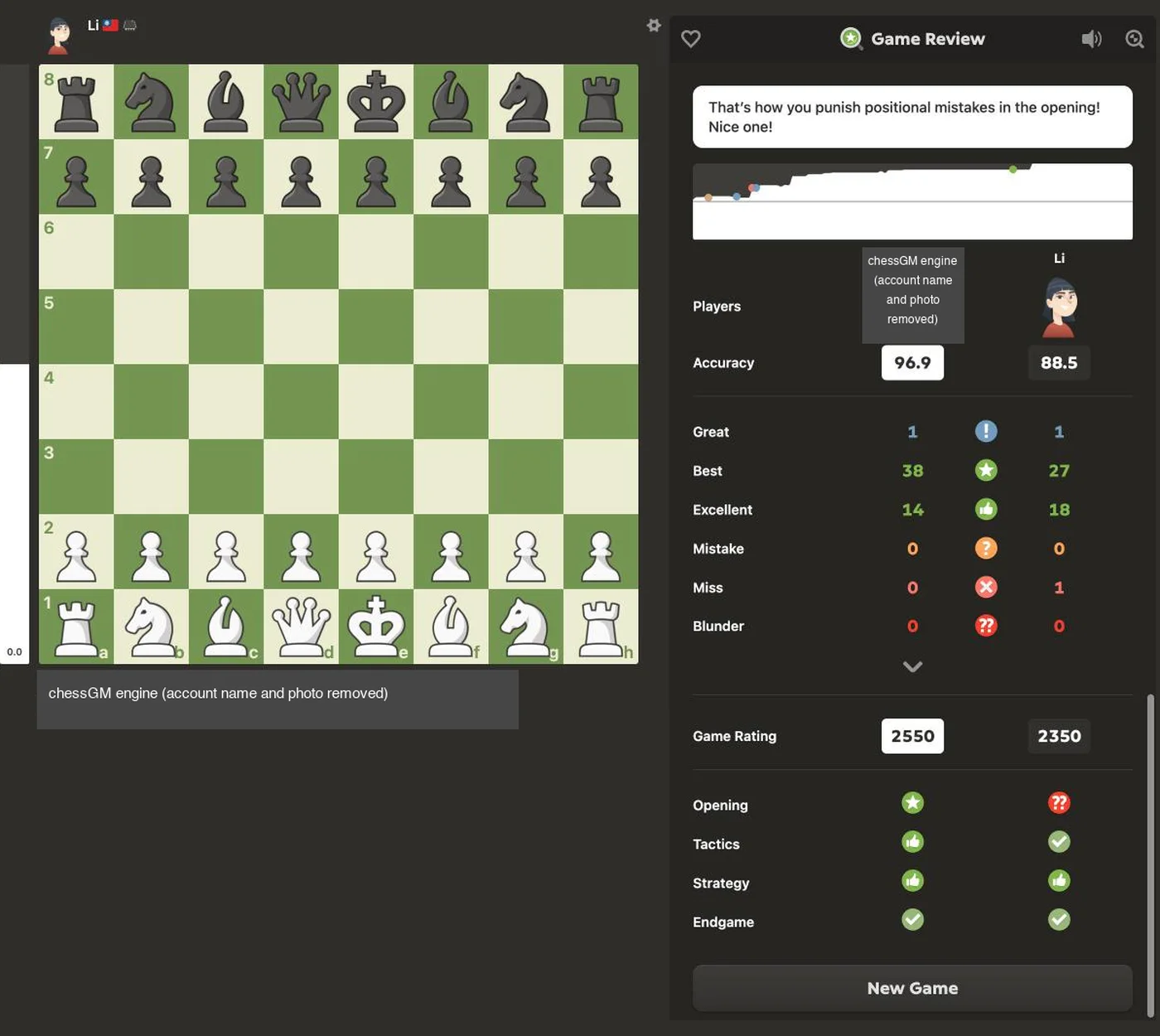
| 21 | Li (2000) | 1-0 | 94.4 | 86 |
| 22 | Manuel (2100) | 0-1 | 96.8 | 85.3 |
| 23 | Nora (2200) | 1-0 | 97.6 | 76.5 |
| 24 | Arjun (2300) | 0-1 | 98.3 | 73.3 |
| 25 | Wei (2450) | 1-0 | 94 | 73.2 |
| 26 | Engine lvl 21 (Master) (2500) | 0-1 | 98.2 | 87.1 |
| 27 | Engine lvl 22 (Grandmaster) (2600) | 1-0 | 96.8 | 88.2 |
| 28 | Engine lvl 23 (Grandmaster) (2700) | 0-1 | 97.7 | 87.5 |
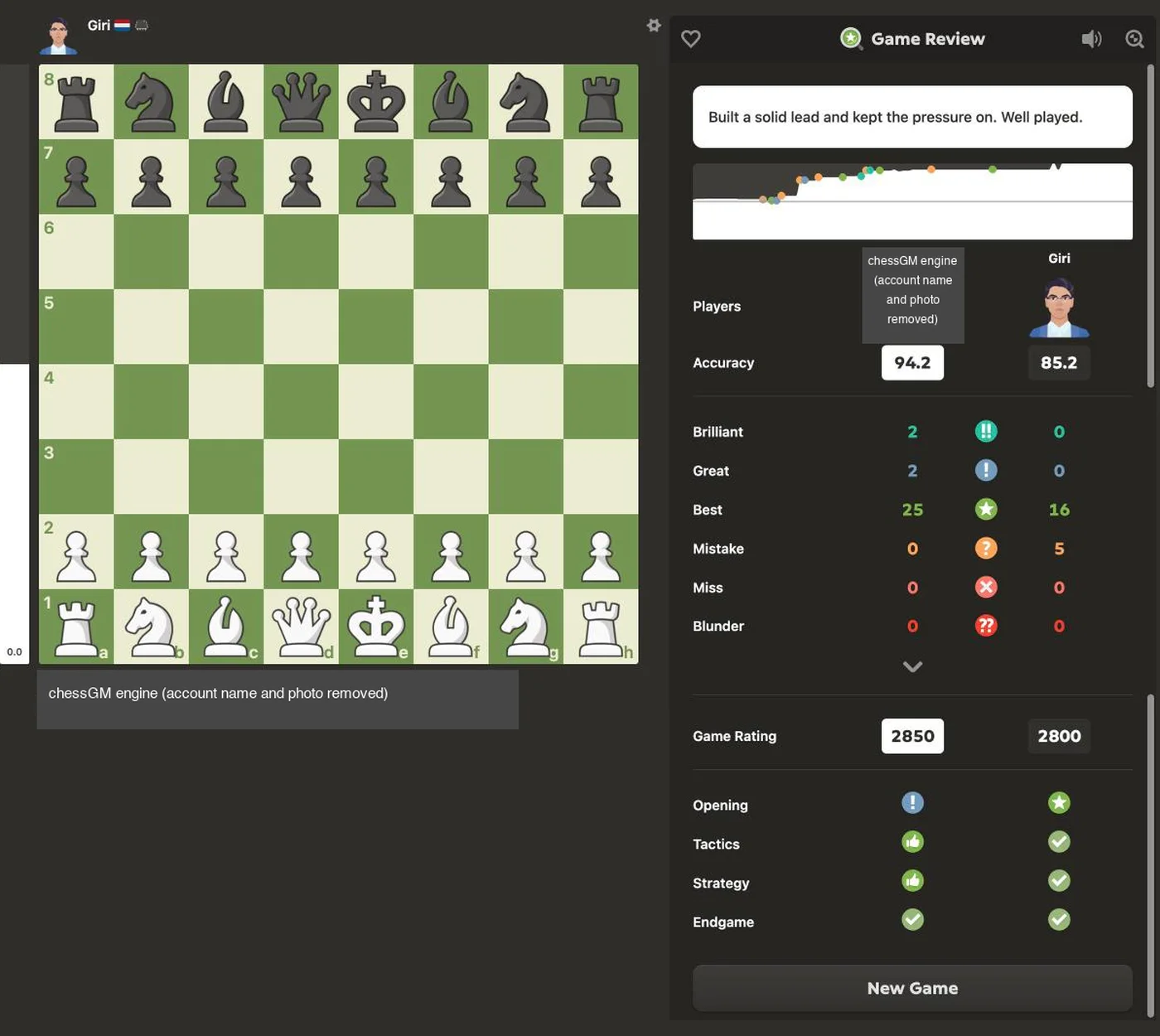
| 29 | Giri (2800) | 1-0 | 93 | 84.2 |
| 30 | Engine lvl 24 (Super Grandmaster) (2900) | 0-1 | 96.1 | 85.4 |
| 31 | Engine lvl 25 (Maximum) (3200) | 1-0 | 97.9 | 89 |
| 32 | Engine lvl 25 (Maximum) (3200) | 0-1 | 98.4 | 88.6 |
| 33 | Engine lvl 25 (Maximum) (3200) | 1-0 | 95.7 | 87.7 |
| 34 | Engine lvl 25 (Maximum) (3200) | 0-1 | 97.2 | 89 |
| 35 | Engine lvl 25 (Maximum) (3200) | 1-0 | 96.8 | 84.3 |
Download all 35 games as one PGN file (the account name has been removed)
Accuracy against the bot’s rating
Two things to notice. First, our engine’s dots sit in a narrow band at the top, from 93.0 to 99.7. That is partly because the engine is strong and partly because accuracy scores reward playing the best move, which is easy when you are winning. Second, the strongest bots do play better: bots rated 2500 and above scored between 84 and 89 against us, while many of the bots rated under 1000 scored in the 50s, 60s and 70s. The games were harder where they should have been.
The five games against Maximum
Maximum is the strongest bot on chess.com’s list, rated 3200 on its card. We played it five times: three times as White (games of 56, 69 and 32 moves) and twice as Black (43 and 63 moves). All five ended in checkmate in our favour. Our mean accuracy in these five games was 97.2 against 87.7 for Maximum.
What chess.com showed
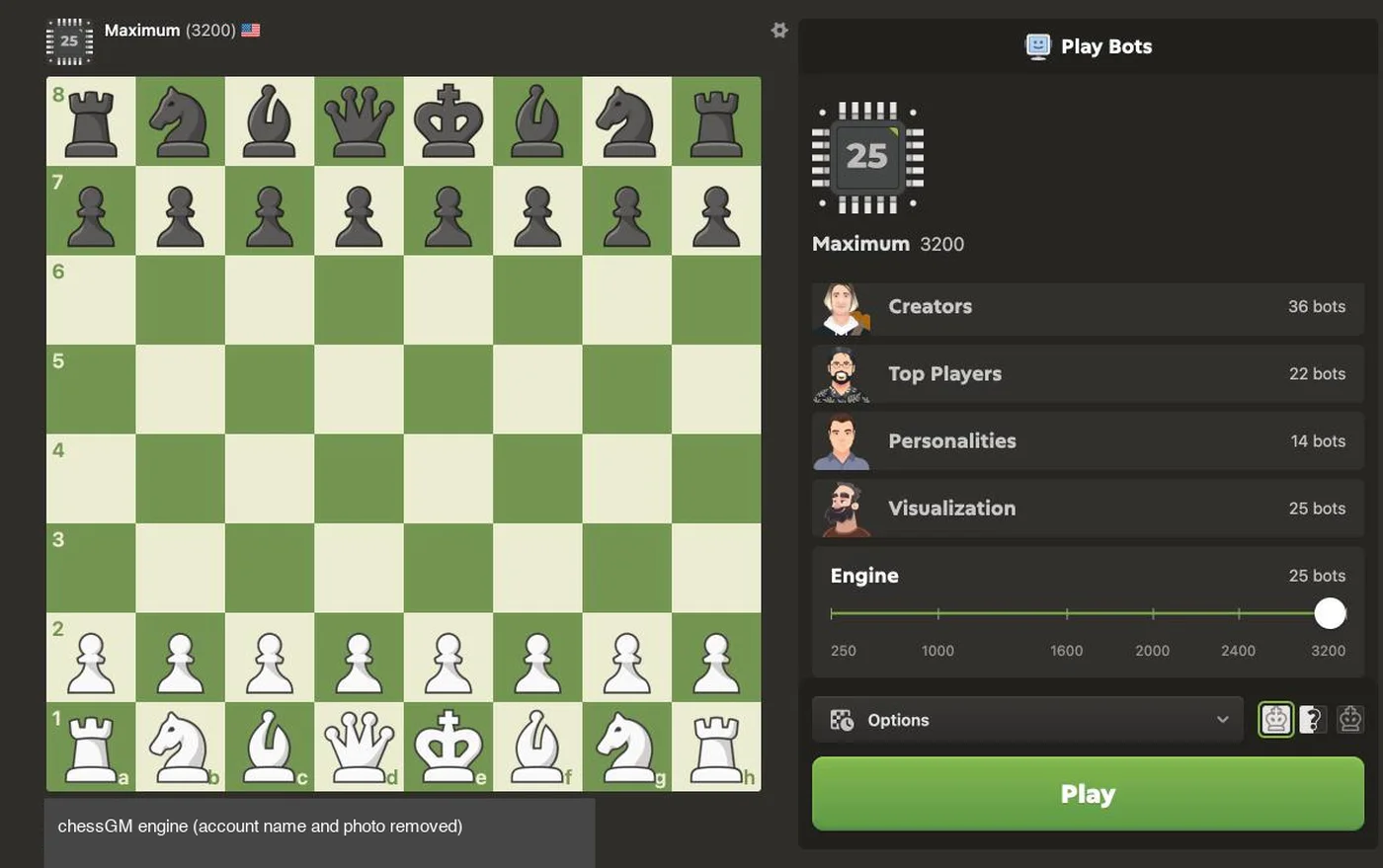
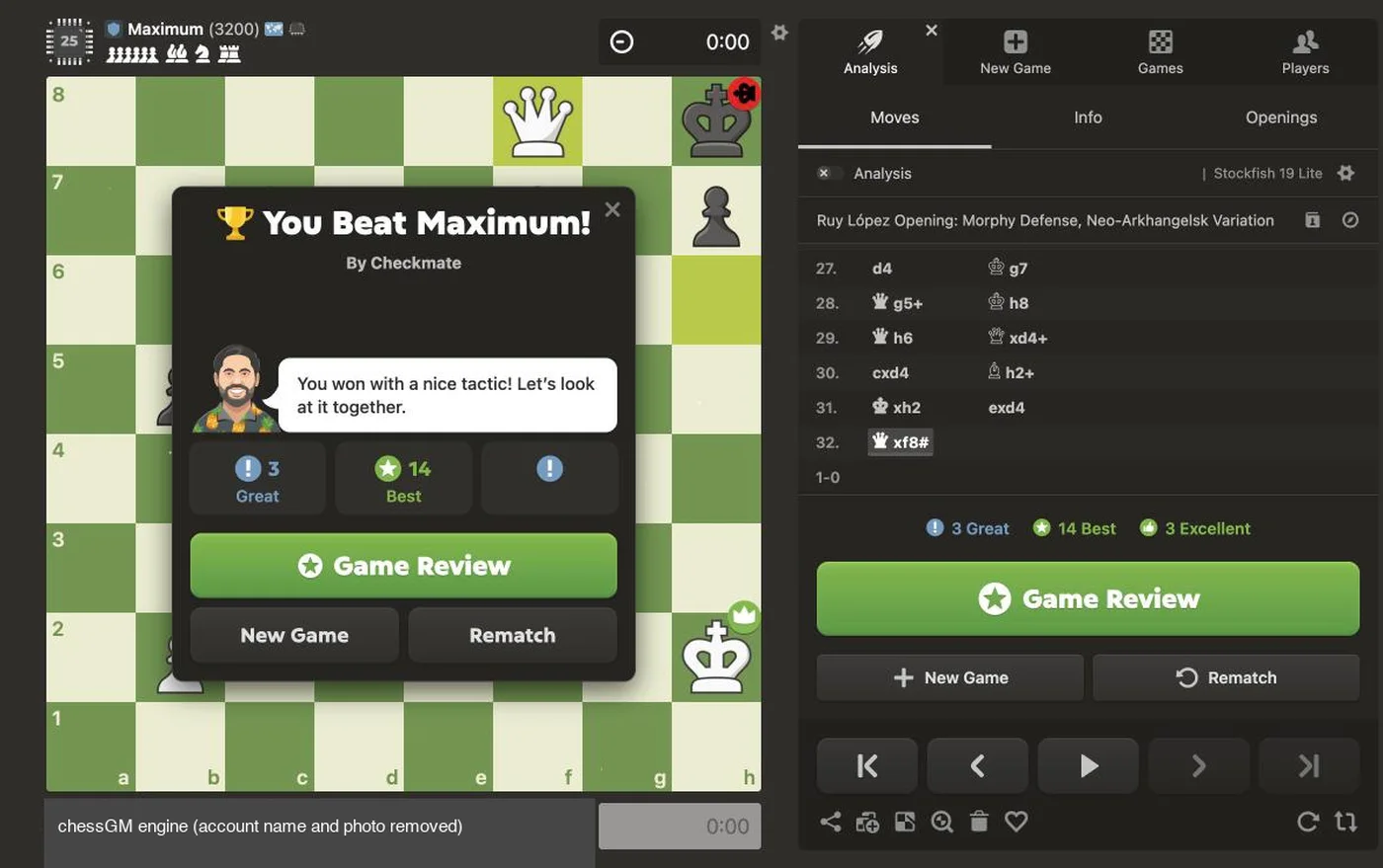
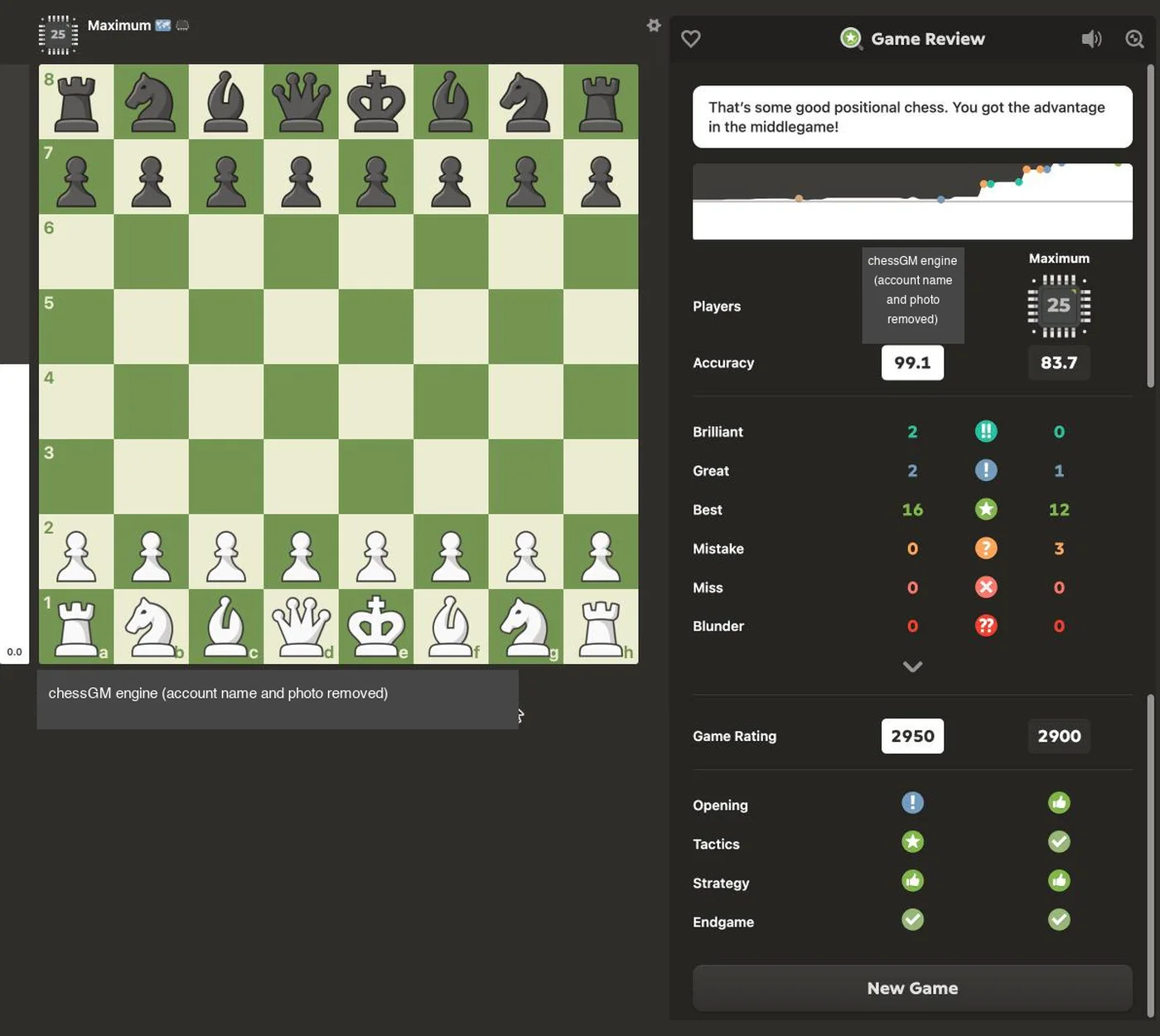
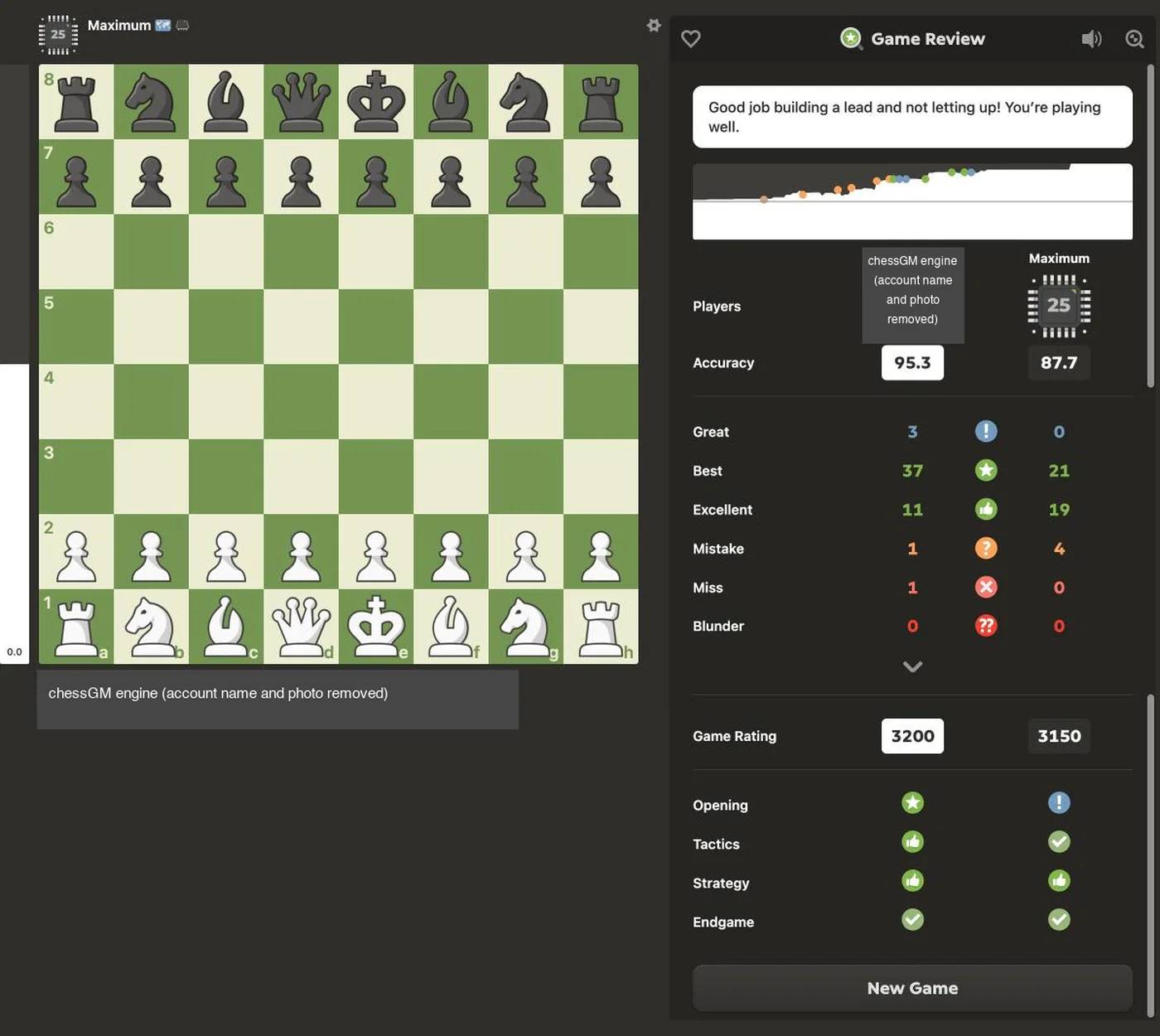
The pictures below are screenshots of chess.com’s own pages for some of these games, taken on 20 October 2026. The account name and photo have been covered with a plain label and nothing else has been changed. Chess.com recalculates Game Review when a game is reopened, so the numbers on these screenshots can differ slightly from those we recorded at game time and use in the table and charts above. Where they differ, the screenshot is the more recent value. In some screenshots the board shows the starting position because the review had not been started.
Four moments from the games
A scoreboard hides the interesting part. We listed every move that either our deeper review (18 half-moves of search, slower than the app’s quick review) or chess.com’s Game Review flagged as a mistake, a miss or a blunder, or after which our win chance fell by 8 points or more in the deep review. That gave 15 moves across the 35 games. Four are shown here, with the position before the move. On each board the two yellow squares show the move the engine played and the green arrow shows the move our deep review preferred. Boards are drawn with chessGM’s own Royal pieces.
Game 35 against Maximum: a capture our deep review did not like
This is the clearest example of why one review should not be treated as the truth. Two analysers read the same move and reached opposite labels. We list it because it is our worst-looking move by our own deeper search, not because it is the best-looking one.
Game 21 against Li (2000): a rook check our deep review questioned
Game 29 against Giri (2800): the lowest accuracy of the 35
Game 33 against Maximum: the longest game
How chess.com’s review compares with ours
The chessGM app has its own game review, so we ran every game through three analysers: chess.com’s Game Review, our quick review (about 12 half-moves deep, the one the app runs in your browser) and our deep review (18 half-moves, run on our server). They gave our side these mean accuracies:
The three agree closely on the headline accuracy. On individual moves they agree less: our quick review gave the same label as chess.com for 54 percent of moves (1,232 of 2,268) and our deep review for 60 percent. Different engines will always split “Best” from “Excellent” differently, so we care more about agreement on the big calls, mistakes and blunders, than on every shade.
How we measured
- The opponents. chess.com’s computer bots, in the bot mode that is not rated, with no timer. One game at a time, one move at a time.
- The moves. Chosen by the chessGM engine on our own Mac, with 1 to 3 seconds each. An AI assistant operating the browser entered each move into the board.
- The sample. 30 bots spread across the rating range plus Maximum five times. We did not choose bots we expected to beat, and we did not leave out any game: all 35 are in the table and the PGN.
- The reviews. Every game was reviewed by chess.com’s Game Review and by our own quick and deep reviews. The Game Review values are copied from chess.com’s analysis pages.
- The privacy. The account used for the games has been removed from the PGN and from every figure here.
What the numbers do and do not mean
- A bot’s rating is chess.com’s label for that bot. It is not a FIDE rating and not a human rating. “Beat a 3200 bot” does not mean “is a 3200 player”.
- These were computer opponents. Nothing here says how the engine would do against a person, and nothing here should be read as a statement about human play.
- Thirty-five games is a small sample, and 31 different bots is a small slice of 217. Five games against Maximum are five games.
- A 35–0 record has no upper limit. The most it supports is a lower bound: against the 10 bots rated 2500 or more, the 95 percent lower bound of the performance is about 3350, on chess.com’s own bot scale, with no upper limit because there were no draws or losses. That is not a human rating and not the Stockfish figure below.
- Accuracy scores are each analyser’s own measure. A winning side finds it easy to score highly, and a single mistake in a short game moves the number a lot.
- In these games 15 of our moves were flagged by one review or the other, and in three of the four examples above the two reviews gave opposite labels. The engine is not perfect.
How we measure engine strength, separately
The measurement that carries an error bar does not use chess.com at all, and it was not made in these 35 games. We play the engine against Stockfish 19 at fixed strength settings (its UCI_Elo scale). The earlier, handcrafted build of our engine measured 2840 on that scale (95 percent interval 2816 to 2866, over 1,000 games at 10 seconds plus 0.1 per move). A later build scored +164 Elo against Stockfish’s 3000 setting and −31 against its 3190 setting, over 200 games each, which puts that build at about 3160, give or take roughly 30, on the same scale.
Read these as yardsticks, not ratings. The engine has been upgraded since those measurements, and we cannot say which build played the 35 games above, so please do not read the two sections as one result. Stockfish calibrates its UCI_Elo levels at longer time controls than ours, and the scale is neither chess.com’s bot scale nor a human rating.
Try it
The engine described here is the one behind chessGM. You can play it at the strength you choose, review your own games with the same quick and deep reviews we used here, and follow a training plan for your rating. Both the app and its guide are free.
How chessGM was built (case study)
Sources
- The 35 games: PGN file linked above, with chess.com’s bot list and ratings as displayed on 20 October 2026.
- Accuracy and move labels: chess.com Game Review for each game, and the chessGM app’s quick (depth 12) and deep (depth 18) reviews.
- Stockfish measurement: chessGM engine against Stockfish 19 with UCI_LimitStrength, the 1,000-game ladder for the earlier build and the 200-games-per-level follow-up for the later build, both from the chessGM team’s engine reports.
- chess.com is a trademark of its owner. We are not affiliated with it and it did not take part in this test.
About the authors
22Softwares is a software company in Thessaloniki, Greece and Dhaka, Bangladesh. We build and run chessGM and Carrom by 22Softwares. This report was written by the 22Softwares team from data produced by the chessGM engine team. Questions and corrections are welcome at info@22softwares.com.
Facts and numbers from the chessGM team’s round-5 report (20 October 2026) and its Stockfish rating measurement. Counts, means and charts on this page are computed from that data.