
chessGM beat Lichess’s strongest computer. We played 3 games and won all 3, each one by checkmate.
It was a proud moment for our team, and we want to show you exactly how it happened, so that you can see the games for yourself.
Replay and analyze these games yourself
Do not just take our word for it. All three games are public. Here is how to open them.
Game 1: chessGM as White
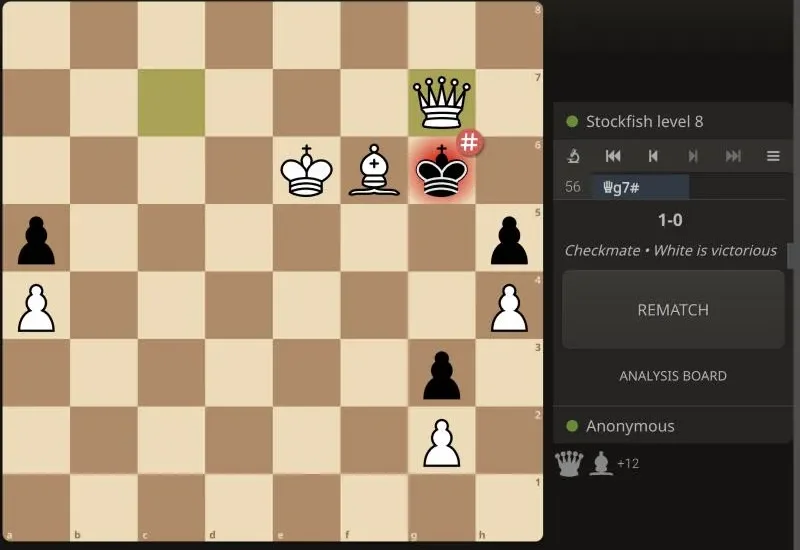
1-0, checkmate on move 56.
Replay on LichessDownload PGNAnalyze in chessGM
Εμφάνιση των κινήσεων σε μία γραμμή για αντιγραφή
Game 2: chessGM as Black
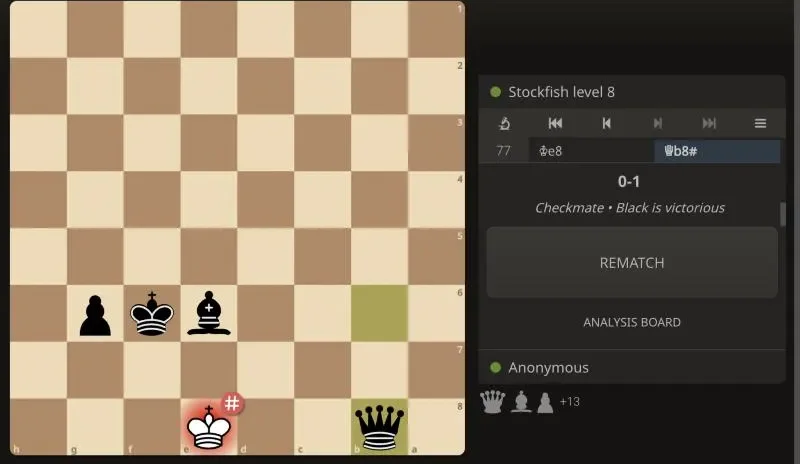
0-1, checkmate on move 77.
Replay on LichessDownload PGNAnalyze in chessGM
Εμφάνιση των κινήσεων σε μία γραμμή για αντιγραφή
Game 3: chessGM as White
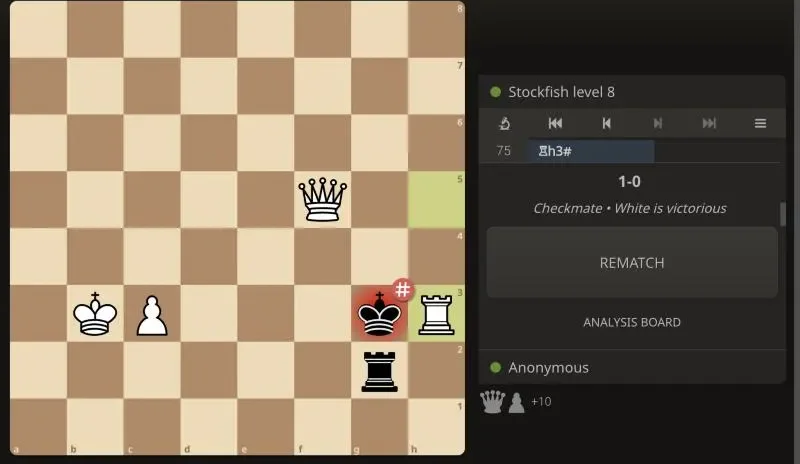
1-0, checkmate on move 75.
Replay on LichessDownload PGNAnalyze in chessGM
Εμφάνιση των κινήσεων σε μία γραμμή για αντιγραφή
A PGN is a plain text file with the moves of a game. Every chess site can read it. You can also download all three games in one file.
Download all three games as one PGN file
In chessGM (free, no account needed)
- Open chessgm.net/analysis.
- Paste the moves into the box that says “Load a FEN, a chess.com game link or a PGN”, then press Load. A PGN file’s text or the one-line moves from the cards above both work.
- The game opens on the analysis board with the engine’s lines. Press Game Review for the computer’s commented report of the whole game. The app works in English, Bangla and Hindi.
On Lichess (a free account is needed for the engine review)
- Open the Lichess game link from the card. Anyone can replay it.
- Use the arrow keys to step through the moves, or open the analysis board from the game page.
- For Lichess’s own computer analysis, go to lichess.org/paste, paste the PGN and import it. Asking for a computer analysis there needs a free Lichess account.
On chess.com (a free account may limit reviews)
- Open chess.com/analysis.
- Load the game by its PGN, using the import or paste option on that page.
- Press Game Review. chess.com may limit how many reviews a free account can run, and may ask you to sign in.
Each tool will give slightly different numbers. That is normal: they use different engines, depths and formulas. We explain this further down.
How the games were played
On 22 October 2026 we used Lichess’s “Play with the computer” feature. We played anonymously, with the computer on level 8, the strongest of its eight levels. The games were casual, unrated and had no clock. There was no human on the other side.
- Our side: chessGM’s own engine, the current main build, which uses a neural network to judge positions. It ran on one thread of our own computer.
- Time: 5 seconds for each of our moves.
- Moves: the engine chose every move. An AI assistant typed Lichess’s replies into the engine and clicked each of our moves on the Lichess board.
- Help: none from outside.
The three games
Game 1: a bold sacrifice and a rare promotion
Game 1 was a Sicilian Defence. On move 9 the engine gave up a knight for activity. The position is below, just before that move.
Black went wrong in the middlegame. By move 20 chessGM was well ahead, and it kept the pressure on.
Then came the moment our team loved most: 32.exf8=N+. The pawn reached the last rank and became a knight instead of a queen. Promoting to a knight is rare, and here it gave check and kept White’s attack going. After that came a pawn ending and checkmate on move 56.
Game 2: Black, and a patient win
In game 2 chessGM had Black, which means White moves first. The game stayed close for a long time. Our worst moment, by Stockfish’s measure, was a small deficit at the very start.
Then Lichess’s computer slipped. After its 34.Rf1, which Stockfish rated as a mistake of about 2.4 pawns, chessGM took over. A long endgame followed. chessGM promoted a pawn and finished with a queen mate on move 77.
Game 3: calm play, then a king walk
Game 3 was a Slav Defence. For about 20 moves chessGM was only slightly ahead. Then Lichess’s computer played 21...Nfd7, which Stockfish rated as a loss of about 1.3 pawns. chessGM used its chance. Its king walked up the board in the endgame, it won material, promoted a pawn and mated with a rook and a queen on move 75.
What the numbers mean, in plain words
After the games, we checked every move with Stockfish on our own computer. Stockfish is a free, open-source chess engine and one of the strongest in the world. It is also the engine behind Lichess’s computer opponent.
- Pawn units. Engines measure a move by how much the position changes, in pawns. If a move “loses 1.0”, the position got about a pawn worse. Engine people call 0.01 of a pawn a centipawn.
- Average loss. The average of those losses over a game. Lower is better. chessGM’s was between 7.3 and 9.3 pawn-hundredths per move; the opponent’s was between 16.3 and 19.0.
- Accuracy. A score out of 100 for how close the moves were to the engine’s best. We use the same win-chance formula as Lichess, but a plain average over the moves, so it will not match the number Lichess shows.
| Game | chessGM | Result | Average loss chessGM | Accuracy chessGM | Accuracy Lichess |
|---|---|---|---|---|---|
| 1 | White | 1-0 mate | 8.6 | 98.5 | 96.9 |
| 2 | Black | 0-1 mate | 9.3 | 99 | 97.3 |
| 3 | White | 1-0 mate | 7.3 | 98.6 | 96.8 |
chessGM’s average loss was about half the opponent’s in every game. One move of ours stood out: 27.Ne6 in game 1, which Stockfish rated as a loss of about 1.9 pawns. chessGM was winning anyway.
What chess.com’s Game Review said
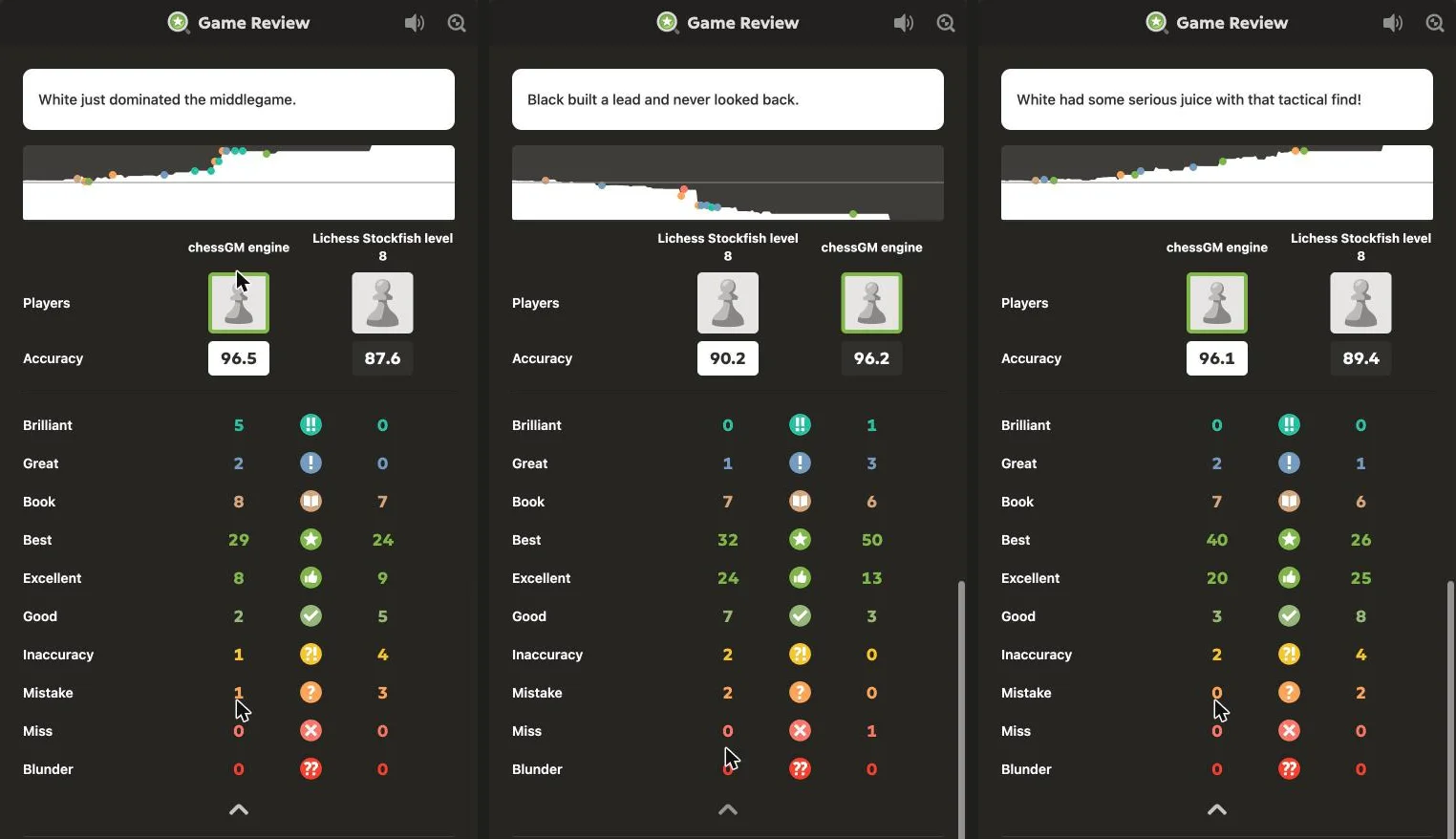
We also ran each game through chess.com’s Game Review, on 22 October 2026 between about 21:30 and 21:45 (UTC+6). We imported each game by its moves and chose the standard review. The panel showed Stockfish 19 Lite. chess.com recalculates its reviews over time, so a review run today could differ a little. It showed no Game Rating for imported games, so we quote none.
chess.com gives some moves special labels. A “Brilliant” move is chess.com’s name for a strong move that is hard to find, often a sacrifice. A “Great” move is a strong move that was the only good one. These labels are chess.com’s opinions, not ours.
| Game 1 chessGM | Game 2 chessGM | Game 3 chessGM | |
|---|---|---|---|
| Accuracy | 96.5 | 96.2 | 96.1 |
| Brilliant | 5 | 1 | 0 |
| Great | 2 | 3 | 2 |
| Book | 8 | 6 | 7 |
| Best | 29 | 50 | 40 |
| Excellent | 8 | 13 | 20 |
| Good | 2 | 3 | 3 |
| Inaccuracy | 1 | 0 | 2 |
| Mistake | 1 | 0 | 0 |
| Miss | 0 | 1 | 0 |
| Blunder | 0 | 0 | 0 |
chess.com’s accuracy is a different number from Stockfish’s accuracy above. The two tools use different depths and formulas. We show both, and we compare each only with its own source.
The moves chess.com called brilliant
chess.com labelled five of chessGM’s moves in game 1 “Brilliant”: 23.Rxe7+, 25.Ng5, 26.Kh2, 28.dxe6 and 29.Qd8. In game 2 it gave one, 36...Qxf1+, a queen sacrifice. In game 3 it gave none, but it called two moves “Great”: 25.Nxd7 and 34.Qe4.
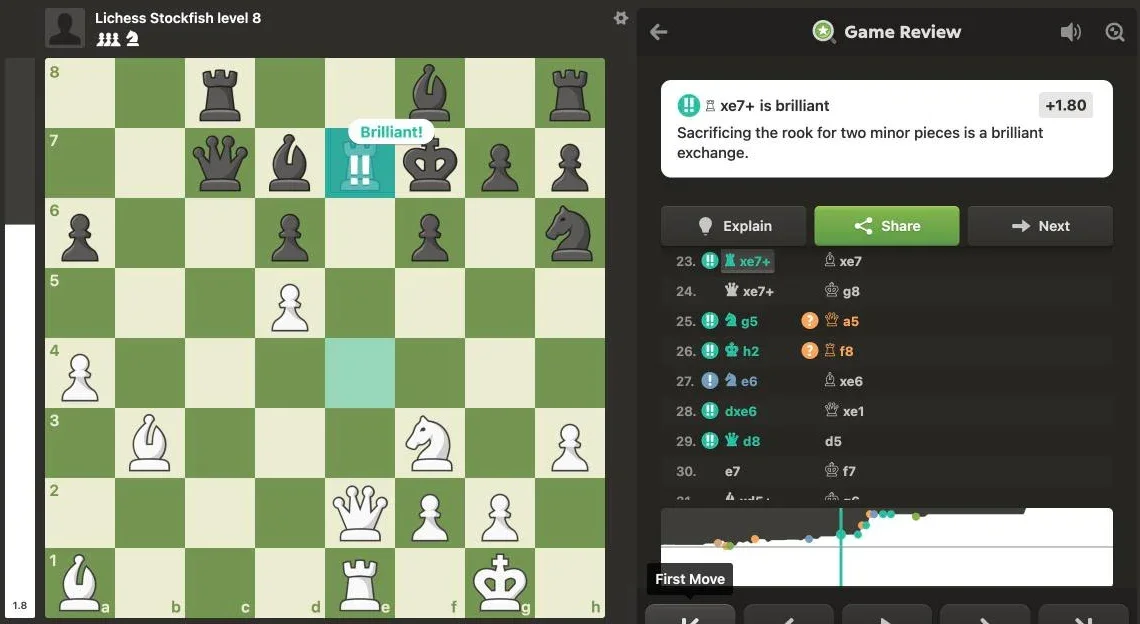
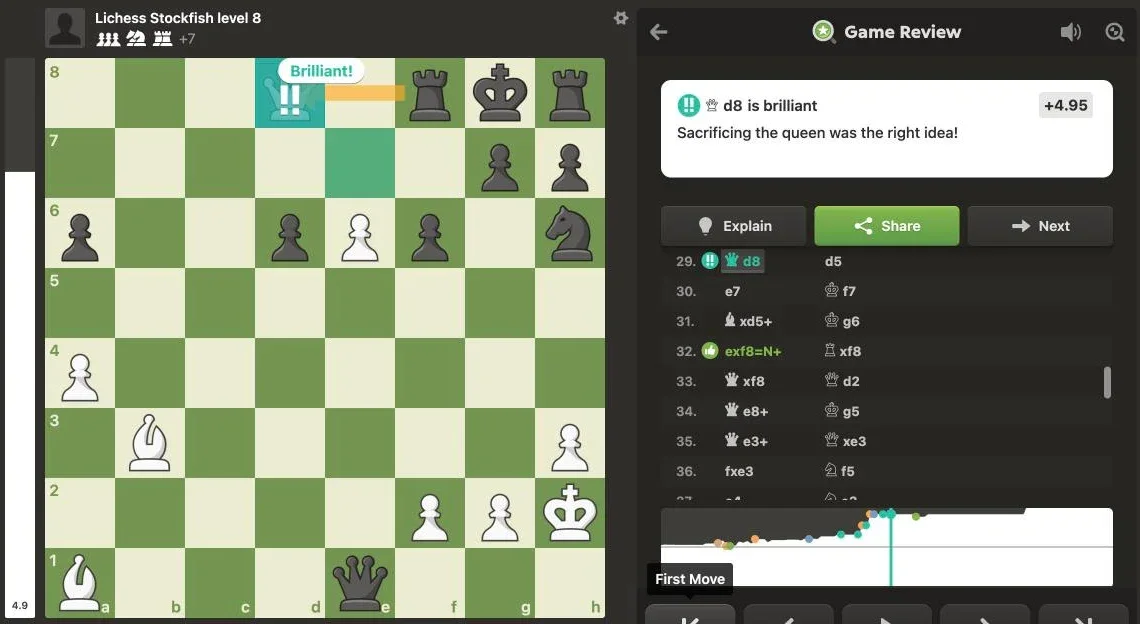
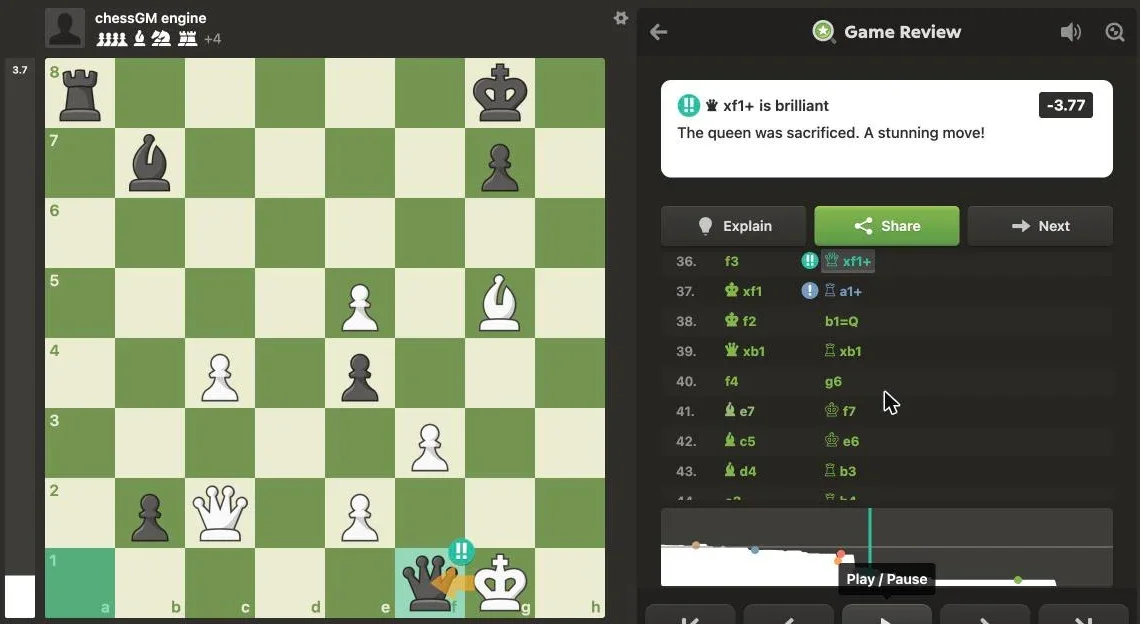
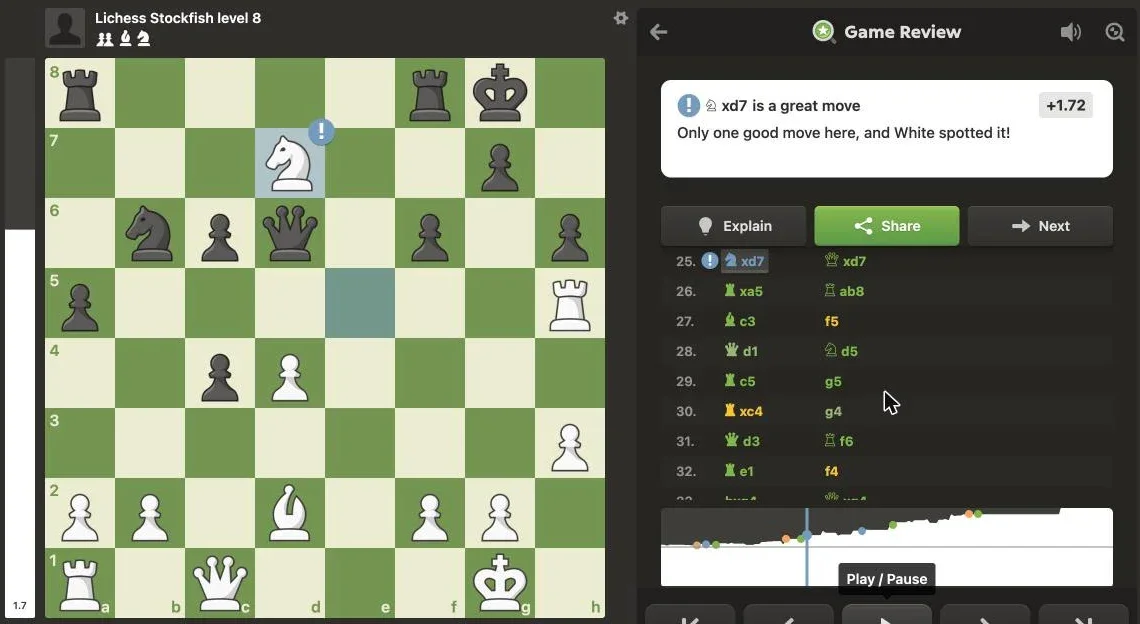
The two tools do not always agree. chess.com’s review called 27.Ne6 in game 1 a “Great” move. Our Stockfish run marked it as our biggest loss of the three games. Both are opinions of a very complicated position.
What three games do and do not prove
We are proud of this result. It is also important to be clear about what it is.
- Three games is a small sample. It shows that the engine can beat this opponent. It does not show that it always will.
- Level 8 on Lichess is one fixed setting of the computer opponent. It is not a rating, and we do not know how it compares with Stockfish running without Lichess’s limits.
- The games were unrated, casual and had no clock. A rated game or a clock would change the conditions.
- There was no human opponent. Nothing here says how the engine plays people.
- Our accuracy numbers come from our own Stockfish run, which searches deeper than the engine did in 5 seconds. They are one tool’s opinion.
We are proud, and you can check it yourself
This is a good day for chessGM. Our own engine, written by our team, beat Lichess’s strongest computer three times in a row, and each game ended in checkmate.
But we do not want you to believe it only because we say so. Open the games. Step through the moves. Run your own analysis, in chessGM, on Lichess or on chess.com. If you find something we missed, tell us.
Back to the replay links and steps
The Apple Chess report: ten games against Sjeng
The chess.com bots report: 35 games
Sources
- The three games: Lichess, played anonymously on 22 October 2026, with the links and the PGN files above.
- Evaluations, average loss and accuracy: Stockfish at depth 18 with two threads, run on our own computer, using Lichess’s win-chance formula for accuracy.
- Game Review: chess.com’s Game Review, run on 22 October 2026 from an import of each game’s moves with the standard review. The labels and accuracy in that section are chess.com’s.
- chess.com’s numbers and our Stockfish numbers come from different tools, and we do not mix them.
- Lichess and chess.com are the names of their owners and are used here as plain text. We are not affiliated with either, and neither took part in this test.
About the authors
22Softwares is a software company in Thessaloniki, Greece and Dhaka, Bangladesh. We build and run chessGM and Carrom by 22Softwares. This report was written by the 22Softwares team from data produced by the chessGM engine team. Questions and corrections are welcome at info@22softwares.com.
Facts and numbers from the chessGM team’s Lichess report (22 October 2026). Counts, means and charts on this page are computed from that data.