
The chessGM courses started as a path from the empty board to master openings. The newest courses fill a gap in the middle: how to think during a game. This article describes what was added, how the new courses work, and how we would use them. Everything here is live on chessGM today and free to try as a guest.
What is new
- The beginner track now has thirteen courses. Scholar’s mate and quick traps, The blunder check and Your first repertoire joined it first; Safe pieces and Stalemate and other draws joined it more recently.
- A new Practice drills ladder has three courses: Castling and en passant drills, Checkmate patterns practice and Rook endgames essentials.
- A new ladder called Thinking and plans has three courses: How to choose a move, Pawn structure and plans, and Converting an advantage.
- Two new fully explained opening courses for Black: the Petroff Defence and the Two Knights Defence. That makes 28 fully explained opening courses, next to 12 line-practice courses.
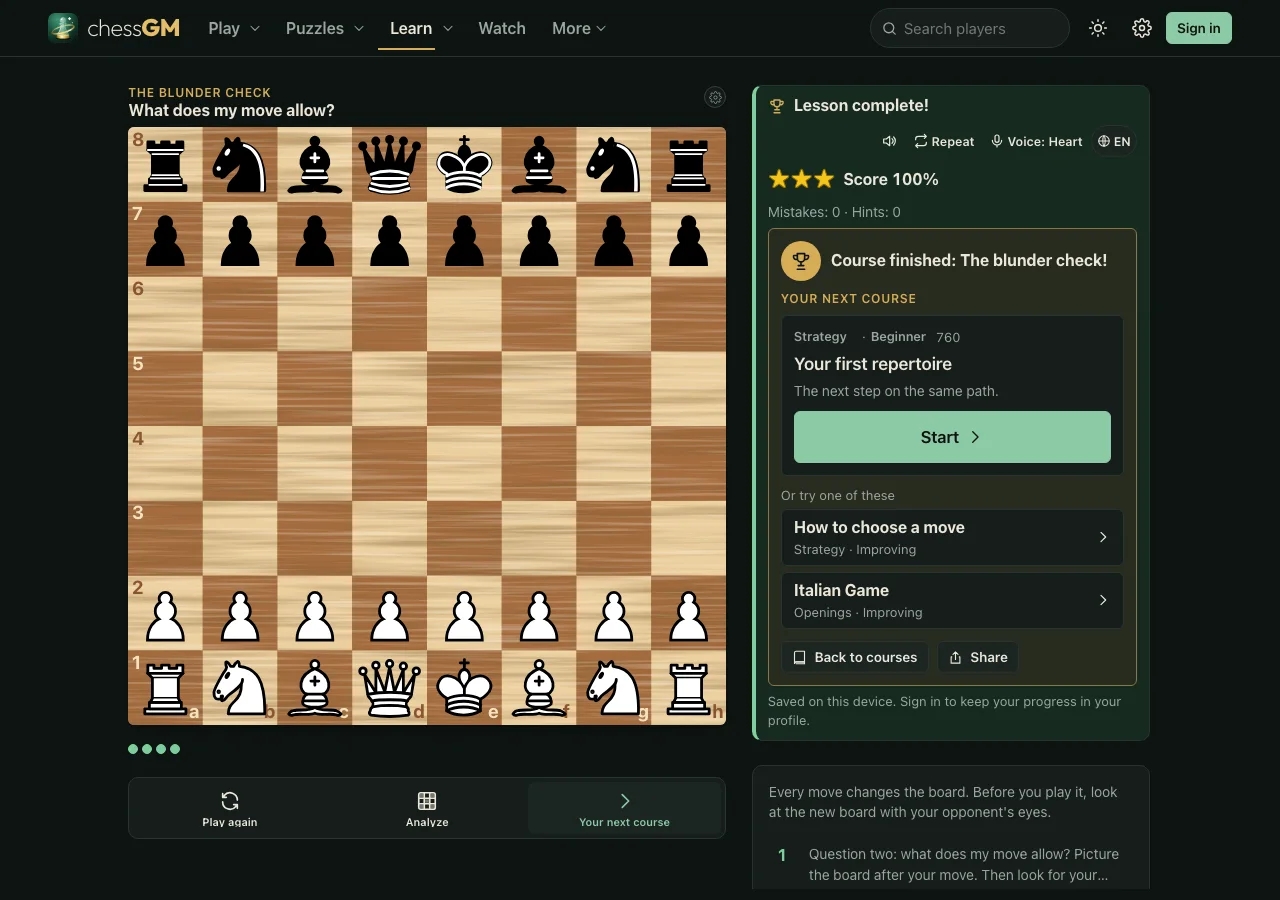
- After you finish a course, a “Your next course” card suggests what to take next, with a Start button and two alternatives.
- Each lesson has a Repeat button next to the coach voice, and each course page lets you download the coach’s voice for that course so it plays without internet.
- The catalogue now lists 92 courses.
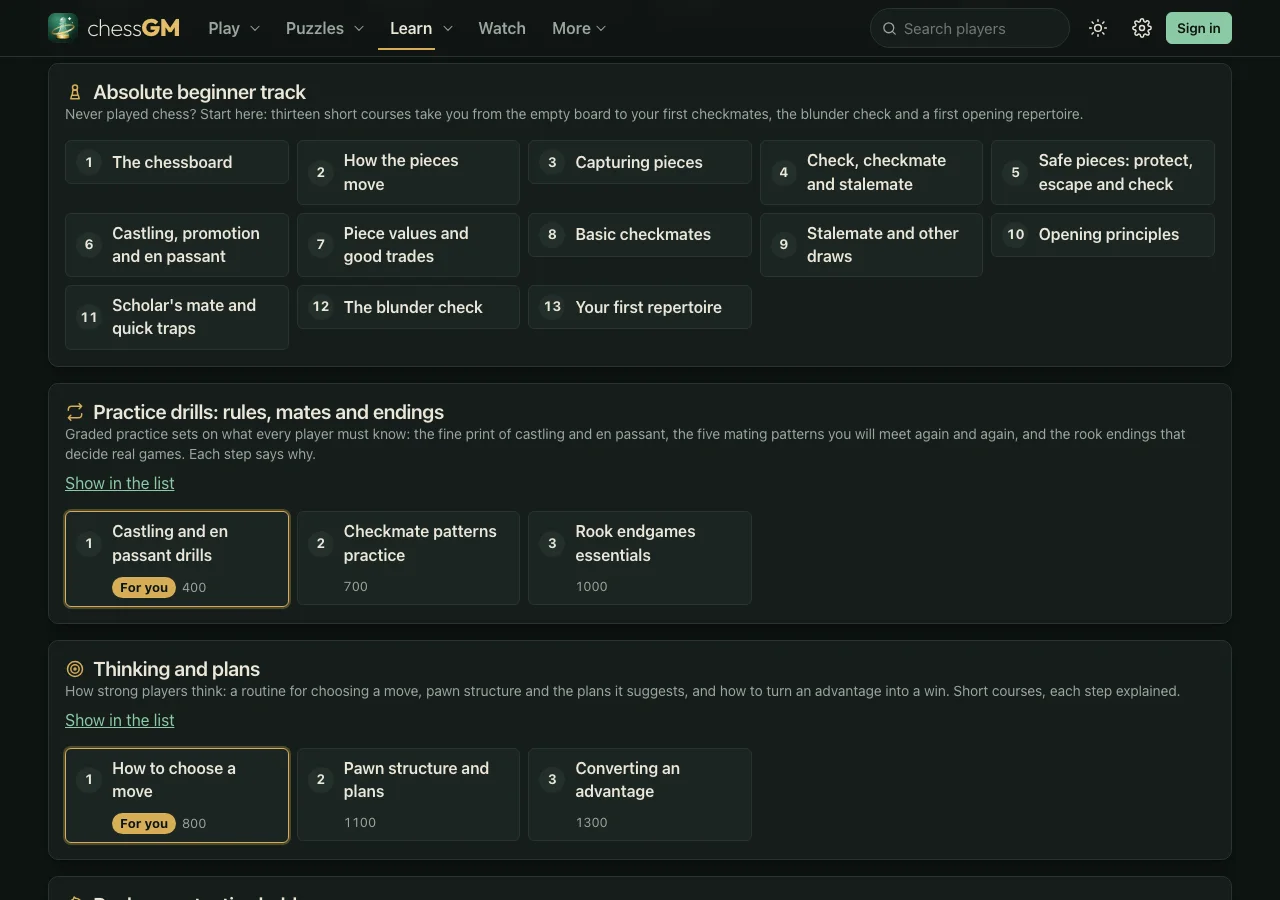
How the new courses are built
The new courses are short: two lessons each, and a few steps in each lesson. Every step explains why, not only what: a short explanation, then a task on the board. If you make a move that looks natural but is wrong, the lesson shows you the reason, and at the end of each lesson there is a recap in a few lines. Like the other lessons, they run in English, Bangla and Hindi.
The blunder check: a worked example
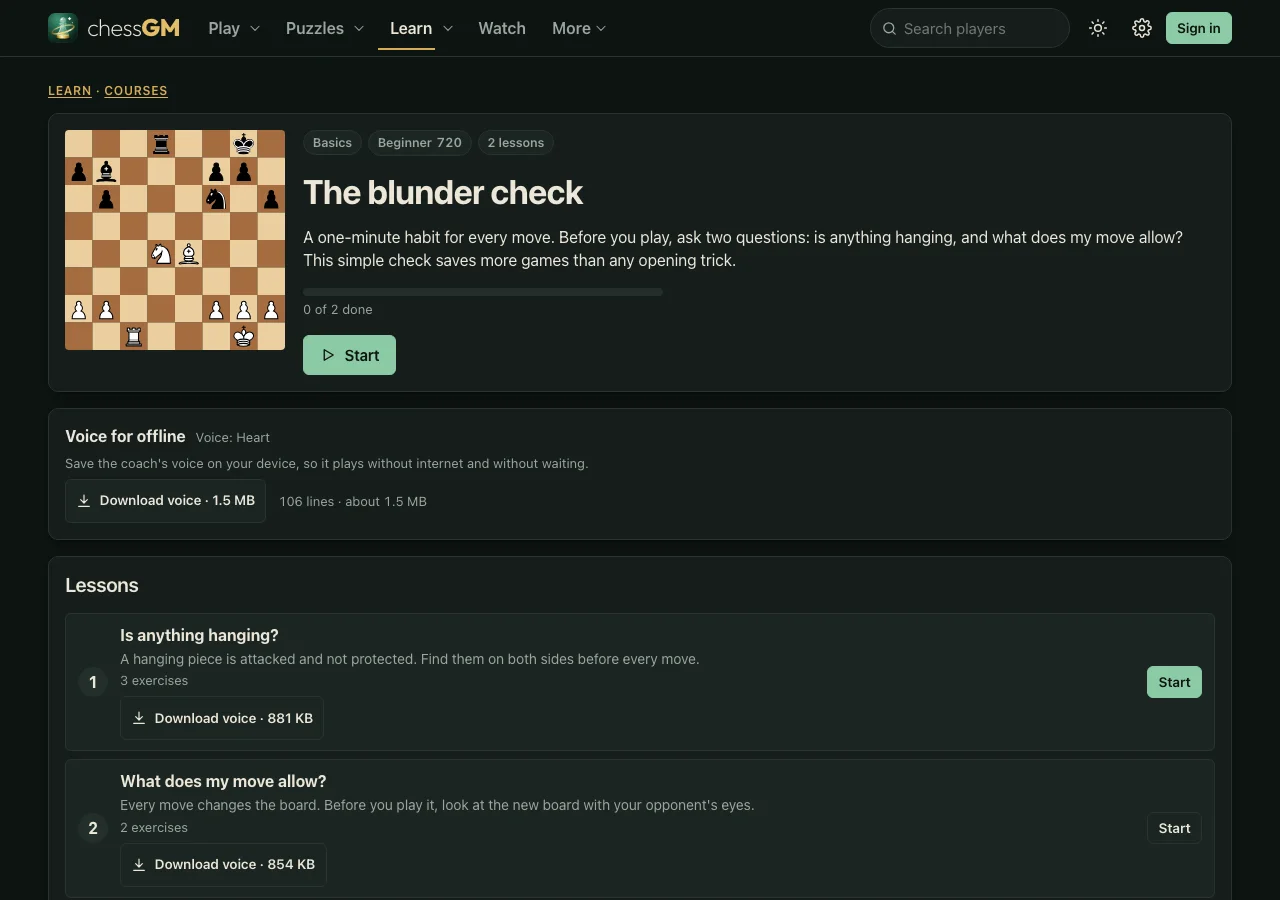
The blunder check is a one-minute habit for every move. Before you play, ask two questions: is anything hanging, and what does my move allow? The course has two lessons, “Is anything hanging?” and “What does my move allow?”.
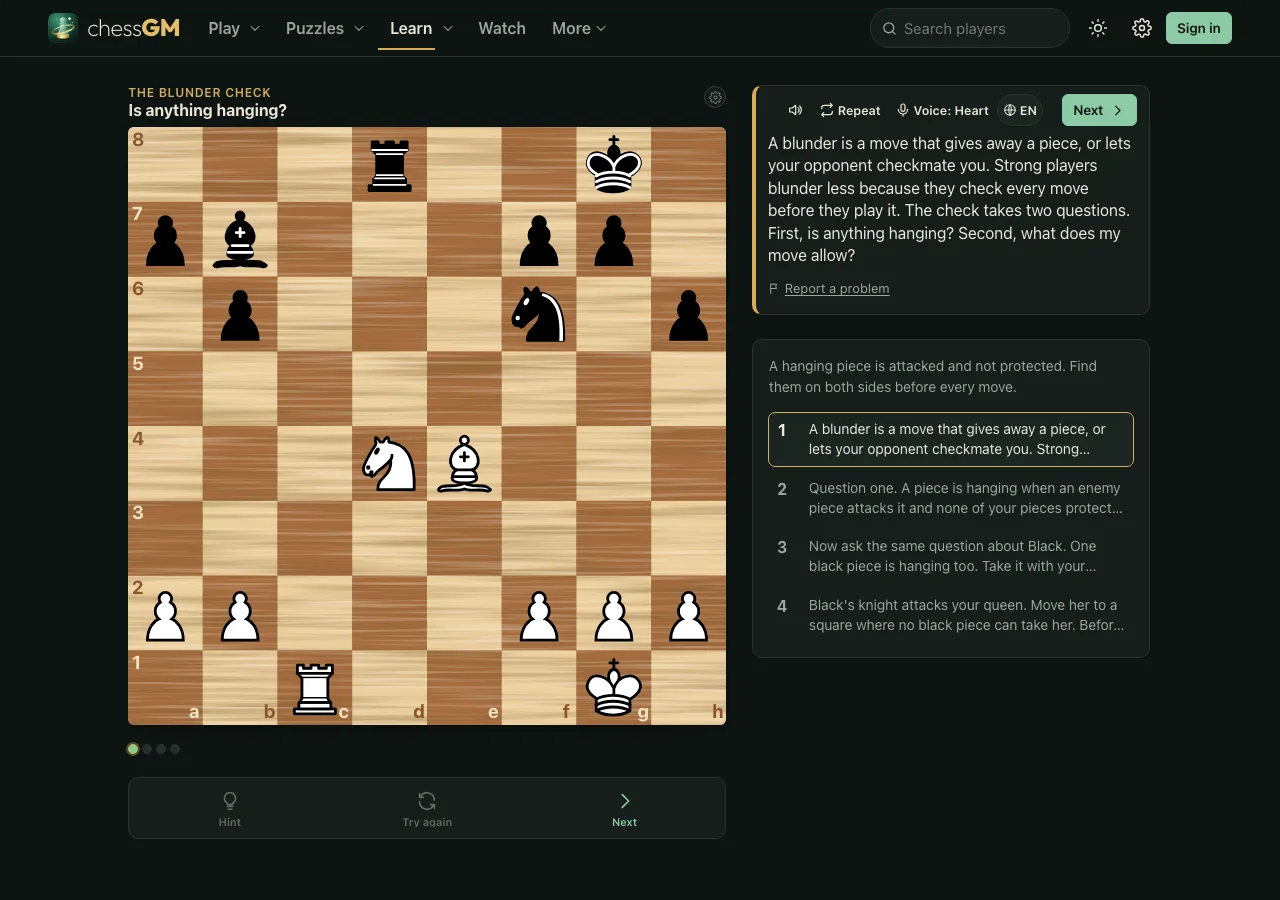
In the first lesson you are asked to tap every white piece that is hanging in a position. A wrong tap tells you which square you picked and asks you to try again; when you find both hanging pieces, the lesson explains why each one is hanging: the rook on d8 attacks your knight, and the bishop on b7 and the knight on f6 attack your bishop, and nothing protects either of them.
The second lesson is about what a capture allows. In one exercise Black’s bishop on c6 is hanging, and you can take it with the rook or with the bishop. If you take with the rook, the lesson stops and shows why: the rook leaves the first rank, Black answers Re1, and that is checkmate because your own pawns box in your king.
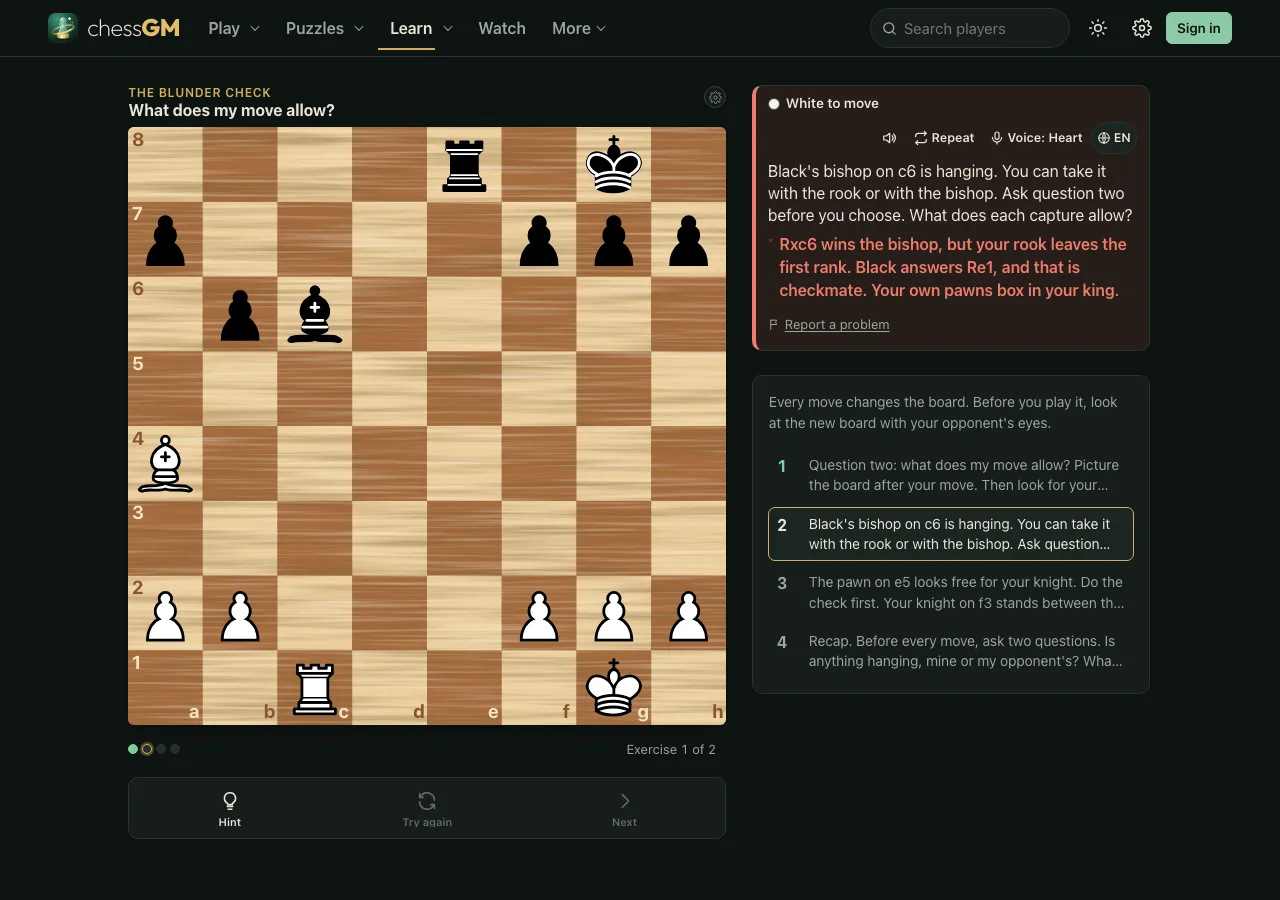
The aim is not to memorise this position but to build the habit of looking at the board after your move with your opponent’s eyes.
When you finish a course
At the end of a lesson you see your stars, score, mistakes and hints, and a note that your progress is saved on this device. At the end of a course you see a card saying the course is finished, with a “Your next course” suggestion on the same path, and two other courses you could try.
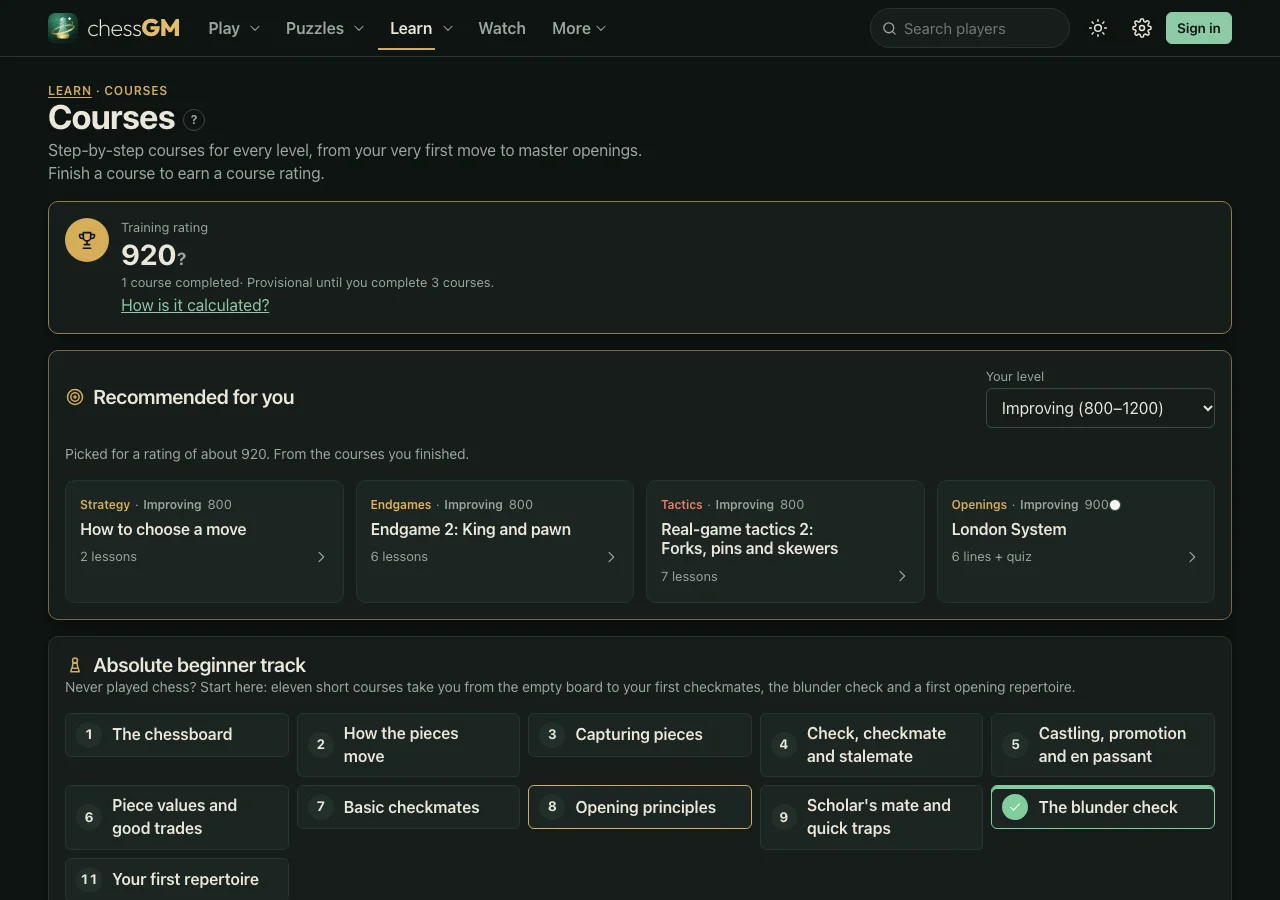
The courses page then shows a training rating and how many courses you have completed. chessGM says the rating is provisional until you have completed three courses. We would not read much into a single number: it is a way to order the courses, and the page explains how it is calculated.
Thinking and plans
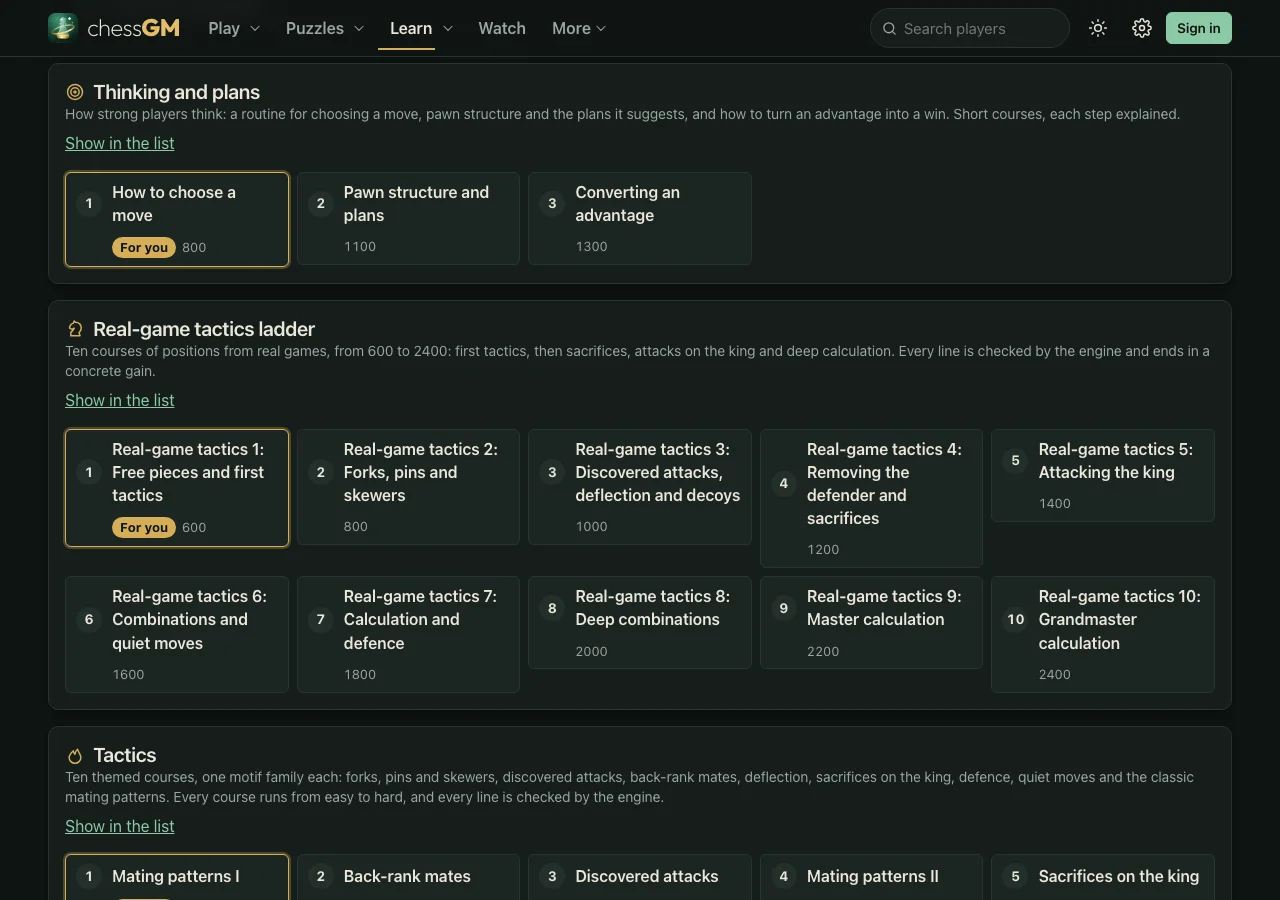
- How to choose a move (level 800, 2 lessons). A thinking routine for every move: ask what your opponent’s last move changed, look at every check, capture and threat, then pick two or three candidate moves and compare them before you play. The lessons are “Checks, captures, threats” and “What changed, and candidate moves”.
- Pawn structure and plans (level 1100, 2 lessons). Pawns cannot move back, so every pawn move shapes the game. The lessons cover isolated and doubled pawns, then passed pawns, open files and how to let the pawns tell you the plan.
- Converting an advantage (level 1300, 2 lessons). How to win a won position (“Being ahead is not the same as winning”) and how to defend a worse one, trading pawns, keeping pieces active and looking for a save.
These are the courses we would add once you know the tactics courses’ basics and want your games to stop turning on one careless move. They are short, so one a day is realistic.
A first repertoire, and the quick traps
- Scholar’s mate and quick traps (level 680, 2 lessons): the fastest checkmates, then the knight attack on f7 and the Fried Liver, with the calm answer and the trap that follows a natural mistake.
- Your first repertoire (level 760, 2 lessons): one opening for White (e4 and the Italian Game) and two classical answers for Black (e5 against e4, and d5 with e6 against d4), each step naming the full course to take next.
Two new openings for Black
Both new opening courses are fully explained: six variations each, with traps and a quiz, like the other explained courses.
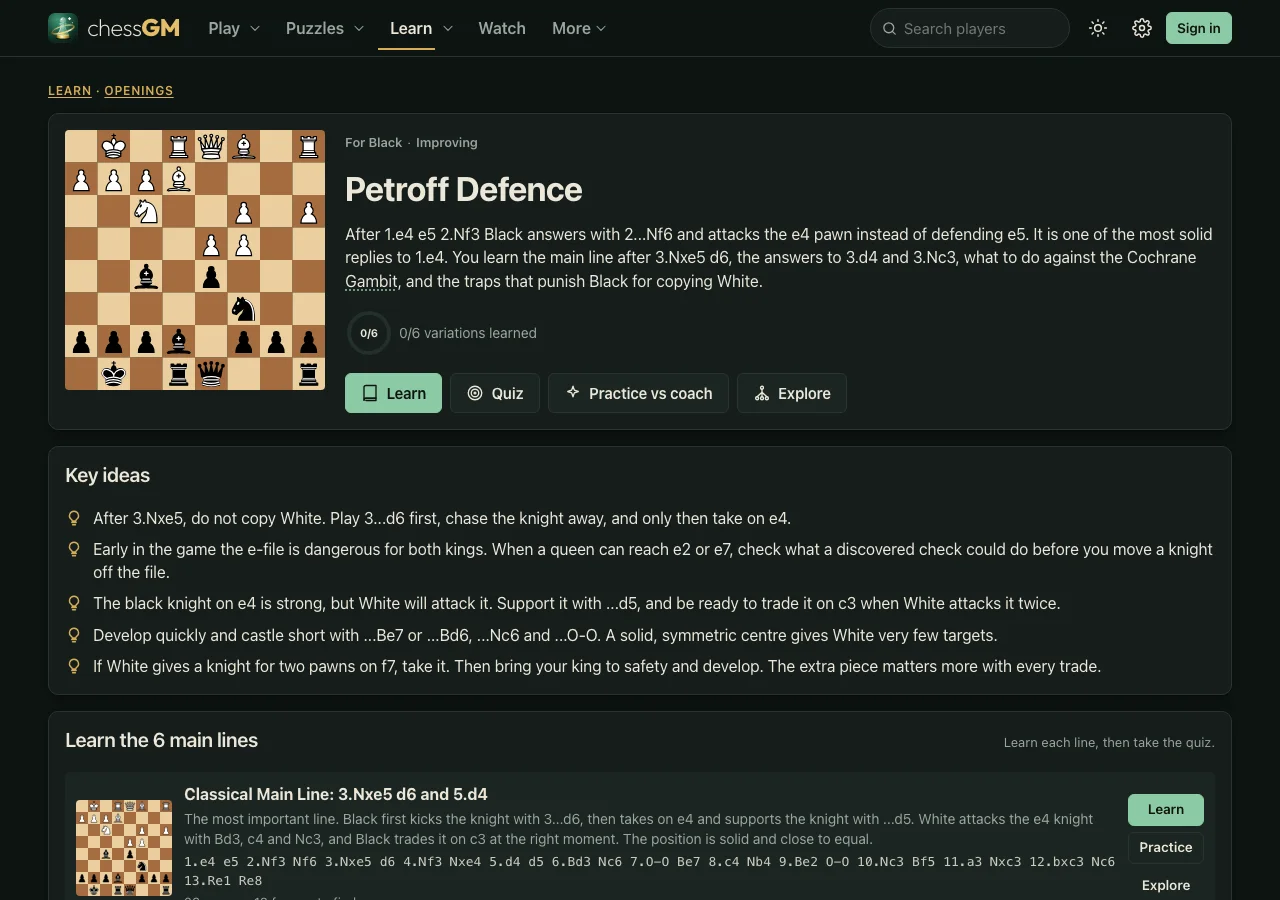
The Petroff Defence (level 1150) is one of the most solid replies to 1.e4. The course covers the main line after 3.Nxe5 d6, the answers to 3.d4 and 3.Nc3, what to do against the Cochrane Gambit, and the traps that punish Black for copying White.
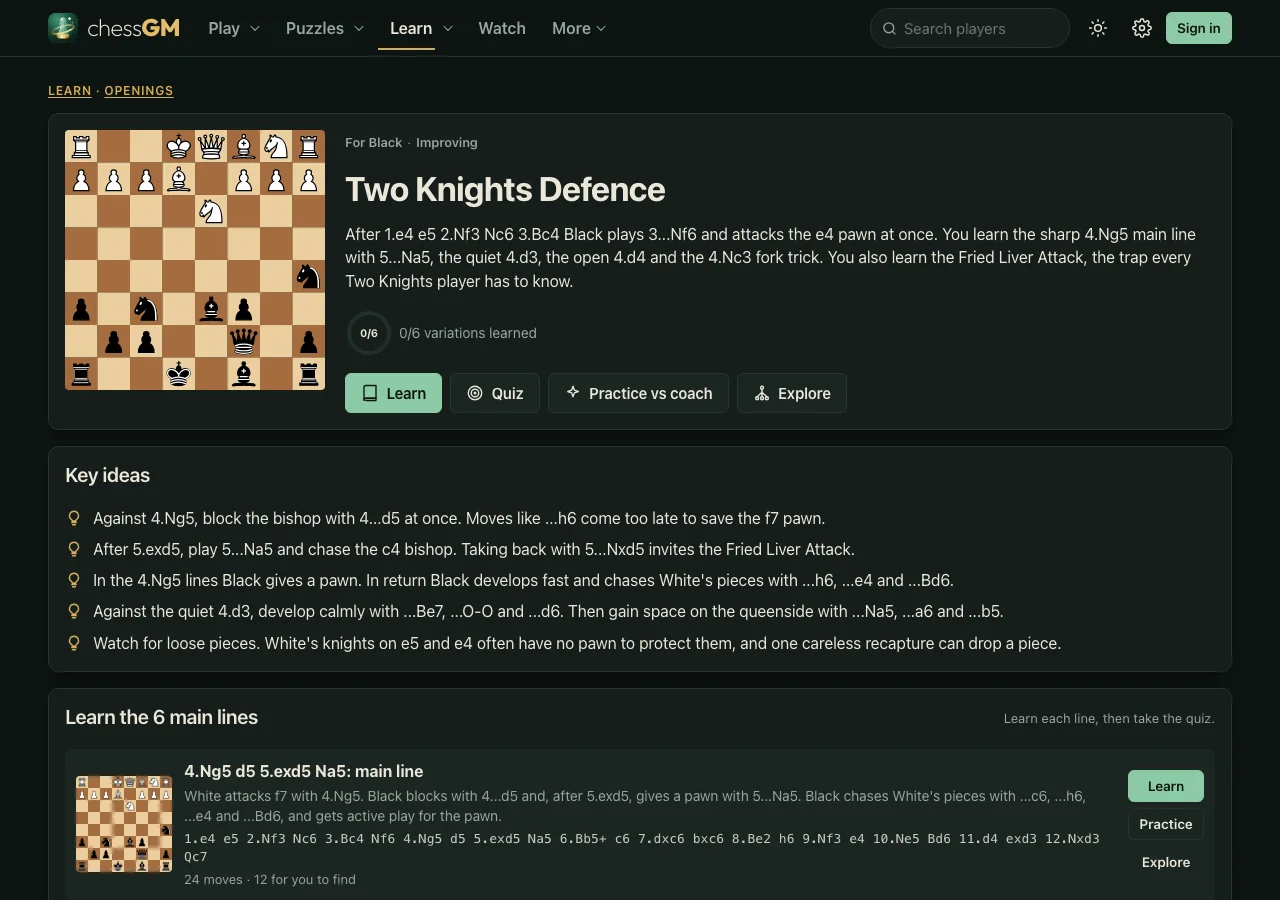
The Two Knights Defence (level 1050) answers 3.Bc4 with 3...Nf6 and attacks the e4 pawn at once. You learn the sharp 4.Ng5 main line with 5...Na5, the quiet 4.d3, the open 4.d4 and the 4.Nc3 fork trick, and the Fried Liver Attack, the trap every Two Knights player has to know.
Two more beginner courses, and a practice ladder
The newest courses are two short additions to the beginner track and a new ladder of drills. Each has a few steps with hints, a reason shown for a wrong move and a short recap, and they run in English, Bangla and Hindi.
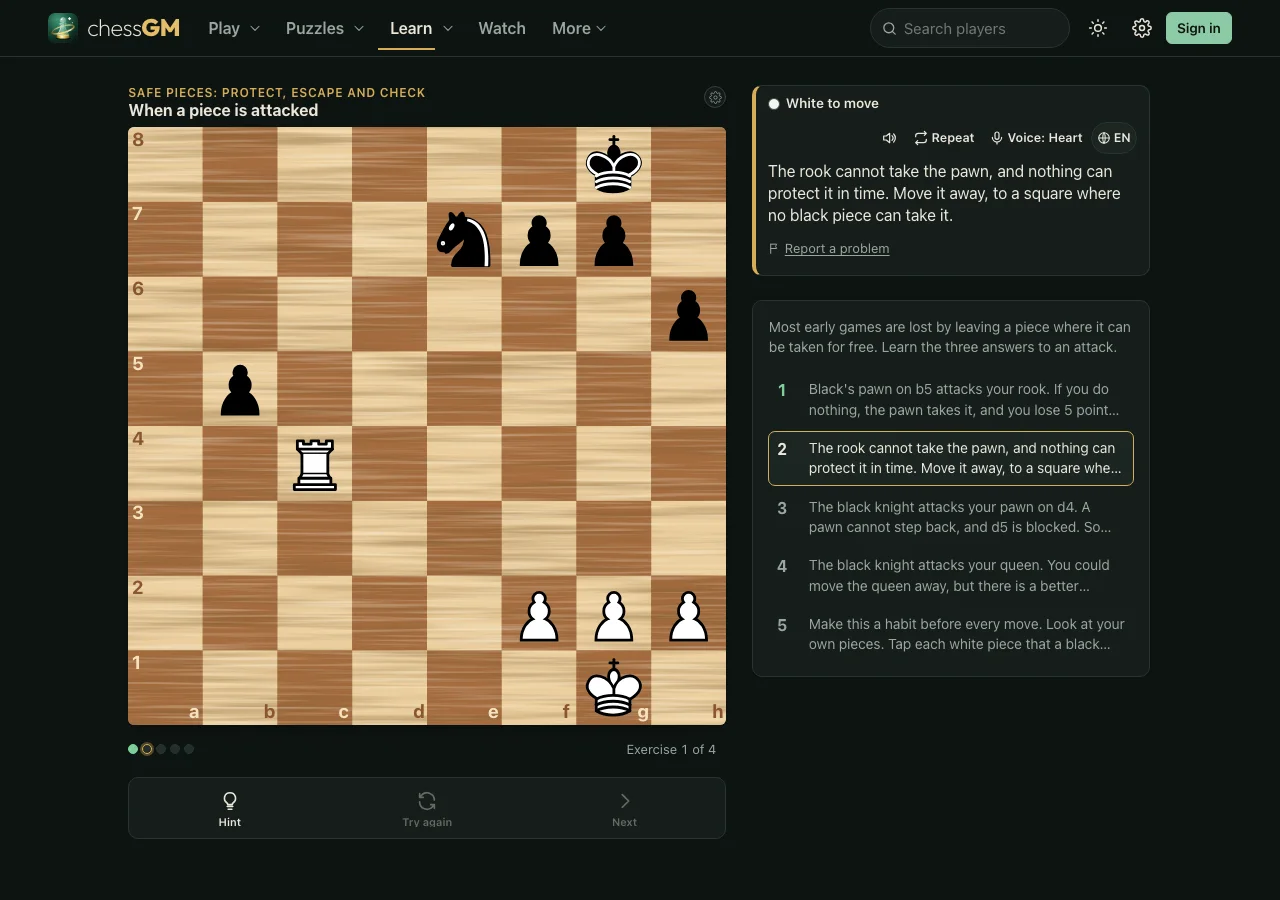
- Safe pieces: protect, escape and check (level 320, 3 lessons). Short drills for your first games: what to do when a piece is attacked (“When a piece is attacked”), the three ways out of check, and how to give a check without losing the checking piece.
- Stalemate and other draws (level 600, 3 lessons). Stalemate turns a won game into a draw, and it can also save a lost one. The lessons are “Stalemate or not?”, “Saving a lost game” and “Other draws”.
The new Practice drills ladder has three graded sets for things every player has to know.
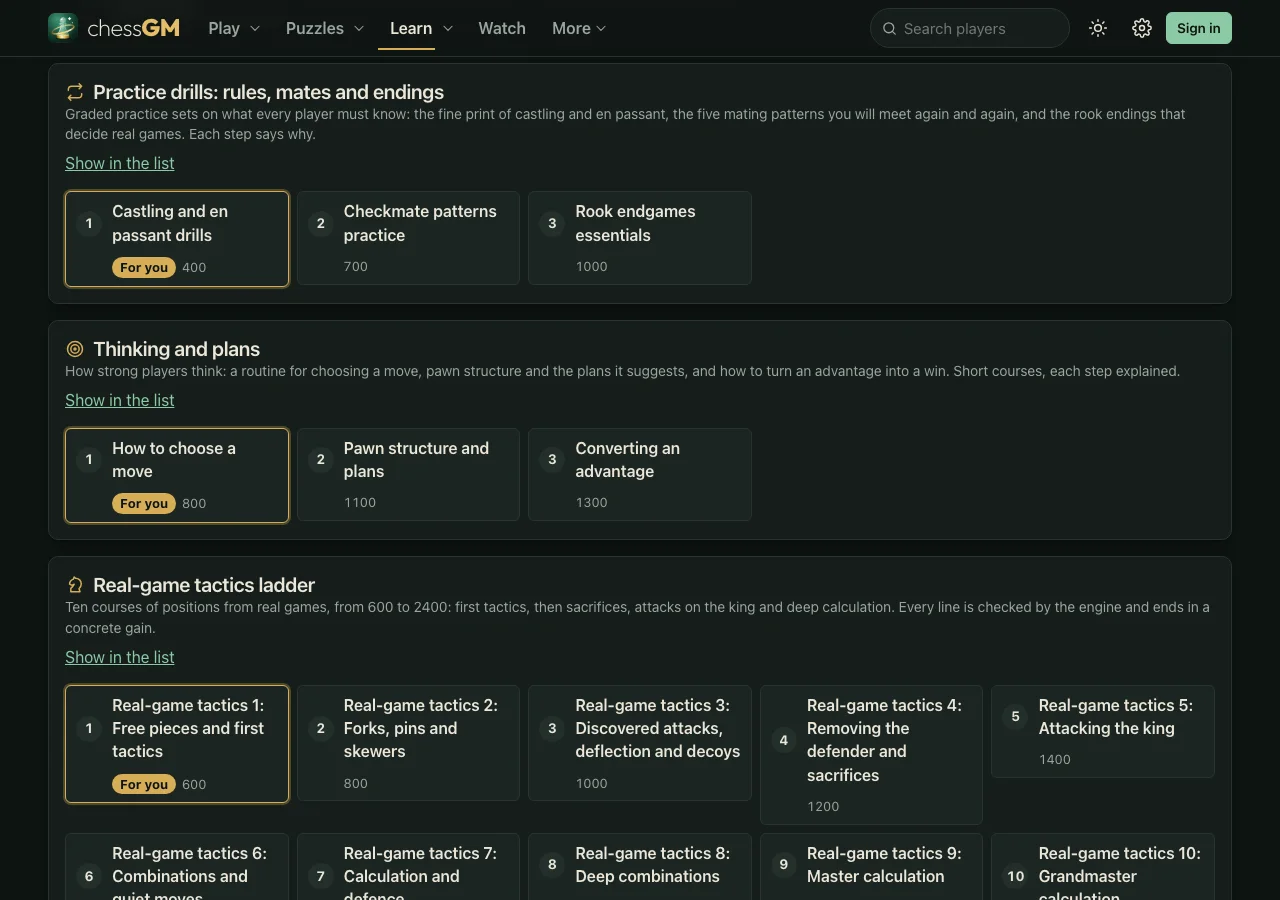
- Castling and en passant drills (level 400, 2 lessons). The fine print of the two special moves: when you may castle and when you may not, and the one moment when en passant is allowed. The lessons are “When can you castle?” and “En passant”.
- Checkmate patterns practice (level 700, 2 lessons). Five mating patterns you will meet again and again, first in one move (“Mate in one: the patterns”) and then in two (“Mate in two”).
- Rook endgames essentials (level 1000, 3 lessons). The rook ending is the most common ending in real games. The lessons are “Rook against pawn”, “The bridge” and “The third rank defence”.
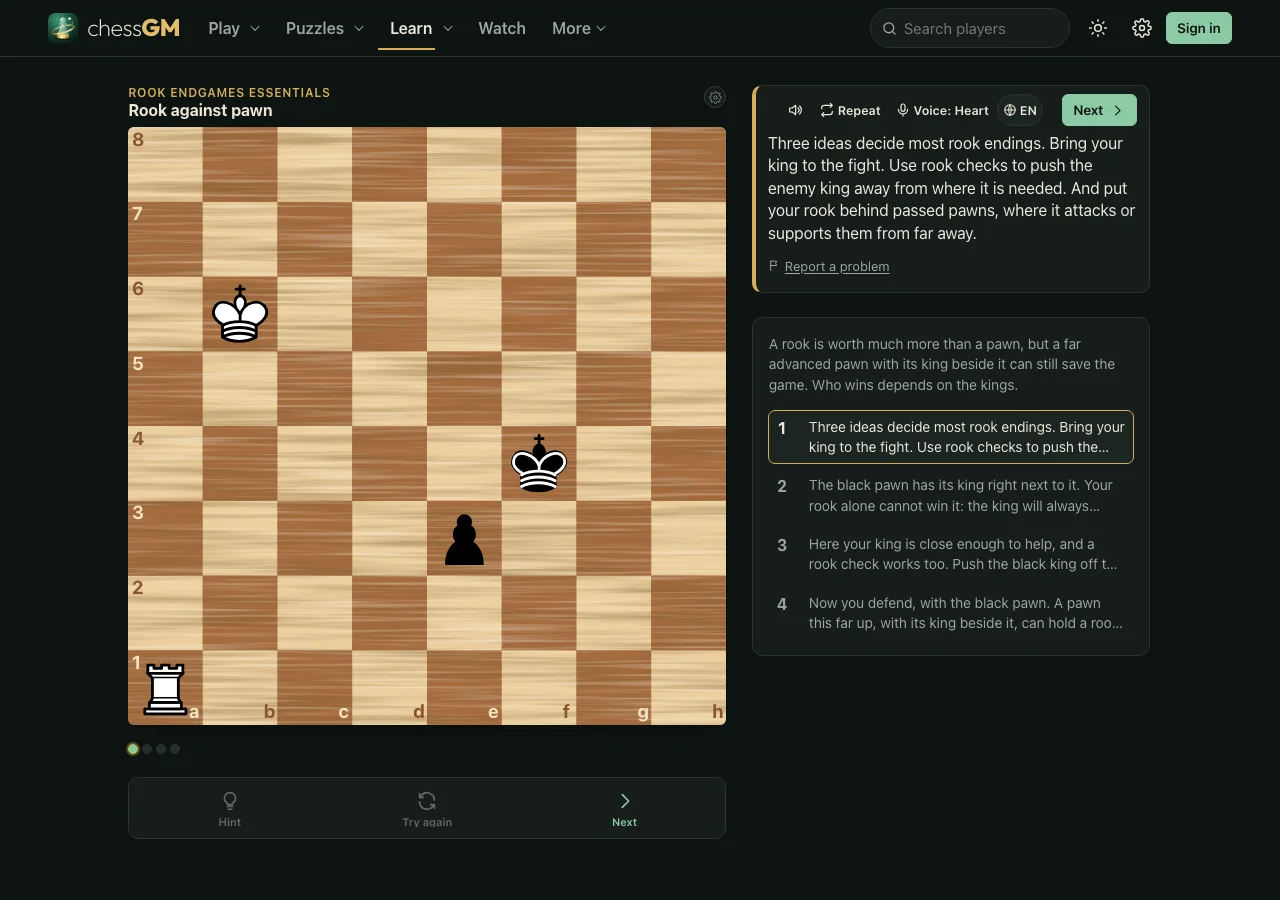
These are small courses, so one a day is realistic. Drills are best used after the matching theory course: Castling and en passant drills after the special-moves course, Checkmate patterns practice after Basic checkmates, and Rook endgames essentials after the first endgame courses.
Offline voice and the Repeat button
Each course page has a “Voice for offline” card: it saves the coach’s voice on your device so that it plays without internet and without waiting, and each lesson has its own download. The size is shown on the button; for The blunder check it is about 1.5 MB for the whole course. Inside a lesson the Repeat button replays the coach’s line. The voice menu also lets you choose a voice, including a female Bangla voice next to the male one.
A realistic plan
- If you are new: finish the beginner track in order, ending with The blunder check and Your first repertoire.
- If you are around 800 to 1200: take How to choose a move and Pawn structure and plans next to your tactics courses, and one opening line a day.
- If you often get a better position and still lose it: Converting an advantage, then the endgame courses.
- Whatever your level, play a slow game or two every week and check, afterwards, which course matches the moment it went wrong.
Screenshots and credits
Screenshots were taken as a guest on the live chessGM website on 22 October 2026 and show the real pages, not edited. The chess pieces in the lesson boards are by Colin M.L. Burnett (CC BY-SA 3.0), as credited on chessGM.
Written from the live chessGM site and its course catalogue on 22 October 2026. The course counts, names and lesson numbers are read from the catalogue; the study plans are general guidance, not coaching.