
Most advice about Tal Gach is about the first stroke: how hard to hit the tower and where to put the striker. That matters, and our guide to the Tal Gach break covers it in detail. But the break is only one stroke, and the game is decided by the many that follow. This guide is about the rest: how to think about the score, which pieces to go for, and what to leave on the board when your turn ends.
Everything below follows the rules as Carrom by 22Softwares plays them; clubs differ in small details.
The rules that shape every decision
Tal Gach has three rules that make it play very differently from Classic carrom.
- Every piece is anybody's. There are no colours to own. Any coin you pocket on a legal stroke scores for you, whether it is white or black.
- Pieces have different values. Each of the 9 white coins is worth 20 points, each of the 9 black coins is worth 10, and the queen is worth 50 the moment she drops. There is no cover.
- The first side to reach 170 wins at once. The board holds 320 points in total, so 170 is more than half and can never be caught.
On top of that, any pot keeps your turn, exactly as in Classic. A foul (the striker leaving the board, or a stroke that touches nothing) passes the turn, and anything you pocketed with that stroke goes back on the board and scores nothing. A foul never takes away points you already have.
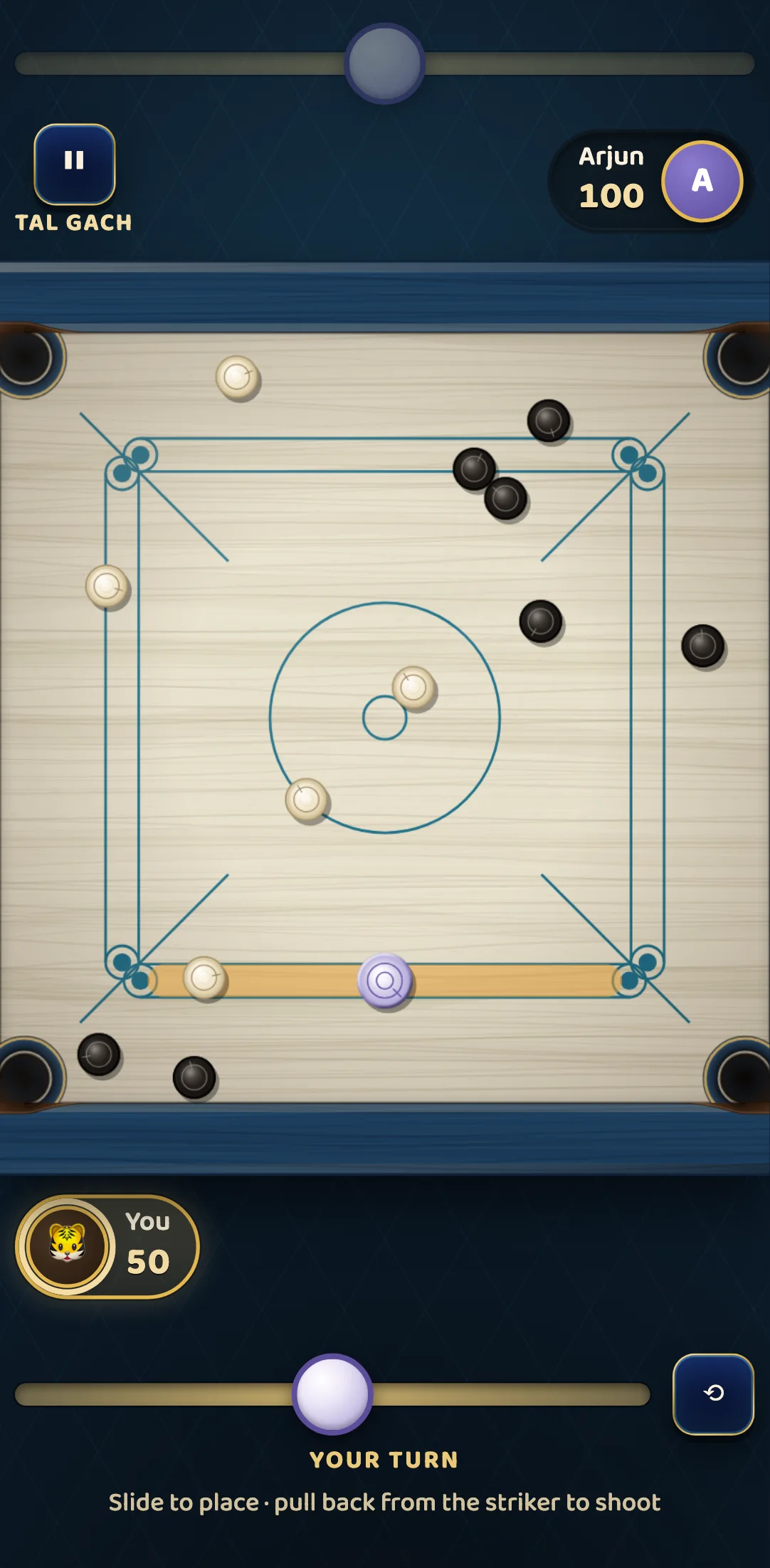
Why the white coins decide the game
Do the arithmetic once and Tal Gach looks very different. The nine whites are worth 180 points between them: more than half the board on their own. The nine blacks are worth only 90.
That has some hard consequences:
- You cannot win on blacks and the queen. All nine blacks plus the queen make 140, which is 30 short.
- With the queen, you need at least 2 whites to reach 170. Without her, you need at least 4.
- The fastest possible win is the queen and 6 whites: seven pieces. Without the queen, the fewest pieces that reach 170 is nine (eight whites and a black, or all nine whites).
So the game is a fight over the whites and the queen. A black still keeps your turn, but given two equally easy pots, take the white: it is worth twice as much.
The bots in the game think the same way. When they rank possible pots in Tal Gach, they value a white as one unit, a black as half a unit and the queen as two and a half units, and that weighting runs through both their choice of target and their judgement of what they leave behind.
The queen: 50 points and no strings
In Classic, the queen is a commitment: pot her and you must cover her on the next stroke or she goes back to the centre. In Tal Gach she is simply 50 points, scored the moment she falls. She is worth two and a half whites, and potting her keeps your turn like any other pot.
That makes her the most important single piece on the board, and her value changes with the score. Look at the numbers before each turn:
- At 120 or more, the queen alone wins you the game.
- At 150 or more, any white or the queen wins it.
- At 160, any piece at all wins it.
The same thresholds apply to your opponent. If they are on 120 and the queen is sitting by a pocket, that is not just a nice pot for them. It is the match.
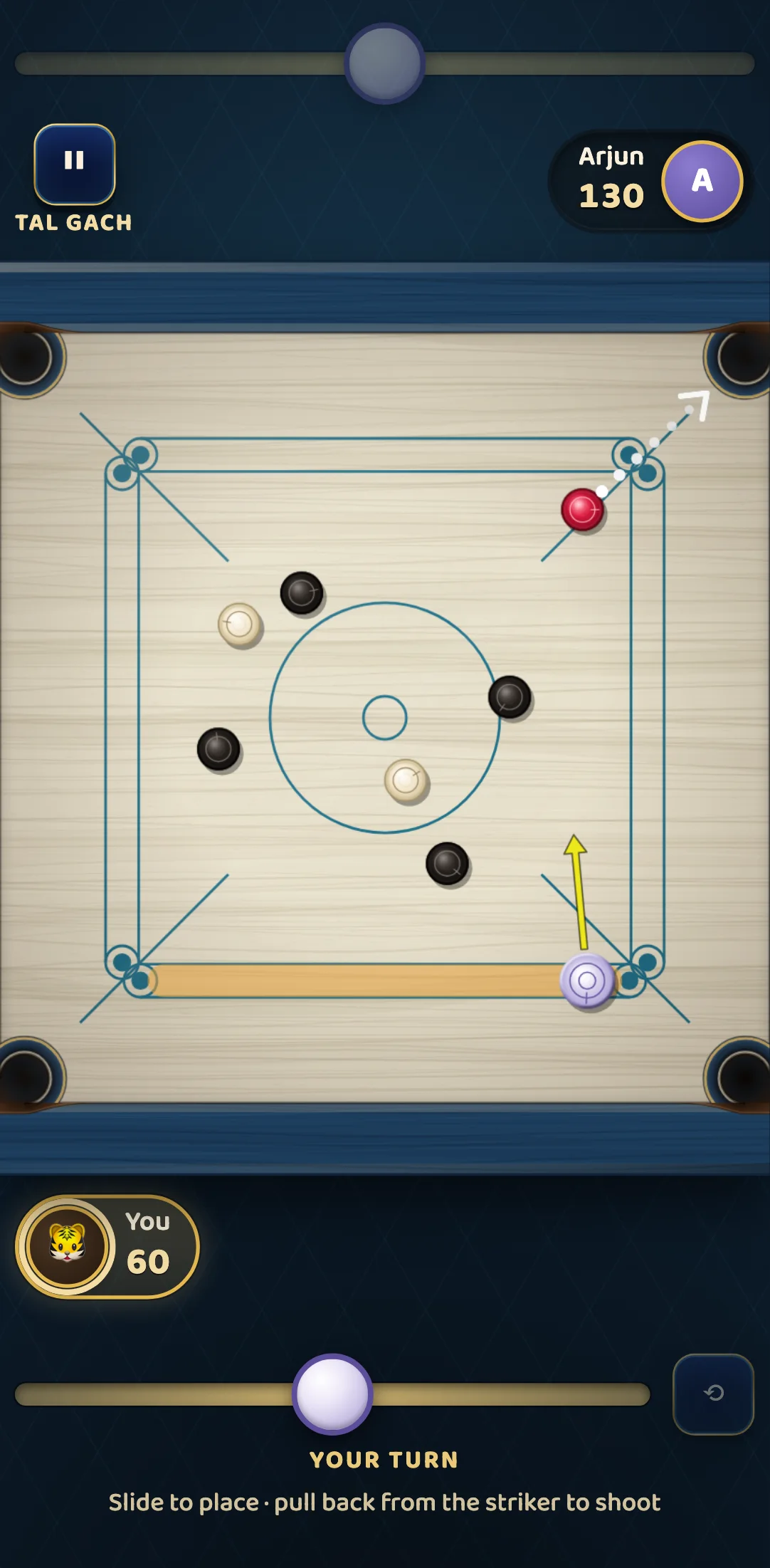
In the position above, Arjun has 130 and needs 40: two whites, or the queen on her own. You have 60. The queen is the obvious pot for you, and it is also the piece you least want to leave him. When the Expert bot was asked for this stroke, it played the queen into the top-right pocket.
The 160-160 trap
There is one way a two-player game ends without anyone reaching 170: the board is cleared at exactly 160 each. In that case the rule is clear: the side that pocketed the last piece wins.
This creates a trap that catches people who are ahead.
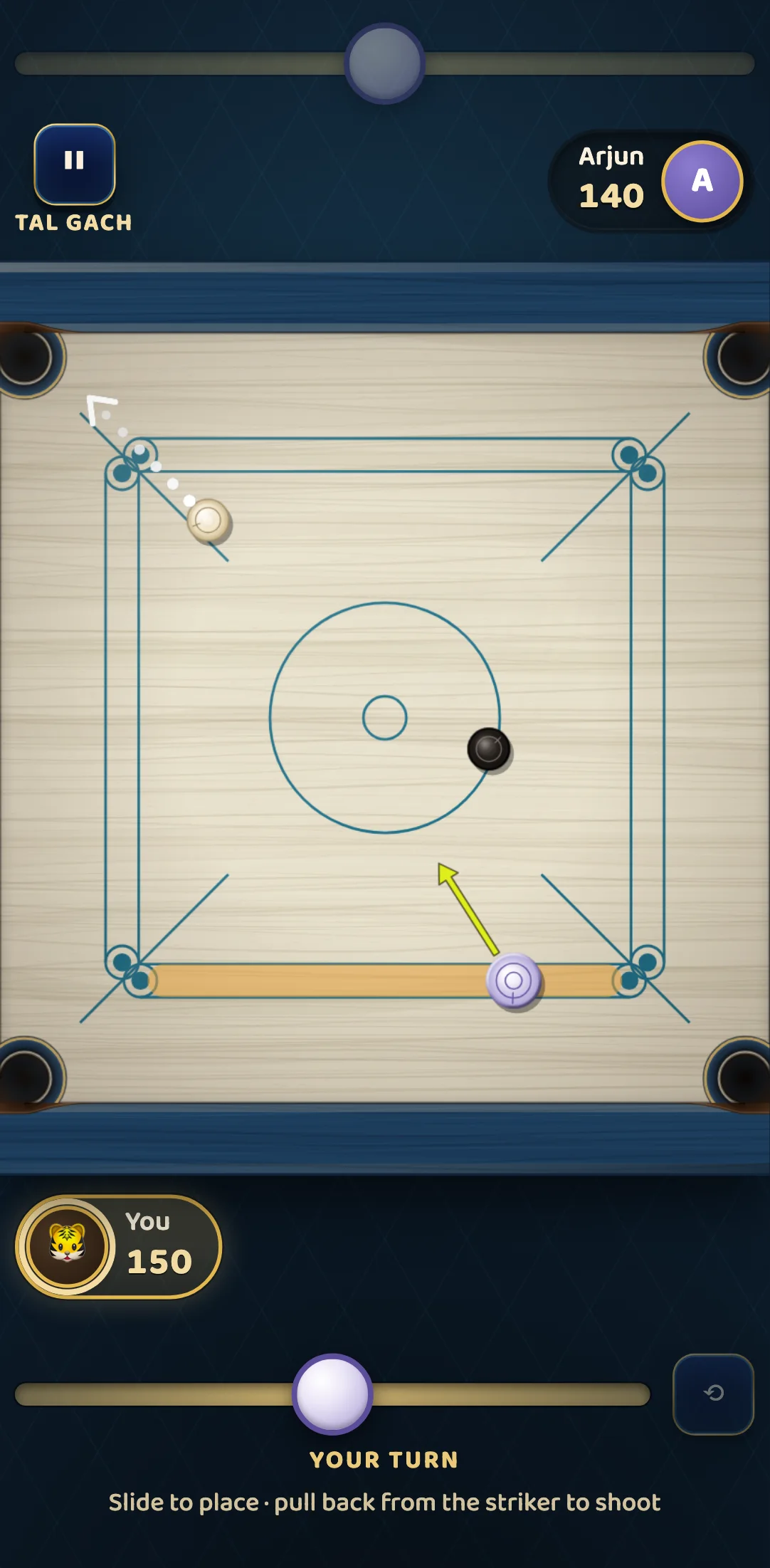
You have 150 and Arjun has 140. Two pieces are left: a white near the top-left pocket and a black near the centre. The white wins it for you at once: 170. Now suppose you play the black first because it looks easier. You go to 160 and keep your turn, then miss the white. Arjun pots it, goes to 160, and the board is clear at 160-160. He pocketed the last piece, so he wins.
Near the end, count what each pot does to the score, not just whether it keeps your turn. When a pot wins outright, play it. The Expert bot chose the white here.
What to leave behind
In Classic, a coin of yours hanging over a pocket when your turn ends is not a disaster: if your opponent pots it, it counts for you and their turn ends. In Tal Gach nothing is safe. Every piece near a pocket is a free pot for whoever shoots next, and it keeps their turn going.
That changes how you end a turn:
- When you have no good pot, a soft stroke that pushes pieces away from the pockets is often the best stroke on the board. Our guide to safety shots shows how.
- Weigh what you leave by its value. A black by a pocket costs you 10 points and a turn. The queen by a pocket can cost you the game.
- Remember that a missed pot often leaves its target still close to a pocket. If the only pot on offer is a long, thin cut, ask what your opponent gets when it fails.
The ordinary bots score their leave in a simple way that is worth copying: when their turn is about to pass, every piece within about 9 cm of a pocket counts against them, weighted by its value. The Expert goes further and assumes its opponent aims like a good player, then counts the two best pots it would be handing over.
Using the turn you keep
Because every pot keeps your turn, Tal Gach rewards runs. An easy black is worth more than its 10 points if it sets up a white next, so look one stroke ahead before you shoot. Our guide to position play covers the technique, and in Tal Gach every coin on the board can be your next target.
Three and four players
Tal Gach works with more than two. With three players it is every player for themselves, and 170 is much harder to reach because the points are split three ways. If the board is cleared without anyone getting there, the highest score wins. If the player who pocketed the last piece is level with the top score, they take it. With four players you play 2 v 2: partners share one score, so the same thresholds apply to the team.
With three players, think about who you are helping. A piece you leave by a pocket goes to the next player, not necessarily to the leader.
A short checklist for every Tal Gach turn
- Read both scores. Are you, or is your opponent, within one pot of 170?
- Find the queen. Who benefits most if she drops next?
- Prefer whites to blacks when the pots are equally easy.
- Near the end, check what each pot does to the score, and beware the 160-160 finish.
- Before a risky pot, picture the board if you miss.
Tal Gach is a race, but it is a race you win with arithmetic as much as with aim. Count first, then shoot.
---
Screenshots: Carrom by 22Softwares on a phone, captured from the game's own test build on 15 November 2026. The second and third positions were set up by hand; the stroke shown in each is the one the game's Expert bot chose.
Facts checked with the Carrom by 22Softwares team against the game’s rules engine.