
Most people learn carrom as a duel, white against black. But the board has four sides for a reason. At home and in clubs, carrom is often played as doubles, two partners against two, and casual groups happily play with three, each person for themselves.
This guide explains how those bigger games work in Carrom by 22Softwares: which game types allow three or four players, who shoots after whom, and what changes for the queen, fouls and scoring when you share a side with a partner. It ends with tips for playing well as a team.
Which game types can you play with three or four?
Every game type can be played one against one. Beyond that, it depends on whether the game has colours.
- Classic, the 29 Game and Disc Pool are colour games: one side plays white, the other black. They can be played 1 v 1 or 2 v 2. A third player would have no colour, so three-player games are not offered.
- Tal Gach and Freestyle are “any piece scores” games: whatever you pocket counts for you. They can be played by 2, 3 or 4, and with three it is every player for themselves.
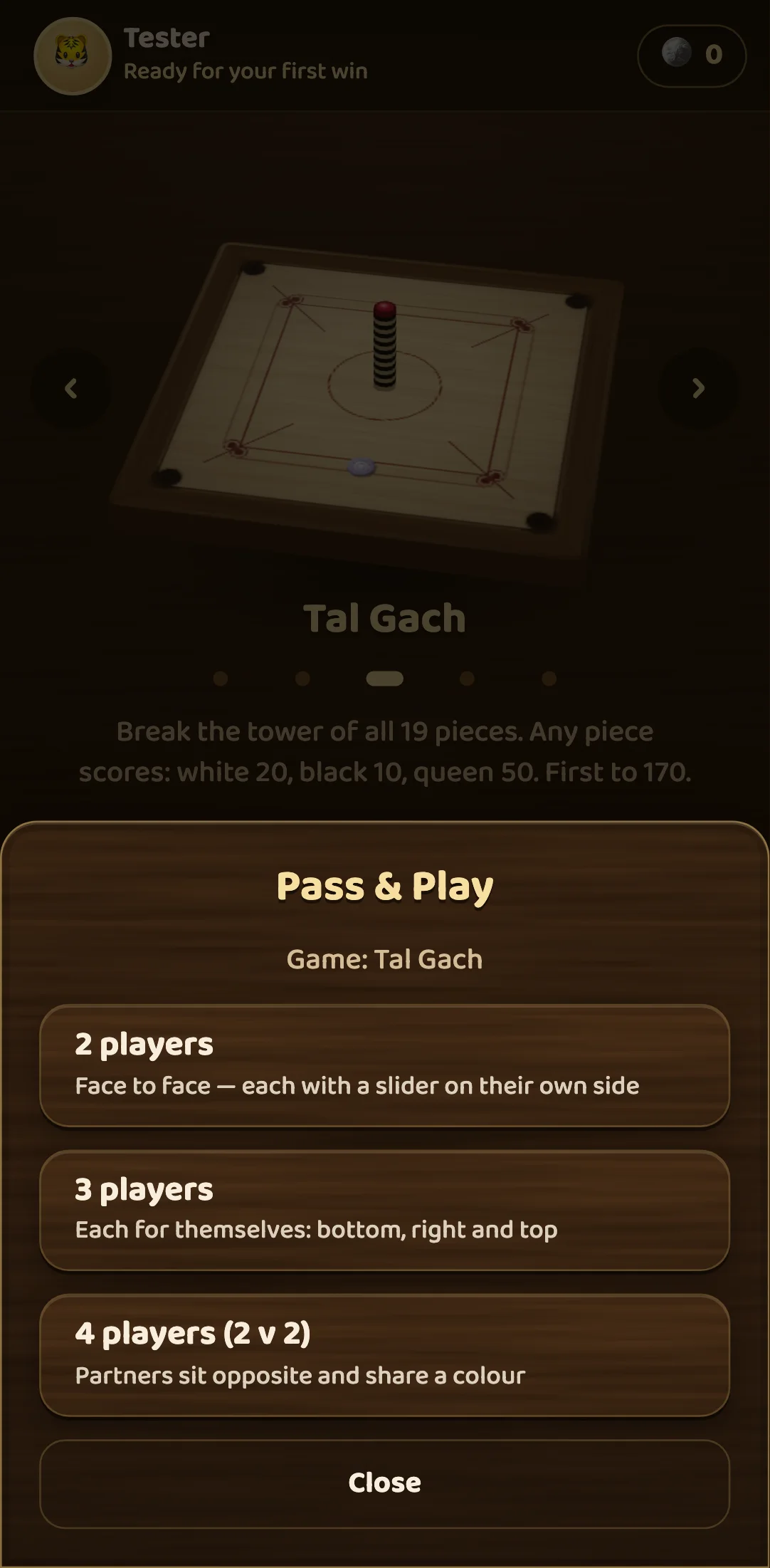
Three ways to fill the table
Pass & Play is for friends around one phone or tablet. Choose the game type, then Pass & Play, then the number of players. With three or four, everyone shares the slider at the bottom, the shooter’s baseline is highlighted, and a line under the board says whose turn it is.
Play Online offers the same player counts, depending on the game type. Quick Match finds the other players for you, or you can create a room and share its code so friends can join. In a 2 v 2 game each seat is marked as your partner or an opponent.
Play vs Bot in Tal Gach and Freestyle lets you take on two bots in a three-player game. The second bot plays the next style along (Balanced, Aggressive, Defensive, Trick-shot, wrapping round), under its own name.
Where everyone sits and who shoots next
With three players, the seats are bottom, right and top. With four, there is a player on every side and partners sit opposite each other: Players 1 and 3 play white, Players 2 and 4 play black.
Turns go round the table in order, so in doubles the turn alternates between the teams: you, an opponent, your partner, the other opponent. As in the duel, pocketing a piece that scores for you on a legal stroke keeps your turn, so one player may take several strokes before the turn moves on.
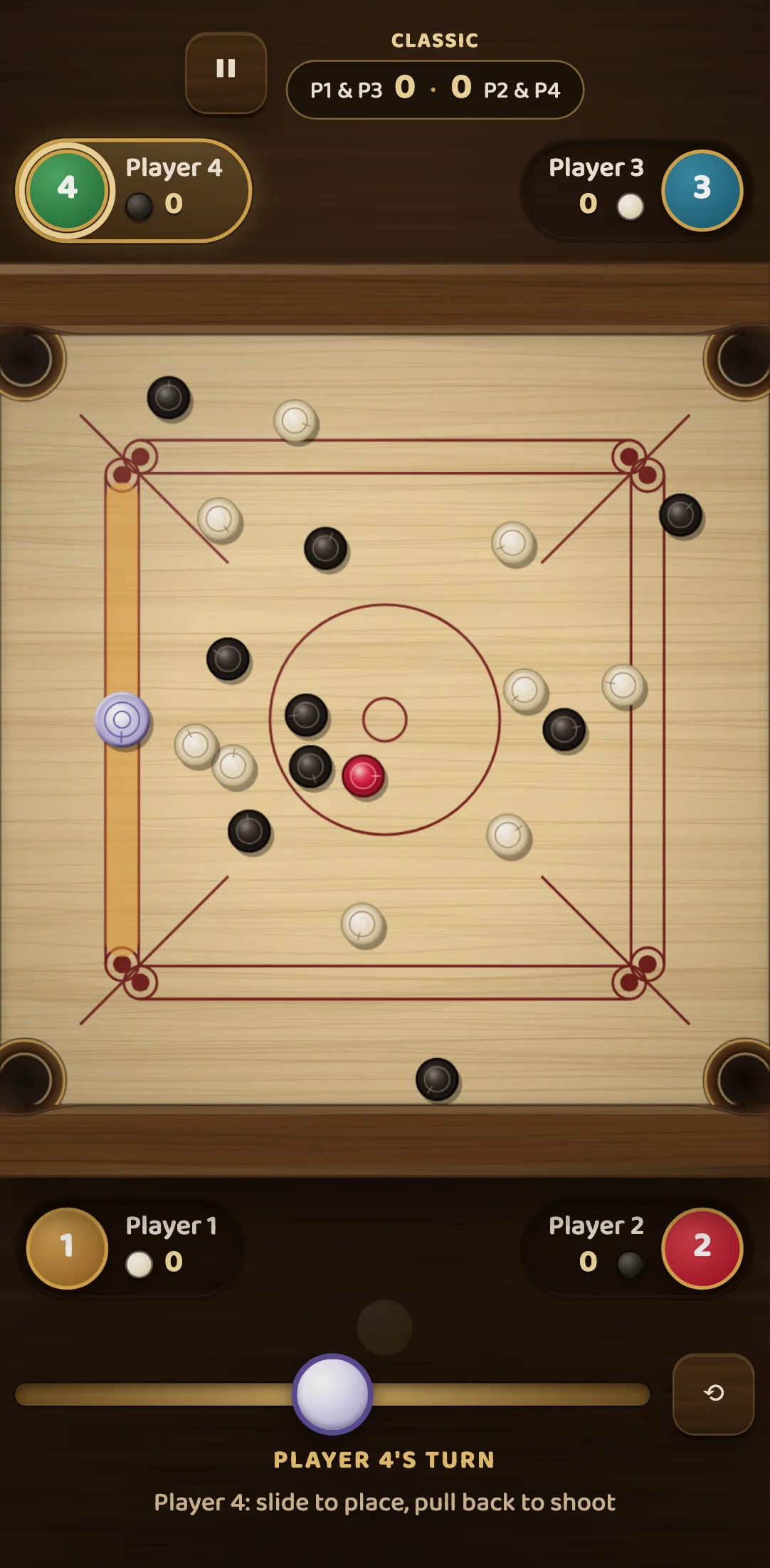
The bar at the top shows each team’s score; each corner shows what that player has pocketed this board.
Doubles in Classic: what the team shares
In Classic doubles, the two partners are one side that happens to have two players. That shows up in a few rules that are easy to get wrong if you have only played 1 v 1:
- The nine coins are counted per team. Together you need all nine of your colour, not nine each.
- The queen belongs to the team. If either partner pockets the queen and covers it, it counts for both. Pocketing the queen keeps your turn, so the cover attempt is always your own next stroke, never your partner’s. Miss the cover, or foul on it, and the queen goes back to the centre.
- The last coin waits for the queen. A side cannot clear its last coin while the queen is still in play, and in doubles that uses the team’s combined count. If the stroke would make nine, that coin goes back on the board.
- A foul’s penalty is paid by the team. If the striker leaves the board, your turn ends, that stroke’s coins are put back, and one coin the team has already won returns too: one of yours if you have any, otherwise one of your partner’s. A stroke that touches nothing simply passes the turn.
- Pocketing the other team’s coins helps them. An opponent’s coin that drops on a legal stroke counts for them, and your turn passes.
The side with all nine coins pocketed and the queen covered wins the board, exactly as in the duel.
Doubles in the 29 Game and Disc Pool
In the 29 Game, partners share one running total across boards, and the first side to 29 wins. After each board the pieces are set up again and the next player round the table breaks. Whoever breaks plays white for that board, with their partner, but points stay with each side whatever colour it plays.
Disc Pool has no queen and gentler fouls. In 2 v 2, every disc counts for the team that owns its colour, whoever pockets it, and the first team with all nine discs pocketed wins.
Three players: Tal Gach and Freestyle
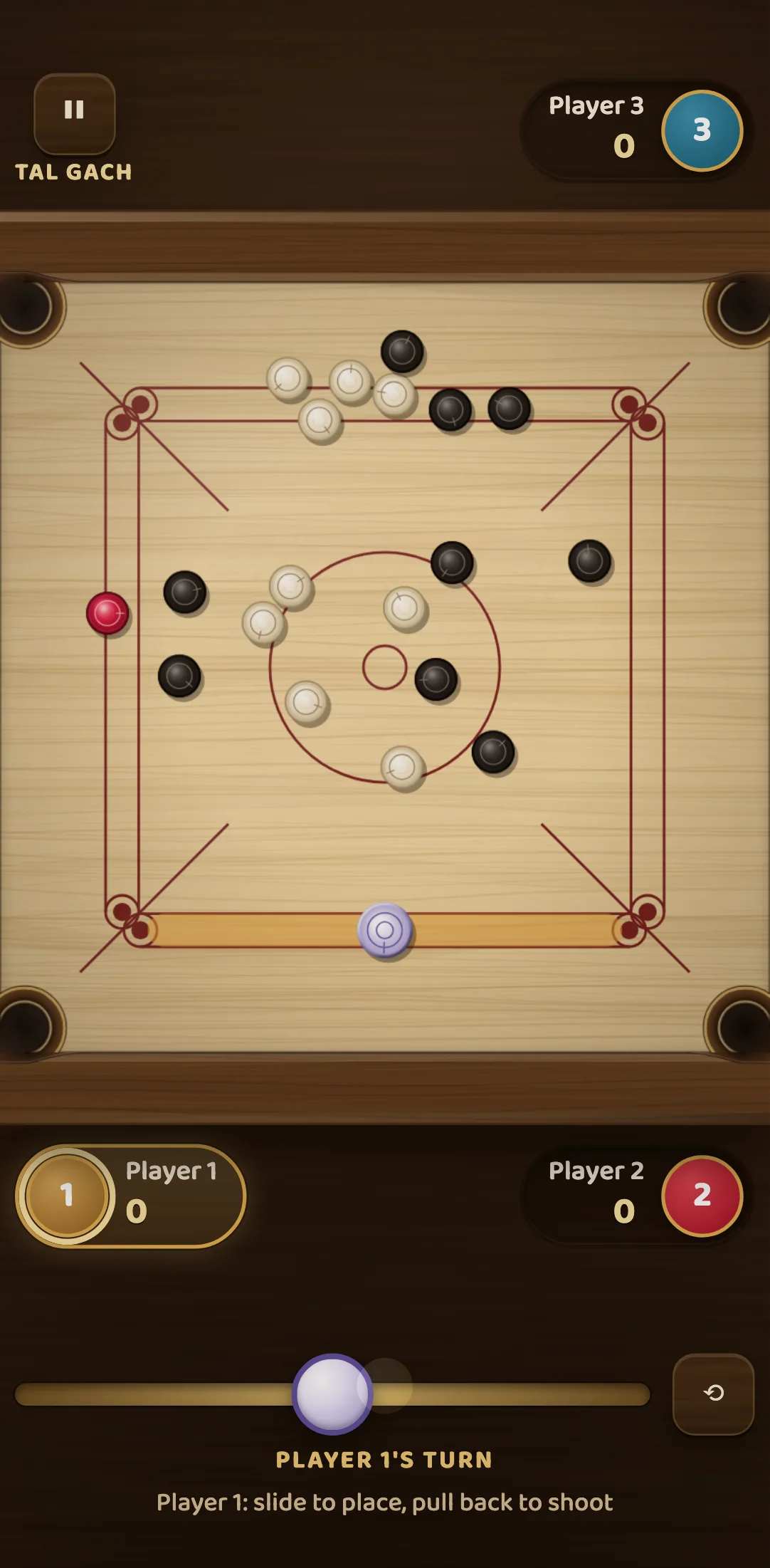
Tal Gach starts with all 19 pieces stacked in a tower in the centre. Whatever you pocket scores for you: 20 for a white, 10 for a black, 50 for the queen the moment it drops. The board holds 320 points and the first player to 170 wins at once. Split three ways, 170 is hard to reach, so three-player games often run until the board is clear. Then the highest score wins, and a tie goes to the player who cleared the board.
Freestyle uses the normal starting layout. Whites are worth 20 and blacks 10 to whoever pockets them, and the queen is worth 50 once covered by potting any coin in the same or the next stroke. The first player to 160 wins. If the board empties first, the highest score wins. A foul puts back that stroke’s pieces, and a striker off the board also costs you your most recent coin.
When someone leaves an online game
Each online turn has a timer, and missing two turns in a row ends the match. If your partner leaves a 2 v 2 game after it has started, your team loses. In a three-player game, if someone leaves after the start, whichever of the two remaining players has more points wins.
Tips for playing as a team
- Think one stroke past your own. In doubles the next stroke is an opponent’s, not your partner’s. When you cannot pot anything, leave the pieces awkward for that opponent rather than open.
- Count for the team. Watch the team bar, not your own corner. When your side is close to nine, the queen becomes the priority, because the last coin cannot be cleared before it is covered.
- Fouls cost the whole side. A foul can take back a coin your partner won. A soft, safe stroke is worth more in doubles than a hard gamble.
- In three-player games, watch the leader. The player who is ahead is everyone’s problem. A safe 10-point black that leaves nothing behind can be better than a 20-point white that sets up the leader.
- Practise the cover. In Classic doubles the queen cover is one stroke by one player. Practising it against a bot pays off when the whole team is depending on it.
Doubles and three-player carrom are slower, more social and more tactical than the duel. If you usually play one against one, try a 2 v 2 game of Classic with friends on one phone: it is the quickest way to learn how much the stroke after yours matters.
Rules checked against the game’s rules code (rules.ts, variants.ts, online.ts) by the Carrom by 22Softwares team.