
Ask three carrom players what a foul costs and you may get three answers: clubs and families all have their own house rules. A digital board cannot. It has to decide, for every stroke, exactly what happened and what it costs.
This guide sets out how Carrom by 22Softwares judges a stroke: the two things it treats as fouls, what each costs in every game type, and the mistakes that feel like fouls but are not.
The two fouls
After every stroke the game looks at three facts: which pieces fell into a pocket, whether the striker left the board, and whether the striker touched any piece at all. From those it finds at most one foul:
- Striker off the board. The striker ended up outside the playing surface.
- No touch. The striker did not touch a single piece during the stroke. Bouncing off a cushion does not count.
Many real-world rule books add a third foul: pocketing the striker. In this game it cannot happen. The pockets are cut tight, with a radius of 2.35 cm. A coin, at 2.07 cm, just fits, but the striker, at 2.68 cm, is bigger than the hole. A striker sent straight at a pocket rides over the hole into the back of the pocket and stays on the board. No foul is called and the turn simply passes.
Striker off the board: the rule, and why you will rarely see it
The penalty for a striker off the board is the heaviest one in the game, so it is worth knowing. In Classic your turn ends, every coin you pocketed with that stroke is put back on the board, and one coin you had already won is returned too.
In practice, though, the cushions keep the striker on the board. We checked this in the game’s own physics: 3,000 random strokes at 70 to 100 percent power, half of them into the Classic rack and half into the Tal Gach tower. The striker did not leave the board once. In Tal Gach the pieces thrown up when the tower breaks are coins, never the striker. The real cost of a hard stroke is not a foul. A coin that arrives too fast rattles out of the pocket, and a fast striker scatters pieces you may want to leave where they are.
No touch: the foul you will actually commit
The no-touch stroke is the one that comes up in real games: a cut you misjudged, a striker that slid past the edge of a coin, a stroke fired by accident. The game shows “No touch — turn passes”, and in most situations that is all that happens. You lose your turn, but no coin comes back.
There is one important exception in Classic and the 29 Game. If you have just pocketed the queen and this was your cover stroke, a no-touch fails the cover. The queen goes back to the centre spot, exactly as if you had played the cover and missed.
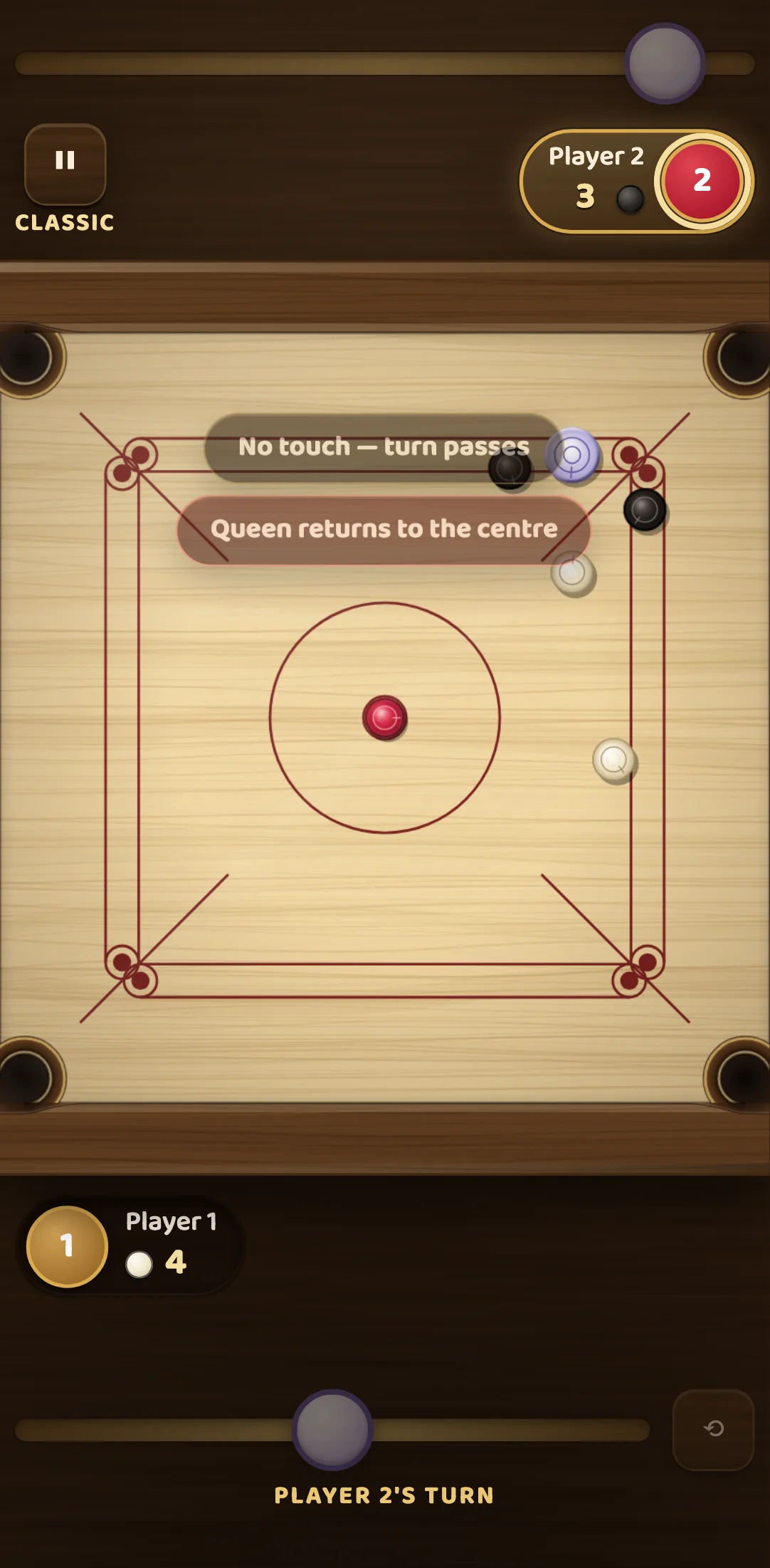
The lesson: on the cover stroke, play the coin you are most sure of touching, even if a different coin would leave a nicer position. A thin cut that misses costs you the queen; a solid hit that fails to pot costs you the same, but it is far less likely.
What a foul costs in each game type
The two fouls are the same everywhere, but their price depends on the game you are playing.
- Classic. A striker off the board ends your turn, puts back that stroke’s coins (yours and your opponent’s), and returns one of your already-won coins. In a 2 v 2 game the penalty is paid by the team: one of your coins if you have any, otherwise one of your partner’s. If the queen dropped on that stroke it goes back to the centre, and a pending cover fails. A no-touch only passes the turn and, as above, fails a pending cover.
- 29 Game. Each board is played under the Classic rules, so fouls cost the same. Because a board’s points come from the opponent’s coins still on the board when you clear yours, a returned coin of yours is worth more than it looks: it is one more coin you must pocket before you can score.
- Disc Pool. This is the forgiving game. There is no queen, and a foul only ends your turn. Discs pocketed on that stroke still count for whoever owns their colour. Nothing comes back.
- Freestyle. Any coin scores for the player who pockets it: 20 for a white, 10 for a black, and 50 for the queen once it is covered. A foul cancels everything pocketed on that stroke. A striker off the board also returns your most recent coin, so the points it was worth come off your score.
- Tal Gach. A foul of either kind passes the turn, and the pieces pocketed on that stroke come back and score nothing. You never lose points you already have. One detail matters near the end: a stroke with a foul can never win the game, even if the pieces it pocketed would have taken you past 170.
- Daily Challenge. A striker off the board puts that stroke’s pieces back, and the stroke still counts against your limit. A no-touch simply uses up one of your strokes.
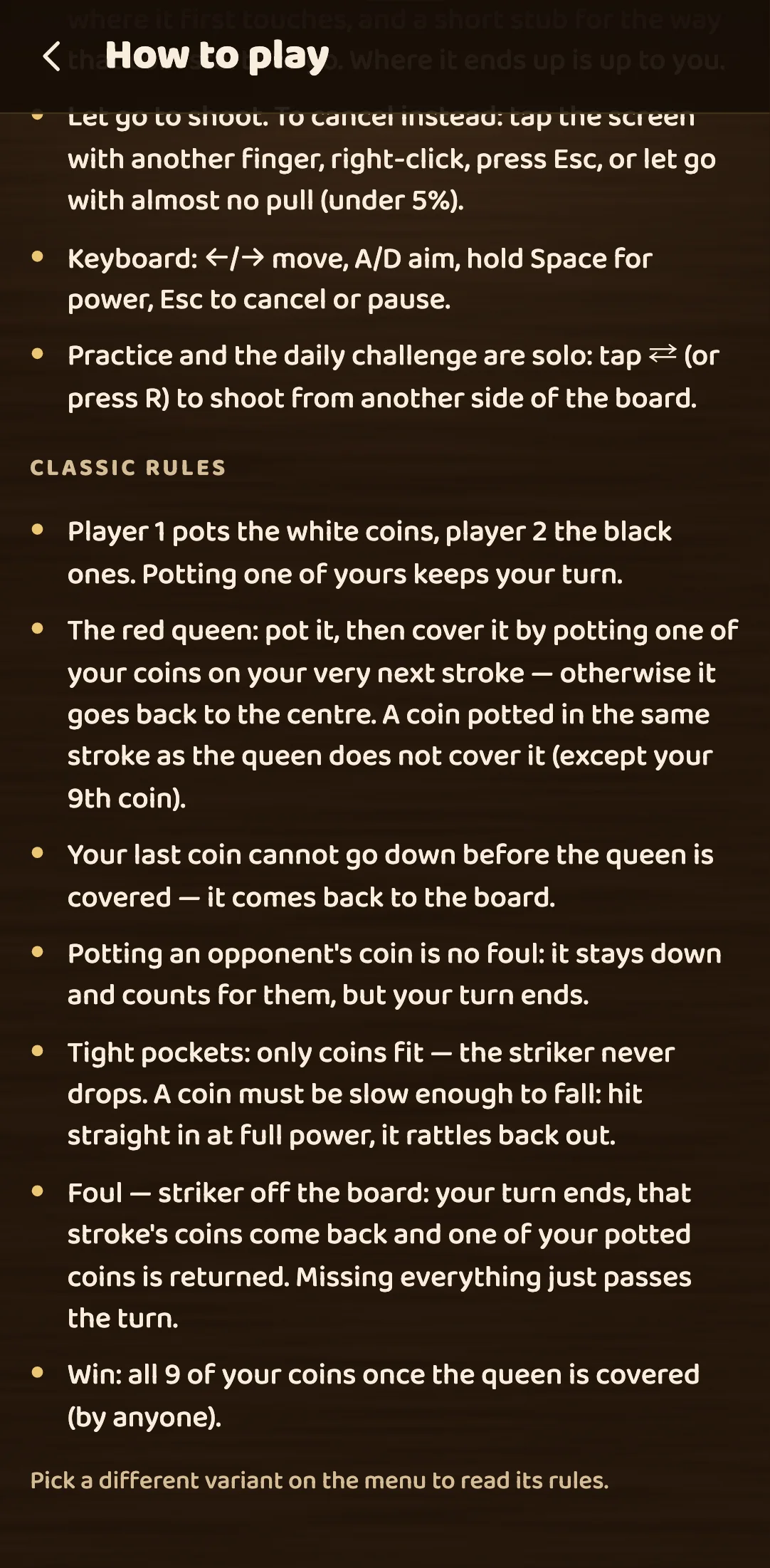
You can read the rules for any game type in the app: choose it on the home screen, then open Rules, or tap How to play from the pause menu during a match.
Mistakes that are not fouls
These are the situations players most often think are fouls. None of them are, but several still cost you something.
- Pocketing your opponent’s coin (Classic, 29 Game). It stays down and counts for them, and your turn ends. No coin of yours is returned. The one exception is their last coin while the queen is still in play: that one comes back to the board.
- Pocketing your last coin before the queen is covered (Classic). The coin comes back to the board. There is no penalty, but it does not keep your turn either. In the 29 Game the coin is instead held while you play on for the queen.
- Pocketing the queen before any of your coins (29 Game). It does not count yet. Your turn goes on, and the queen returns to the centre when your turn ends.
- Sending the striker at a pocket. As explained above, it cannot drop. The turn passes like any other stroke that pots nothing.
- Placing the striker on top of a coin. The game will not let you. A striker that overlaps a piece is moved to the nearest free spot on your baseline before you shoot.
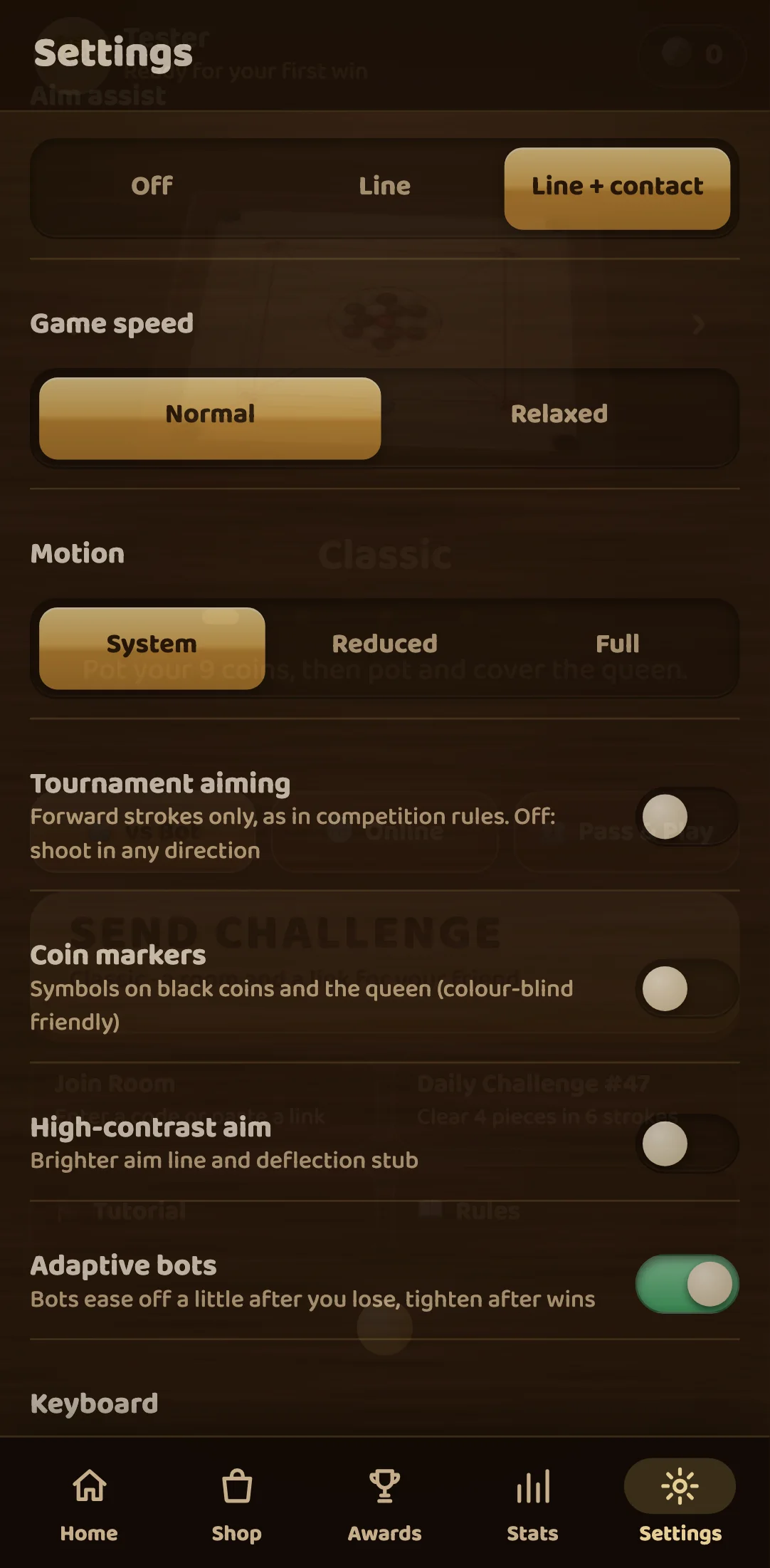
- Shooting backwards. In casual play you may shoot in any direction. If you switch on Tournament aiming in Settings, only forward strokes are allowed, as in competition rules. The game simply will not let you fire a backward stroke, so there is no penalty to pay. The bots follow the same setting as you.
The online turn clock
Online games add a rule that the board itself does not have: a turn clock on every stroke, set between 10 and 20 seconds. If it runs out, your turn passes. The game sends a tiny nudge in place of your stroke, so a timed-out turn behaves like a stroke that touched nothing. In Classic that means a timed-out cover stroke also sends the queen back. Let the clock run out on two of your turns in a row and you lose the match.
Fouls in your stats
The Fouls number on the Stats screen counts your strokes against bots and in the Daily Challenge that ended with the striker off the board. Strokes that touched nothing are not included, so a careful player’s count stays at or near zero. The Flawless award goes to anyone who wins a match without a single such foul.
Fouls in carrom are less about bad luck than about knowing the price. Once you know exactly what each mistake costs in the game you are playing, you can decide when a risky stroke is worth it, and when a quiet, safe hit is the better choice.
Rules checked against the game’s rules code (rules.ts, variants.ts, online.ts) by the Carrom by 22Softwares team.