
Classic carrom asks a lot of a new player. You have to learn the queen, the cover stroke, what happens when you pocket your last coin too early, and which mistakes give a coin back. Sometimes you want a game you can explain in one sentence.
That is what Disc Pool and Freestyle are for. Both use the same board, the same striker and the same physics as Classic. What changes is how pieces score and how much a mistake costs. This guide explains exactly how Carrom by 22Softwares plays each one, and how to win them.
Disc Pool in one sentence
Clear all nine of your discs before your opponent clears theirs.
Disc Pool starts from the usual Classic rack with one piece missing: there is no queen. You get nine whites or nine blacks, and the first player (or pair) to have all nine pocketed wins. Against a bot you play white and take the first stroke, and in pass and play Player 1 is white and breaks.
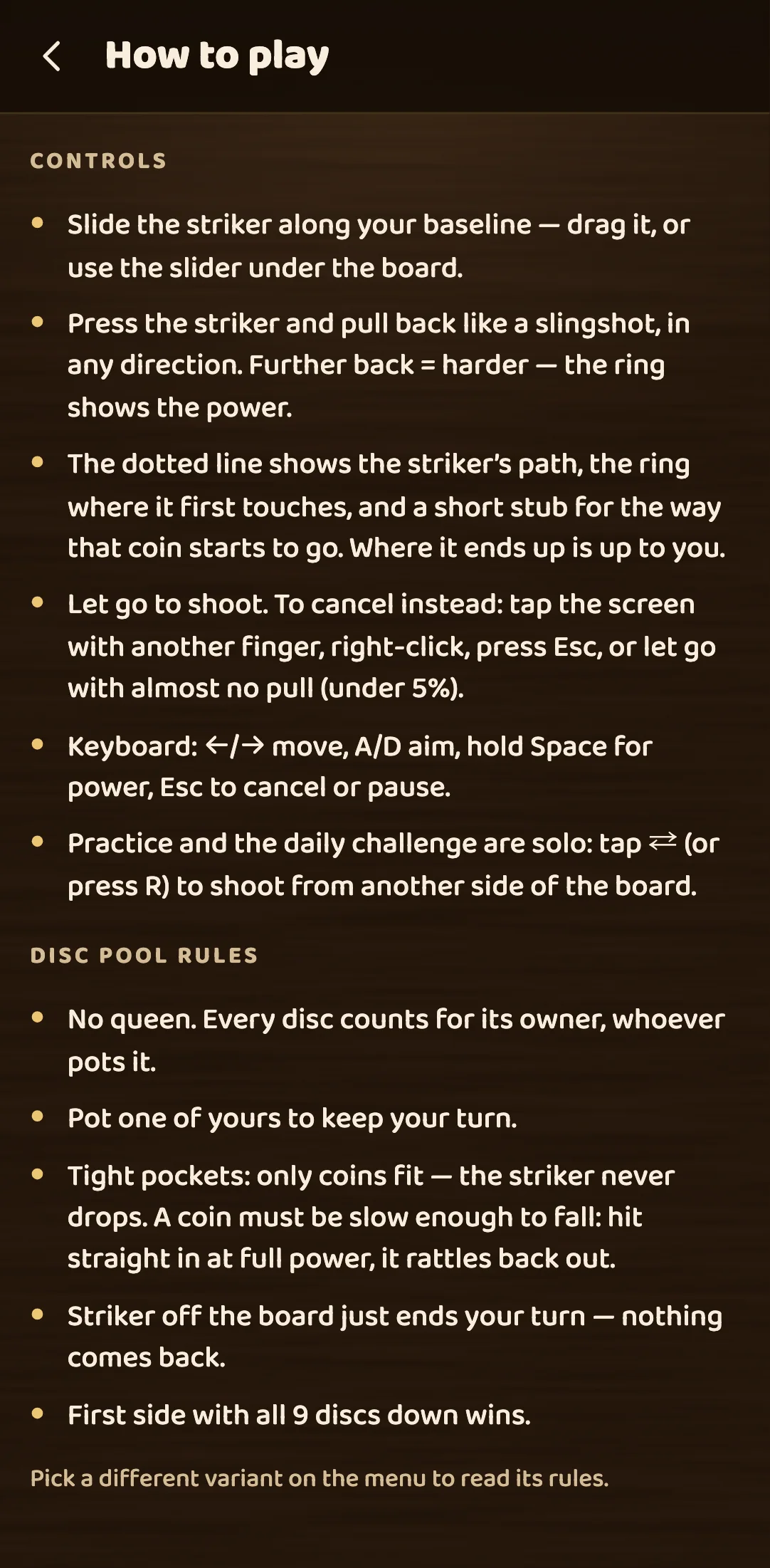
Every disc belongs to its colour, not its shooter
This is the rule that surprises people. In Disc Pool, a disc counts for the player who owns its colour, whoever pockets it. If you are white and you knock a black into a pocket, that black is now down for your opponent. It is one fewer disc they have to clear, and your turn ends.
The upside works the same way. If your opponent clips one of your whites in, you are a disc closer to winning without lifting a finger.
When you keep your turn
You shoot again only if the stroke pocketed at least one disc of your own colour and was not a foul. A stroke that pockets one of yours and one of theirs still keeps your turn. Both discs count, each for its own side.
A stroke that pockets nothing, or only the opponent's colour, passes the turn.
Fouls barely cost anything
Disc Pool is the forgiving game. A foul only ends your turn. Nothing is put back on the board, and any discs that dropped on the foul stroke still count for whoever owns them.
In practice there are two ways to foul. One is a stroke where the striker touches nothing at all. The other, which is rare, is the striker leaving the board. You cannot sink the striker: a pocket's radius is 2.35 cm and the striker's is 2.68 cm, so it simply does not fit.
Who wins when one stroke finishes both sides
It can happen that a single stroke pockets the last disc of both colours. The game checks the shooter's side first, so finishing your own colour wins, even if the same stroke also finished theirs.
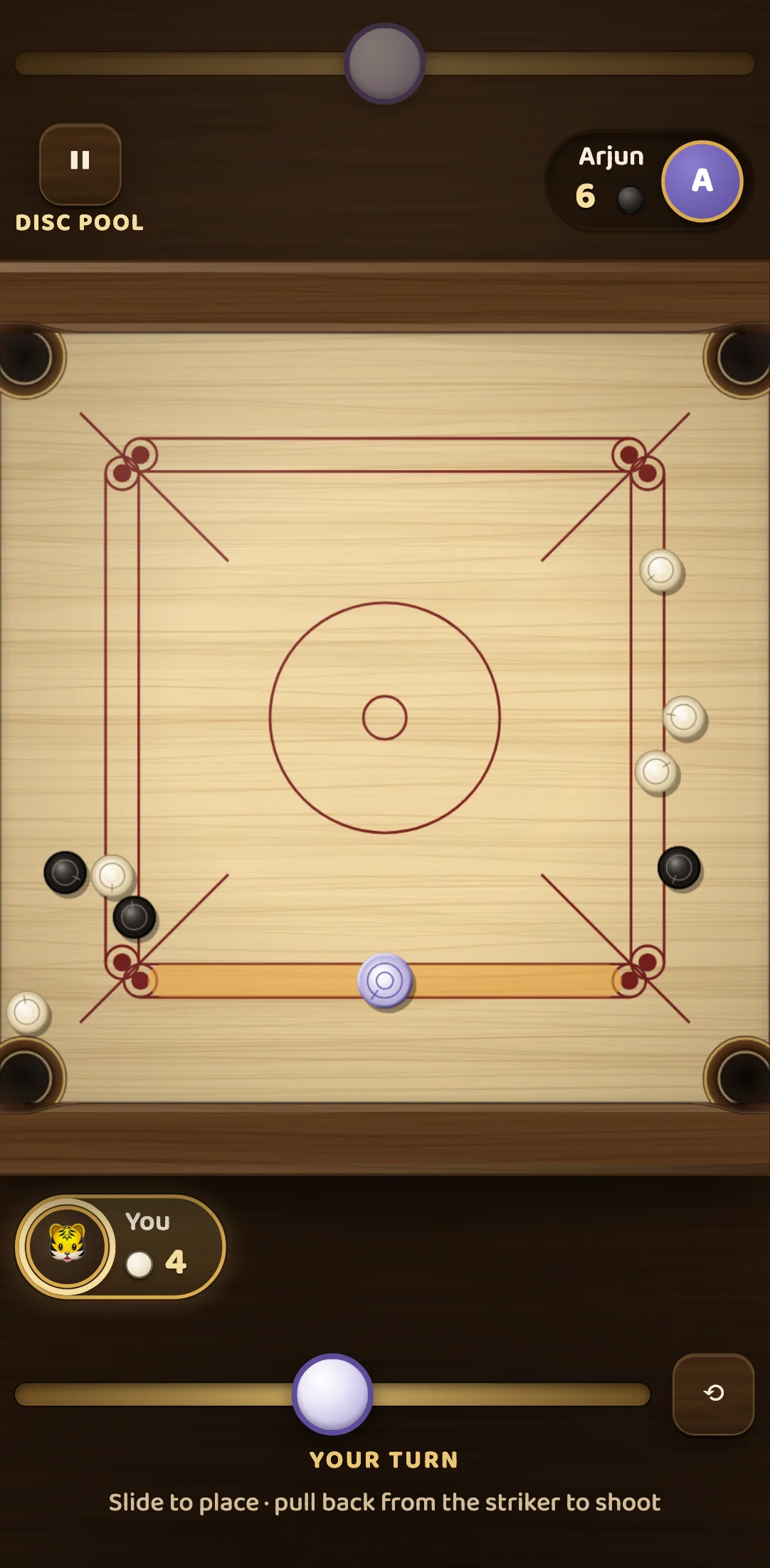
How to win at Disc Pool
Look at the colour next to the pocket, not just the one you are aiming at. Because any disc counts for its owner, a stroke that sends one of their discs in alongside yours is a gift to them. Before you shoot, check what is sitting in the path of the disc you are hitting and near the pocket you are aiming for.
Use soft strokes near the pocket. The pockets are tight and only take a coin that is slow enough to fall. A coin that hits the hole faster than 240 cm/s bounces off the back and rattles out, and a full-power stroke sends the striker at about 304 cm/s. When a disc is already close to a pocket, a gentle push drops it far more reliably than a hard hit.
Clear the awkward ones early. Discs stuck against a cushion or tucked behind the baseline get harder as the board empties and you lose the other discs you could bank off. Deal with those while you still have options.
Do not be afraid to attack. A foul here costs you only the turn. An ambitious cut or a two-disc combination is cheaper to try here than in any other game type.
Freestyle in one sentence
Anything you pocket scores for you, and the first to 160 points wins.
Freestyle uses the full Classic rack, queen included, but nobody owns a colour. Every piece you pocket goes on your own score:
- White: 20 points
- Black: 10 points
- Queen: 50 points, once covered
There are 320 points on the board in total, so 160 is half of everything. The first player to reach it wins at once. If the board is cleared before anyone gets there, which can only happen in a three-player game, the highest score wins.
Freestyle can be played by two, three or four. With four it is two pairs, and partners share one score. With three it is every player for themselves.
Keeping your turn
Any clean pot keeps your turn: a white, a black, the queen, or the queen's cover. A foul, or a stroke that pockets nothing, passes the turn.
Covering the queen
The queen only scores once it is covered, but in Freestyle the cover is easy to understand: pocket any coin, white or black.
- Pocket the queen and a coin in the same stroke, and the queen is covered there and then.
- Pocket the queen alone, and you shoot again. Pocket any coin on that next stroke and the queen is yours, worth 50 points.
- If the next stroke pockets nothing, or is a foul, the queen goes back to the centre spot and the turn passes.
There is one small exception. If the queen is the very last piece on the board, there is nothing left to cover it with, so it counts straight away.
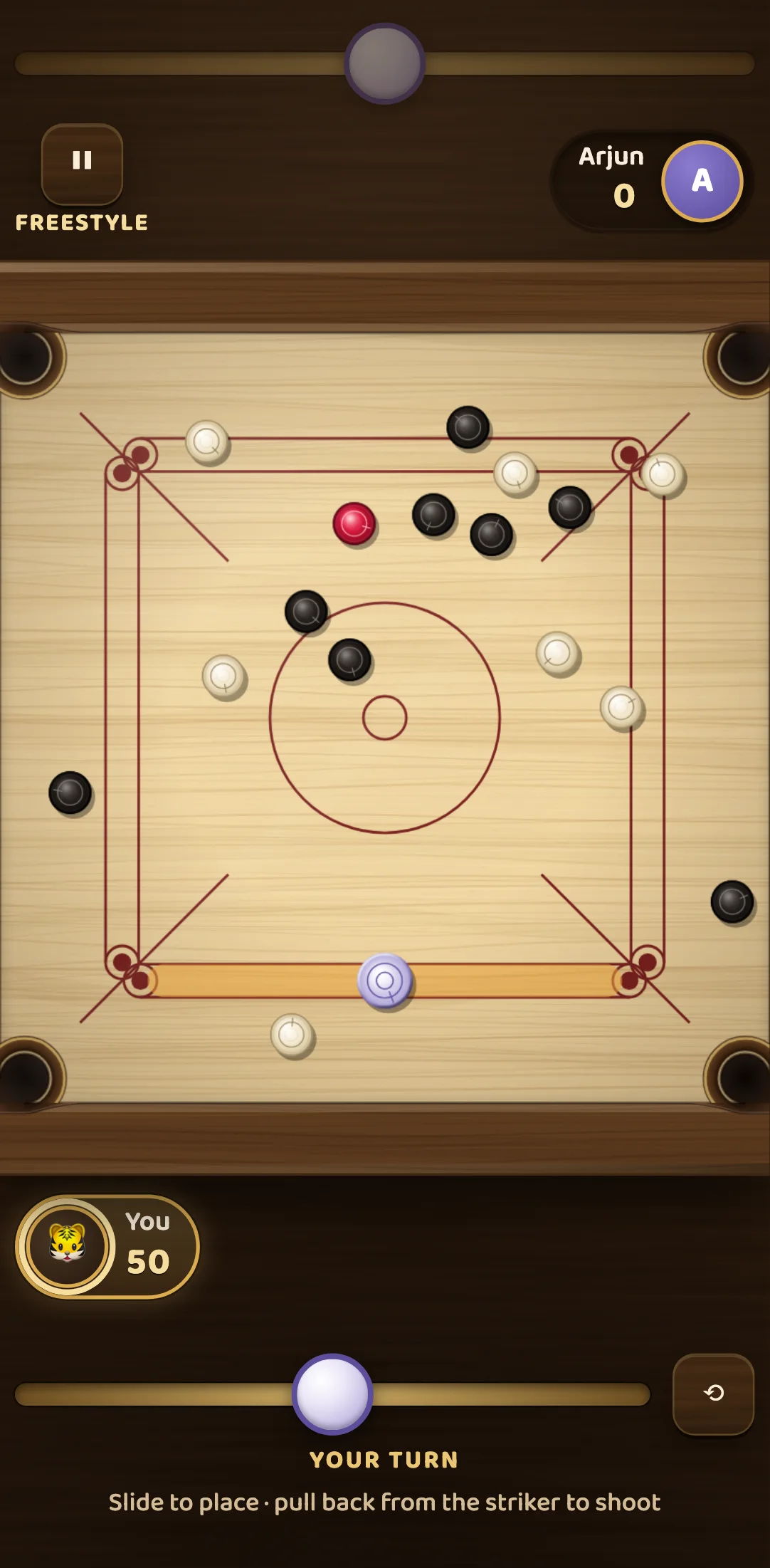
What a foul costs in Freestyle
Freestyle punishes mistakes more than Disc Pool does. A foul cancels everything pocketed on that stroke: those pieces are put back on the board along the centre line. If the striker left the board, your most recent coin also comes back out, and its points come off your score.
A stroke where the striker touches nothing is a foul too. It cannot have pocketed anything, so it does not cost a coin. If you were in the middle of covering the queen, though, the queen goes back to the centre.
How to win at Freestyle
Whites first, when the choice is even. A white is worth twice a black. If you have two pots of the same difficulty, take the white, and leave the black for when it is the only safe shot.
Value the queen properly. At 50 points, the queen is worth more than two whites. But going for it costs you a stroke, and a missed cover hands it back. The best time to pocket it is when there is an easy coin sitting near a pocket for the cover stroke. Check that before you shoot at the queen, not after.
Think about what you leave behind. Your opponent can score with any piece, so every coin you leave hanging over a pocket is one they can take. When you are not confident of a pot, a soft stroke that pushes pieces away from the pockets is often better than a hopeful long shot.
Count to 160. Because the target is exactly half the board, a player who gets to 160 cannot be caught. Near the end, work out what you still need. Sometimes two blacks and a cover are enough, and there is no need to chase the queen at all.
Which one should you play?
If you are new to carrom, or teaching someone, start with Disc Pool. There is no queen to explain, fouls are cheap, and the goal is easy to see on the board.
If you like scoring runs and taking risks, try Freestyle. The points make every stroke a small decision: the white or the black, the queen now or later, attack or play safe. With three players it becomes a busy, every-player-for-themselves game that works well when friends share one phone in pass and play.
Both are in the game type picker on the home screen. You can play them against a bot, in pass and play, or online, and the How to play screen always shows the rules of the game type you have selected.
Rules checked against the game’s rules code (variants.ts, board.ts, physics.ts) by the Carrom by 22Softwares team.