
Doubles is how a lot of people first meet carrom: four friends round one board, partners sitting opposite each other. It looks like the singles game with more people, but it plays differently, because the stroke after yours is never your partner's.
Our guide to carrom with three or four players sets out the rules of the team game. This article is about how to play it well. The rules here are the ones used in Carrom by 22Softwares, where you can play 2 v 2 in Pass & Play on one phone or online, through Quick Match or a room with friends.
carrom with three or four players
The order round the table changes everything
In a four-player game you sit at the bottom, the first opponent sits on your right, your partner sits opposite you at the top, and the second opponent sits on your left. Turns go round the table in that order: you, the opponent on your right, your partner, then the opponent on your left. You and your partner play white, the other team plays black. As in singles, a legal stroke that pockets one of your own coins lets you shoot again.
That one fact drives most of doubles strategy. When your turn ends, an opponent always shoots next. Your partner only gets a look at the board after that opponent has finished, and you only get it back after the second opponent. So every position you leave is tested by an opponent first.
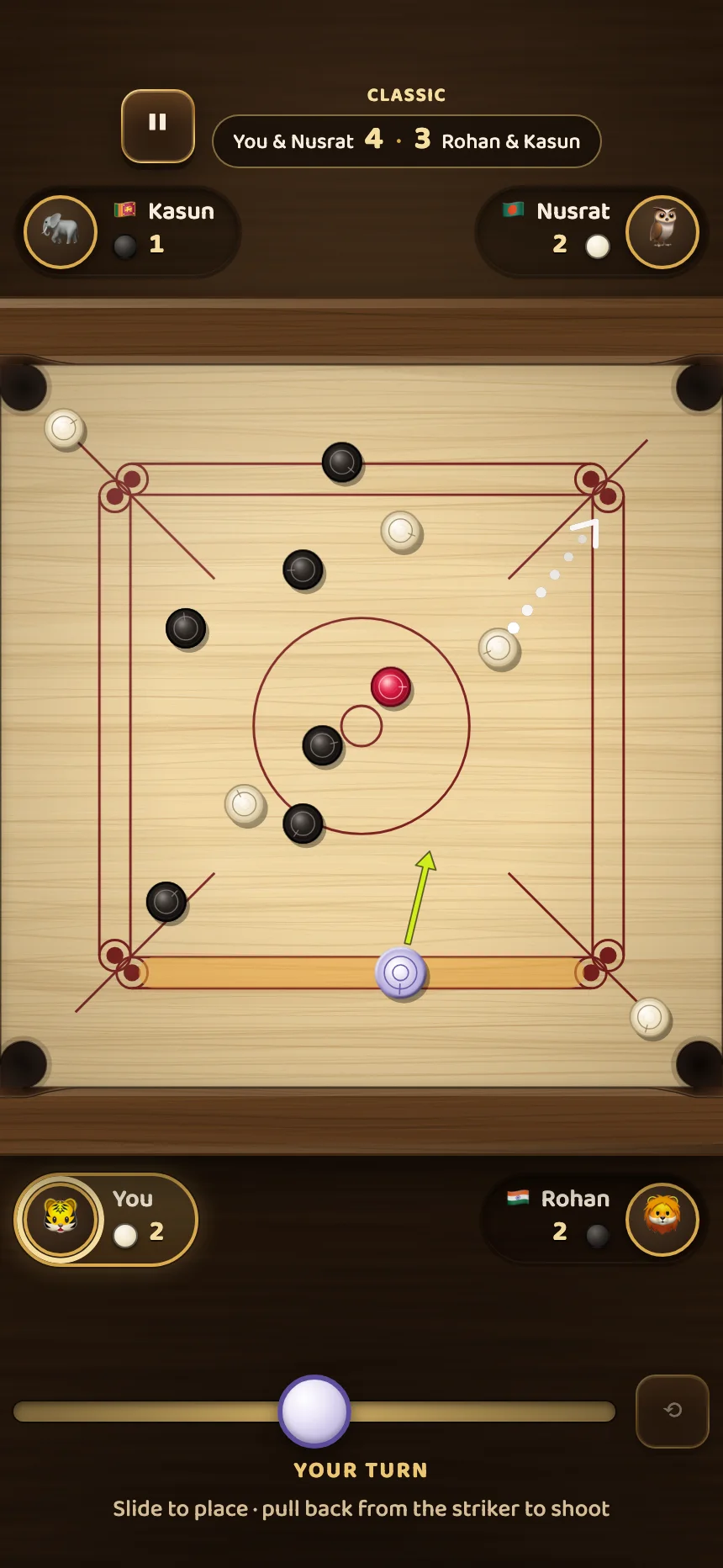
Your coins by the pockets are safe; theirs are not
In Classic, a coin always counts for the side that owns its colour. If an opponent knocks one of your whites in, it goes down for your team, and their turn ends there unless the same stroke also pocketed one of their own. So a white you leave hanging over a pocket is not something the next opponent can use to score. They can push it away with a careful stroke, but that costs them a stroke they could have used on their own coins. And if they leave it alone, it is still there when your partner comes to the table.
Black coins by the pockets are the opposite. A black on the lip is an easy pot for the opponent who shoots next, and an easy pot keeps their turn going. When your stroke is going to end your turn, the most useful thing it can do is move their coins away from the pockets and keep yours close.
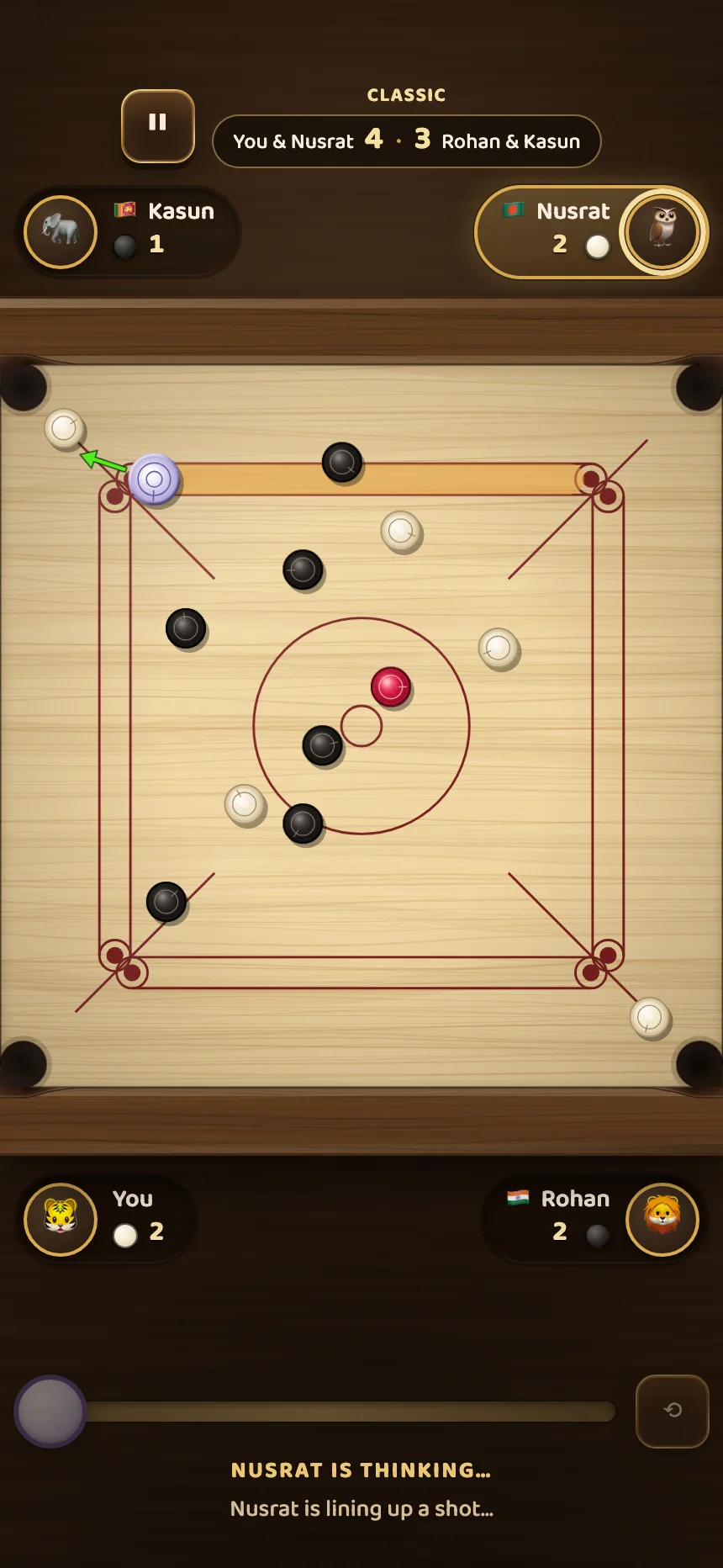
Read the board from the next player's seat
Every player shoots from their own baseline. The opponent on your right sees the board from the right-hand side, and a coin that looks awkward from your seat may be a simple straight pot from theirs.
So before you play a safety shot, turn the board round in your head. Ask what the opponent on your right can pot from the right-hand baseline, not what you could pot from yours. This is also how the Expert bot in Carrom judges a stroke: when it works out what a stroke leaves behind, it looks for pots from the baseline of the player who shoots next.
The nine coins and the queen are shared
In Classic doubles your team needs all nine coins of its colour, not nine each, plus the queen covered by someone. That changes some decisions near the end of a board.
The last coin waits for the queen. A side cannot clear its ninth coin while the queen is still in play, and that count is for the team. If your partner has five and you have three, the next white you pot is the team's ninth. Pot it before the queen is covered and it comes back to the board, and it does not keep your turn. So once your team reaches eight, the queen stops being optional.
The cover is always your own stroke. Pocketing the queen keeps your turn, so you are the one who must cover it, on your very next stroke, by pocketing a white. Your partner cannot do it for you. If you miss the cover, or foul on it, the queen goes back to the centre, and the next player to see it is an opponent. Only go for the queen when you can see a cover shot from some spot on your own baseline.
The same rule protects you. The other team's last coin cannot go down before the queen is covered either. If you knock in what would be their ninth black while the queen is still on the board, it comes back out. But once the queen has been covered, by either side, clearing the opponents' coins for them hands them the board. Late in a board, be careful with strokes that could drop their last black.
Fouls cost the whole side
If the striker leaves the board, your turn ends, every coin that went down on that stroke goes back on the board, and one coin your team had already won comes back too: one of yours if you have any, otherwise one of your partner's. A stroke where the striker touches nothing simply passes the turn.
That penalty lands on the team: a full-power gamble that flies off the board can undo your partner's good work. Soft, controlled strokes matter even more in doubles than in singles.
Doubles in the 29 Game
In the 29 Game the two partners share one score across several boards, and the first side to 29 wins the match. When a side clears a board, it scores one point for every opponent coin still on the board, plus 5 for the queen if it covered the queen and had 23 points or fewer.
Two things matter for doubles. First, the break moves round the table: the next board is broken by the player after the last breaker, and that player's side plays white for the board. Your team switches colour from board to board, but the points stay with the team. Second, the queen bonus stops at 23. Once your team is on 24 or more, the queen is only worth what it takes to finish the board, so a quick, clean clearance is the better plan.
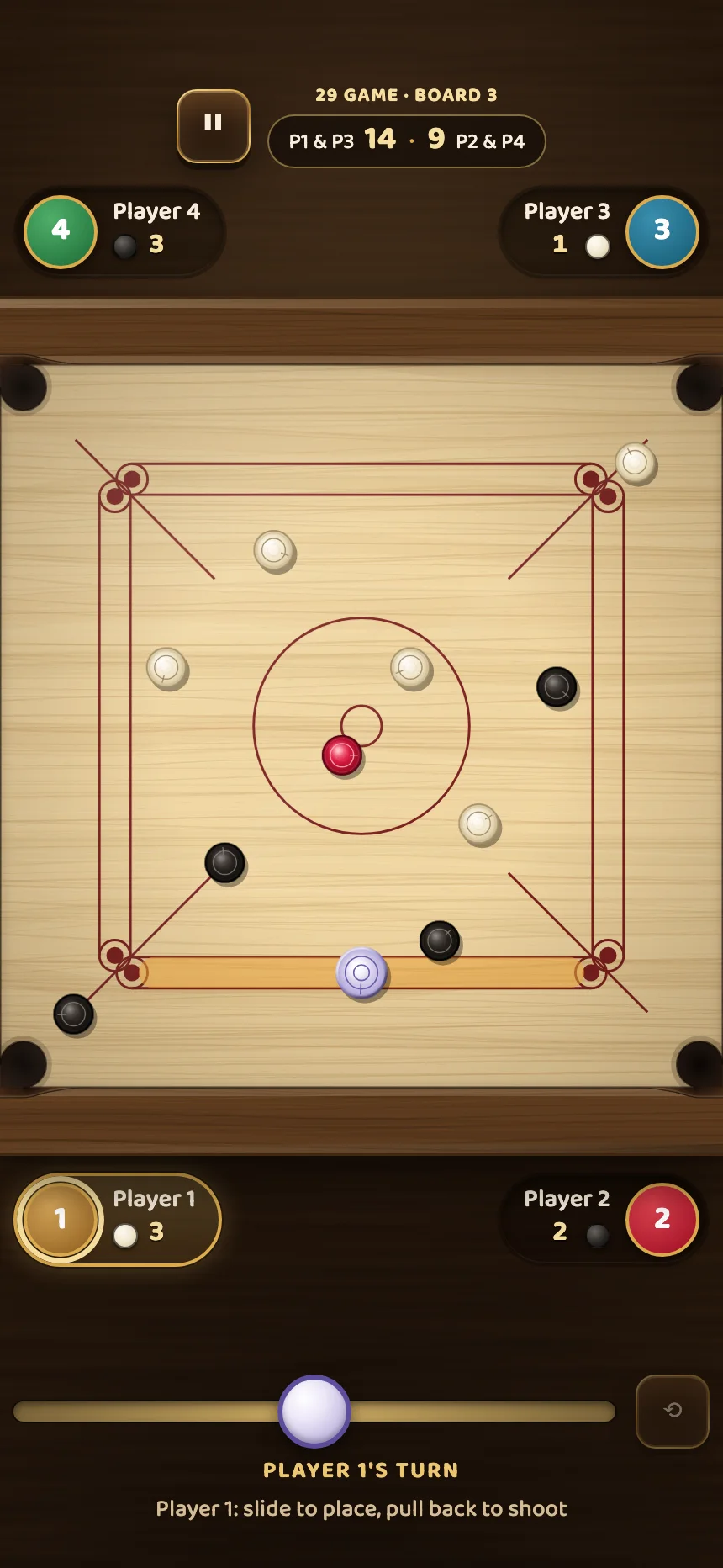
Our 29 Game strategy guide goes into the scoring decisions in more detail.
Disc Pool doubles in one paragraph
Disc Pool has no queen. Every disc counts for the side that owns its colour, whoever pockets it, and the first side with all nine down wins. So the Classic idea holds: your discs near the pockets are safe to leave, theirs are not. A foul only ends your turn.
A checklist for every doubles stroke
- Can I pot my own colour? If so, which pot leaves another of ours close to a pocket?
- If my turn ends, what does the opponent on my right see from their baseline?
- Where are their coins? Push them away from the pockets.
- What is the team count? At eight, the queen comes first.
- Do I have a cover? No cover in sight, no queen.
- Is this stroke soft enough to stay on the board? A foul costs the team a coin.
How to practise
The easiest place to practise is Pass & Play with four players on one phone or tablet. The shooter's baseline is highlighted and the line under the board says whose turn it is, so even new players can follow. If you play online, Quick Match finds a partner and two opponents for you; when nobody is free in time, bots tagged BOT fill the empty seats while the search goes on.
Try playing a few boards where your only goal is to end every turn with your coins by the pockets and theirs in the middle of the board. You will pot fewer spectacular shots, and win more boards.
Facts checked with the Carrom by 22Softwares team against the game’s rules engine.