
Most carrom advice is about winning one board: pot your coins, cover the queen, keep the turn. The 29 Game asks a different question. A match is several boards, and the score from each board depends on how far behind the loser was when it ended. So a board you are about to lose is not finished. Every coin you still pot changes the score, and that can decide the match two boards later.
If you only need the rules, our guide to scoring in the 29 Game and Tal Gach covers them. Here we look at what the scoring means for the way you play.
guide to scoring in the 29 Game and Tal Gach
Rules vary between clubs. Everything below is how the 29 Game works in Carrom by 22Softwares, checked against the game's own rules code.
How a board is scored, in one paragraph
Each board is played like Classic carrom. It ends when one side has potted all 9 of its coins and the queen has been covered, by either side. The side that cleared its coins wins the board. It scores one point for each of the opponent's coins still on the board. If that same side also covered the queen, it adds 5 points for the queen, but only if it had 23 points or fewer before that board. The first side to reach 29 wins the match. A board is worth at most 14 points, so a match always takes at least three boards.
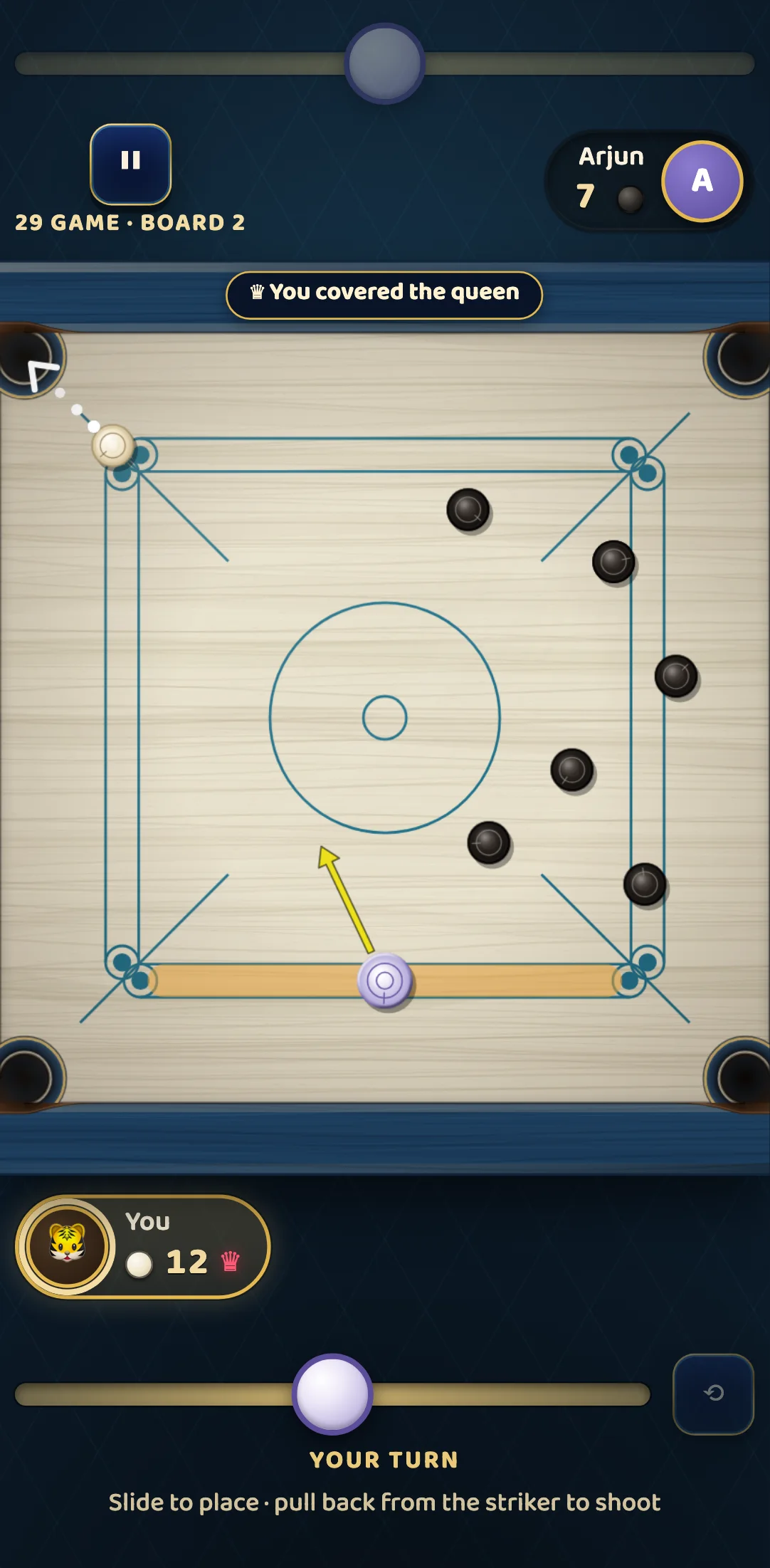
Think in points, not just in boards
Because the winner scores the loser's leftover coins, the same board can be worth 1 point or 14. Two things follow from that.
When you are winning the board, every coin they pot costs you a point
If you are clearly ahead on the board, the race is no longer just to finish. It is to finish before your opponent pots more coins, because each of their coins that goes down is one point fewer for you. That changes a few habits:
- Do not pot their coins for them. In Classic it already ends your turn. In the 29 Game it also takes a point off your board score, since a coin potted for them no longer counts as "left on the board".
- Do not leave them easy pots when your turn ends. Every coin of theirs you leave hanging over a pocket is a point they can take back.
- Finish when you can. A long board gives them more turns to pot coins.
When you are losing the board, every coin you pot is a point saved
This is the half most players forget. Once a board is clearly lost, it is tempting to play loosely. But the winner scores your coins still on the board, so every coin you pot now is one point less for them. Potting four more of your coins before they finish turns a 9-point board into a 5-point one.
Fouls matter more for the same reason. If your striker leaves the board, your turn ends, that stroke's coins come back, and one of the coins you had already potted is returned to the board. That returned coin is one more point for the winner. (The striker cannot fall into a pocket in this game, because the pockets are smaller than the striker, so going off the board is the foul to watch.) A stroke that touches nothing only passes the turn.
The queen: 5 points, but only for the side that wins
The queen is where the 29 Game is most different from Classic.
Only the board's winner can score the queen, and only if they covered it themselves. If you cover the queen and then lose the board, nobody gets the 5 points. That makes covering the queen a defensive move as well. When your opponent is likely to win the board, taking the queen and covering it denies them up to 5 points, even though you will not score it yourself.
The queen cannot be your first piece. If you pot it before you have potted any coin of your own on that board, it does not count. Your turn goes on, and the queen goes back to the centre when your turn ends. Pot one of your coins first.
Your last coin waits for the queen. If you pot your ninth coin while the queen is still on the board, that coin is held out and you play on for the queen. Pot the queen, and the coin comes back to the centre for you to cover it with. Miss, and the coin comes back to the board and the turn passes. In practice: try to deal with the queen before you get down to your last coin.
Above 23 points, the queen adds nothing. Once your side has more than 23 points, a board you win with the queen scores only your opponent's leftover coins. The queen still has to be covered by someone before the board can end, but it is no longer a prize for you.
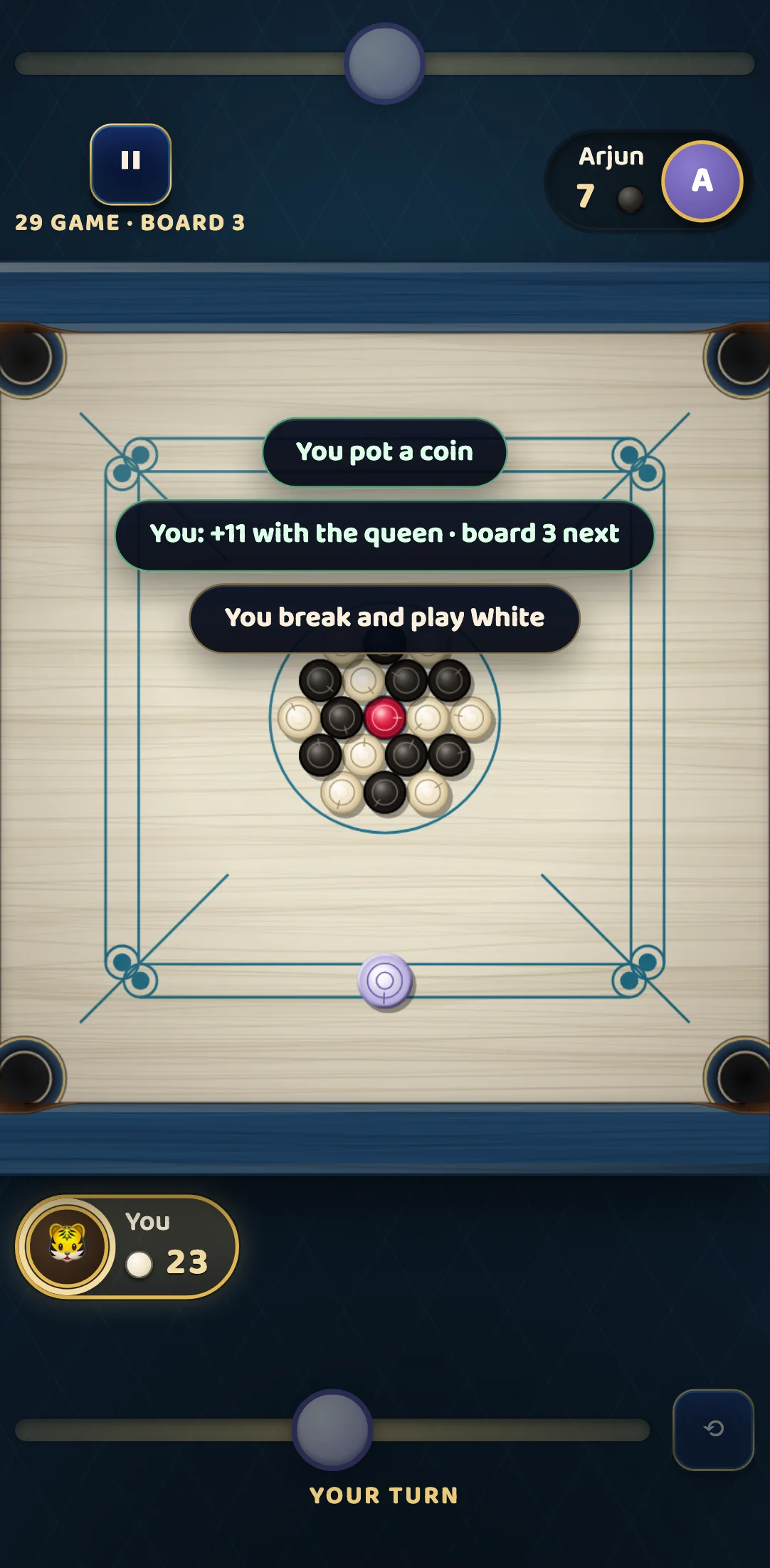
Breaks and colours change every board
After each board the pieces are set up again. The next player in turn after the last breaker breaks the new board and plays White. In a one-against-one match that means you take turns to break. The sides keep their points whatever colour they play, and in a 2 v 2 match partners share one score.
Closing out a match from 20 points or more
Late in a match, the arithmetic is simple enough to do in your head, and it should guide every decision.
When you need only a few points, you do not need a big board. If you are on 25, any board you win with at least 4 of their coins left finishes the match. Play safe, avoid fouls and finish the board. You do not need the queen's points, and above 23 you would not get them anyway.
When your opponent needs only a few points, count your own coins. Say they are on 25. The queen no longer counts for them, so they need at least 4 of your coins still on the board when they finish. If you have potted 6 of your 9 coins, only 3 are left, and even if they win this board they can reach only 28. Each coin you pot pushes their finish out by another board.
When you are far behind, remember that 14 is the most one board can give. Big boards come from clearing fast while they still have many coins on, so take a little more risk on your own pots, but still do not hand them easy coins.
How the computer players handle the 29 Game
The bots know these rules too. Every level knows that a queen potted before its first coin does not count, so it does not chase the queen too early. The Expert bot also counts coins the 29 Game way while a board is still going. It treats each of its own coins as a gain and each coin it pots for you as a loss, rewards covering the queen, and marks a queen potted too early as a small mistake and a last coin held for the queen as a chance.
A short checklist
- Before each stroke, check the score as well as the board.
- Winning the board: finish quickly, never pot their coins for them, and do not leave theirs over a pocket.
- Losing the board: keep potting your own coins, and avoid going off the board, because each coin left is a point for them.
- Pot one of your coins before you go for the queen, and deal with the queen before your last coin.
- If they are likely to win the board, covering the queen yourself denies them 5 points.
- Above 23, forget the queen's points. Count coins.
Quick answers
Who gets the queen's 5 points if I cover it but my opponent wins the board? Nobody. Only the board's winner scores the queen, and only if they covered it.
Who breaks the next board? The next player after the last breaker, and they play White. In a one-against-one match the break alternates.
Is there a daily mission for it? "Win a 29 Game" is one of the daily missions that can come up. It pays 100 coins and 60 XP.
Facts checked with the Carrom by 22Softwares team against the game’s rules engine.