
It is your turn and nothing is on: one coin is frozen against the cushion, another is hidden behind an opponent’s coin. Most beginners shoot anyway and hope.
Strong players do something else. When they cannot pot, they ask a different question: what will my opponent have after this stroke? That stroke is called a safety, and it is the most underrated shot in carrom. This guide explains when to play one, what it costs under the rules, and how the computer players in Carrom by 22Softwares make the same decision. The rules are the game’s Classic rules; clubs differ in details, but the thinking carries over to a real board.
What an empty stroke really costs
Before you can judge a safety you need to know what you give up by not potting. In Classic:
- Potting your own coin keeps your turn. That is the only way to shoot again.
- Potting your opponent’s coin is not a foul, but the coin stays down, counts for them, and your turn ends.
- A stroke that touches nothing ends your turn and costs nothing else. No coin comes back.
- The striker leaving the board is the expensive one: your turn ends, anything you potted on that stroke is voided, and one of your potted coins returns to the board.
So a quiet stroke that moves a few coins and pots nothing costs you exactly one thing: the turn. A missed pot attempt costs the same turn, plus whatever the miss leaves behind. That is the whole argument for safety play. If you are going to lose the turn anyway, choose the position your opponent inherits.
The three questions before a safety
1. Which of their coins are easy? Look from your opponent’s baseline. A coin of theirs near a pocket with a clear line keeps their run going; deal with it first.
2. Where are my coins? Your own coins near pockets are fine when the turn passes: if your opponent pots one, it counts for you and their turn ends. A safety that leaves a coin of yours in a pocket mouth is a bonus.
There is one exception. In Freestyle and Tal Gach any coin scores for whoever pots it, so every coin near a pocket is a gift to the next player, whatever its colour. Safety play in those modes means keeping all coins away from the pockets.
3. Soft or firm? There are two basic safeties:
- The touch. Hit one coin gently so it moves a short way, for example off the lip of a pocket, and leave everything else where it is. Use it when one coin is the whole problem.
- The knock. Hit firmly into a group so the coins spread. Use it when several of their coins are lined up, or when you simply have no good shot and want to change the position. It is less predictable, so it suits positions that are already bad for you.
An example from a real game
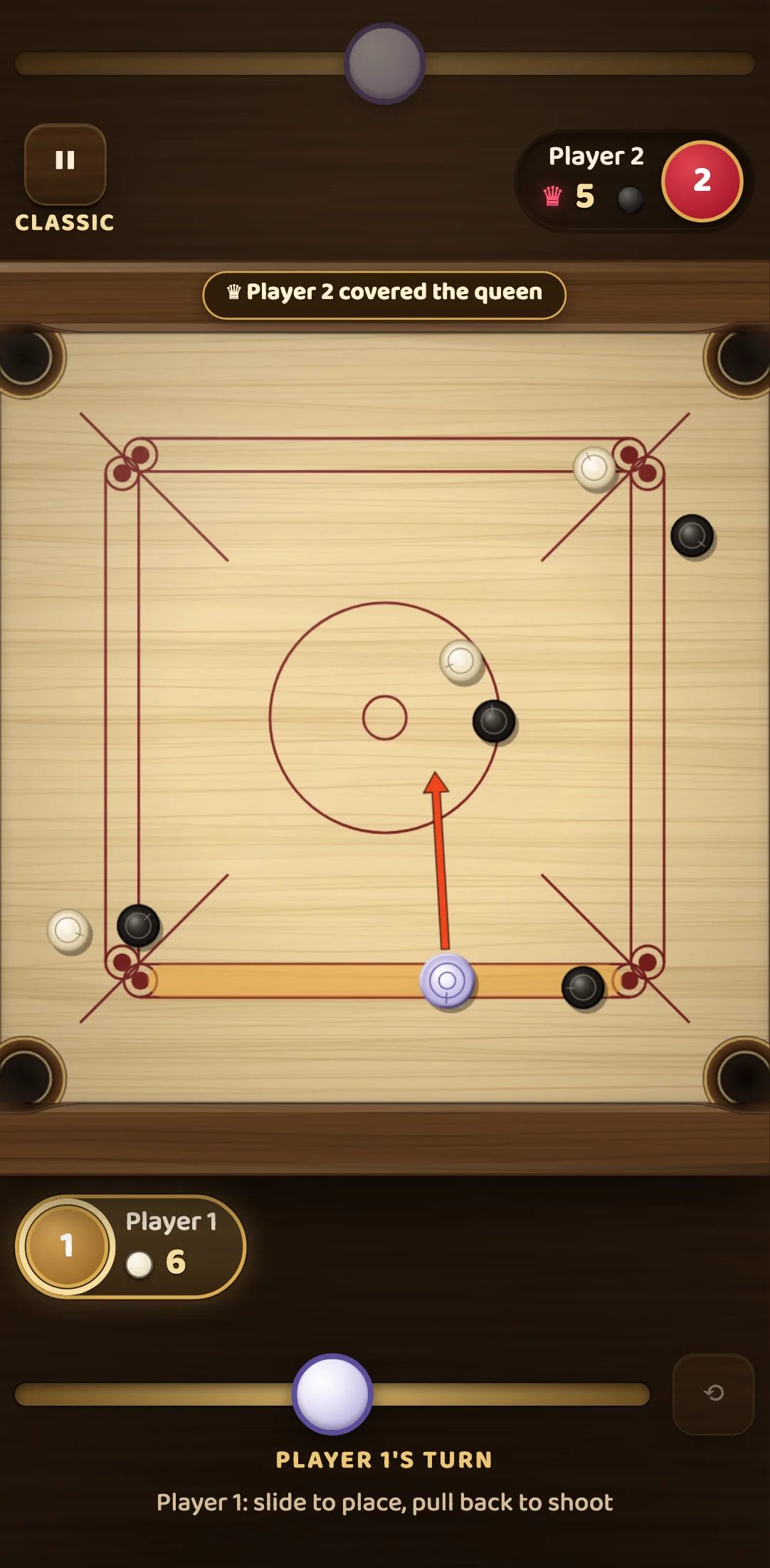
In the first picture, Player 1 (white) has six coins down and Player 2 (black) has five plus the covered queen. Look at white’s coins: one is pressed into the top-right corner area, one sits against the left cushion, one is in the middle, tucked next to a black coin. There is no straight pot for white at all.
Black, on the other hand, has two coins that are easy from the top baseline. Measured with the Expert bot’s own position estimate, which assumes a player who aims to within about half a degree, black’s two best pots were near certain: about 99 percent and 95 percent.
So we let the Expert bot choose white’s stroke from this position, and it chose a safety: a firm, almost straight stroke from just right of centre into the white coin in the middle.
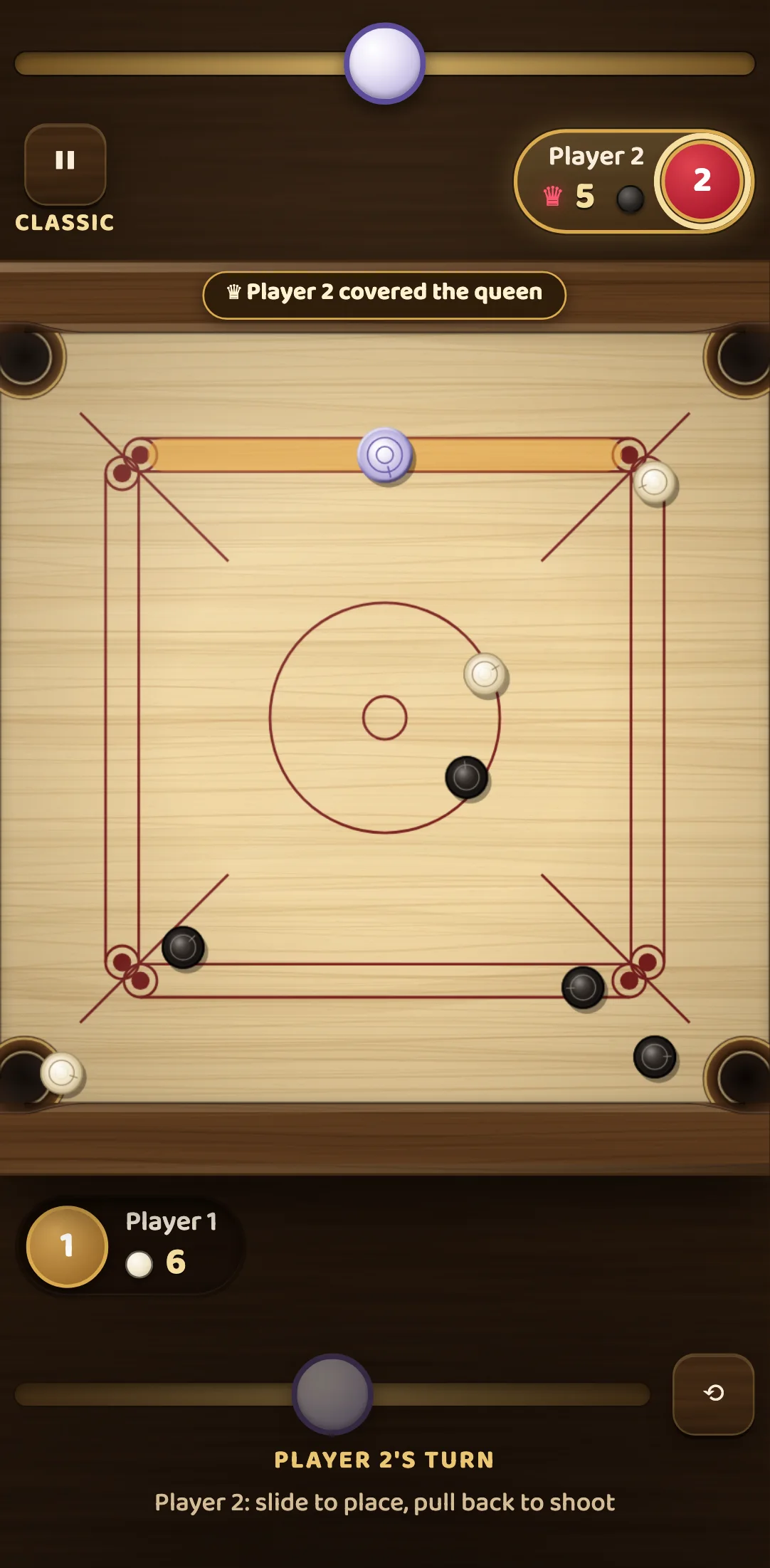
After the stroke, nothing was potted and the turn passed, but the position is very different. The coins in the middle were broken up, one black coin went down to the bottom-right corner, far from black’s baseline, and a white coin came to rest in the mouth of the bottom-left pocket. If black knocks it in, it counts for white.
By the same estimate, black’s best pot fell from about 99 percent to about 78 percent, and the second easy pot was gone. That is what a good safety looks like: you lose a turn you were going to lose anyway, and your opponent gets fewer and harder chances.
Safety habits that win boards
- Look before you settle for a long pot. A 40 percent pot that leaves their coins scattered if it misses is a fine shot. A 40 percent pot that leaves them two easy coins if it misses is often worse than a safety.
- Do not knock their coin towards a pocket. A coin of theirs that you push into a pocket stays down and counts for them. When you move a dangerous coin, move it along the cushion or back towards the centre, not into the corner.
- Watch out for clearing their coins. Once the queen is covered, potting your opponent’s last coin for them hands them the board. Late safeties must keep well clear of their final coins.
- You can shoot in any direction. Unless Tournament aiming is on in Settings, sideways and backward strokes are allowed.
How the Carrom bots decide to play safe
The bots in Carrom by 22Softwares do not have a separate “defensive mode”. Every bot simulates candidate strokes with the game’s real physics and scores each one by the rules, so safety comes out of the same scoring as potting.
On Easy, Medium and Hard, part of that score is what a stroke leaves. If the turn will pass, every opponent coin left within 9 cm of a pocket counts against the stroke. How much it counts depends on the bot’s personality. Vikram, the Defensive bot, weighs those coins 28 points each, more than twice as much as Arjun (Balanced, 12), and far more than Rani (Aggressive, 6). He also has the biggest penalty for fouls and plays slightly softer, which is why he is the bot most likely to pass up a risky pot. A stroke that touches nothing at all is marked down, so the bots prefer a safety that moves something. Hard is the exception in the other direction: it never passes up a pot it is likely to make.
The Expert bot has its own search, and safety is a real part of it. It first looks for straight and cut pots. If it finds one it is at least 60 percent sure of, it still tries a couple of safeties to compare. If it finds none, it looks harder: coins banked off a cushion, the striker off a cushion onto a coin (a kick), and combinations. Then it simulates up to 14 safety strokes, each either a bare touch or a firm knock straight at a coin, starting with the opponent’s coins closest to a pocket, plus firm strokes into the pack.
Each stroke is judged by what it leaves: the Expert assumes its opponent aims like a good player and counts the two best pots on offer to them. A pot attempt is scored with its miss in mind: a miss hands the opponent the position as it is now. That is the comparison this guide asks you to make.
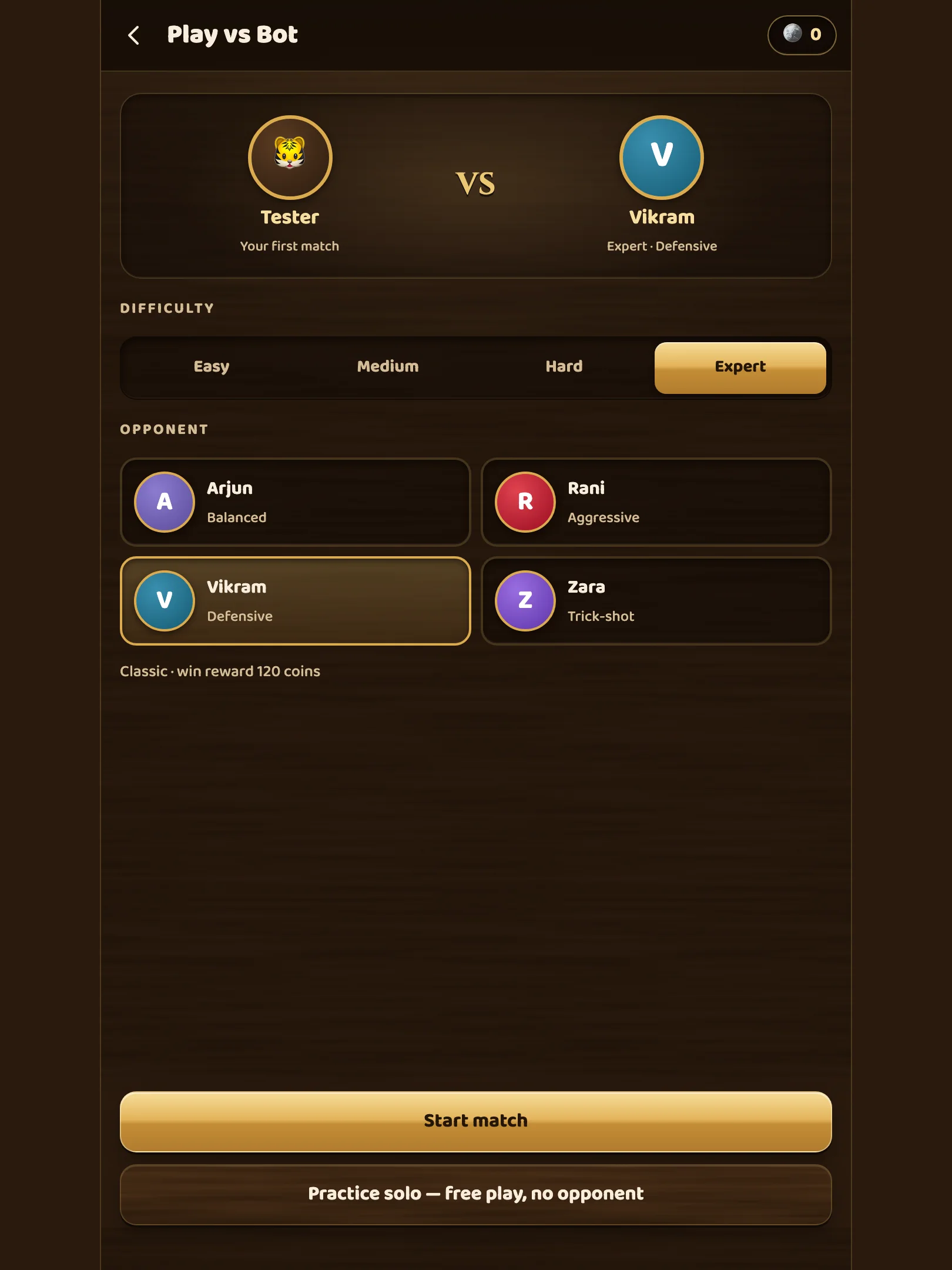
To practise, pick Vikram in Play vs Bot and watch what he does when he has no pot. Boards are won as much by the turns you give away well as by the coins you pot.
Facts checked with the Carrom by 22Softwares team against the game’s rules engine.