
Every Classic board starts the same way: nineteen pieces packed into the centre circle and one player with the striker on their baseline. The first stroke, the break, is the only shot in carrom you can practise from exactly the same position again and again. That makes it a good place to stop guessing.
This guide explains how the rack is built, who breaks, what the rules say about the first stroke, and how power and striker position change what happens. To give real numbers instead of folklore, we fired 12,000 simulated breaks through the same physics that runs Carrom by 22Softwares and counted the results. Clubs differ in small details, but the ideas carry over to a wooden board.
How the coins are racked
The queen sits on the centre spot. Six coins touch it in an inner ring, and twelve more make an outer ring around those, so the whole rack is a tight hexagon. White and black alternate all the way round, nine of each.
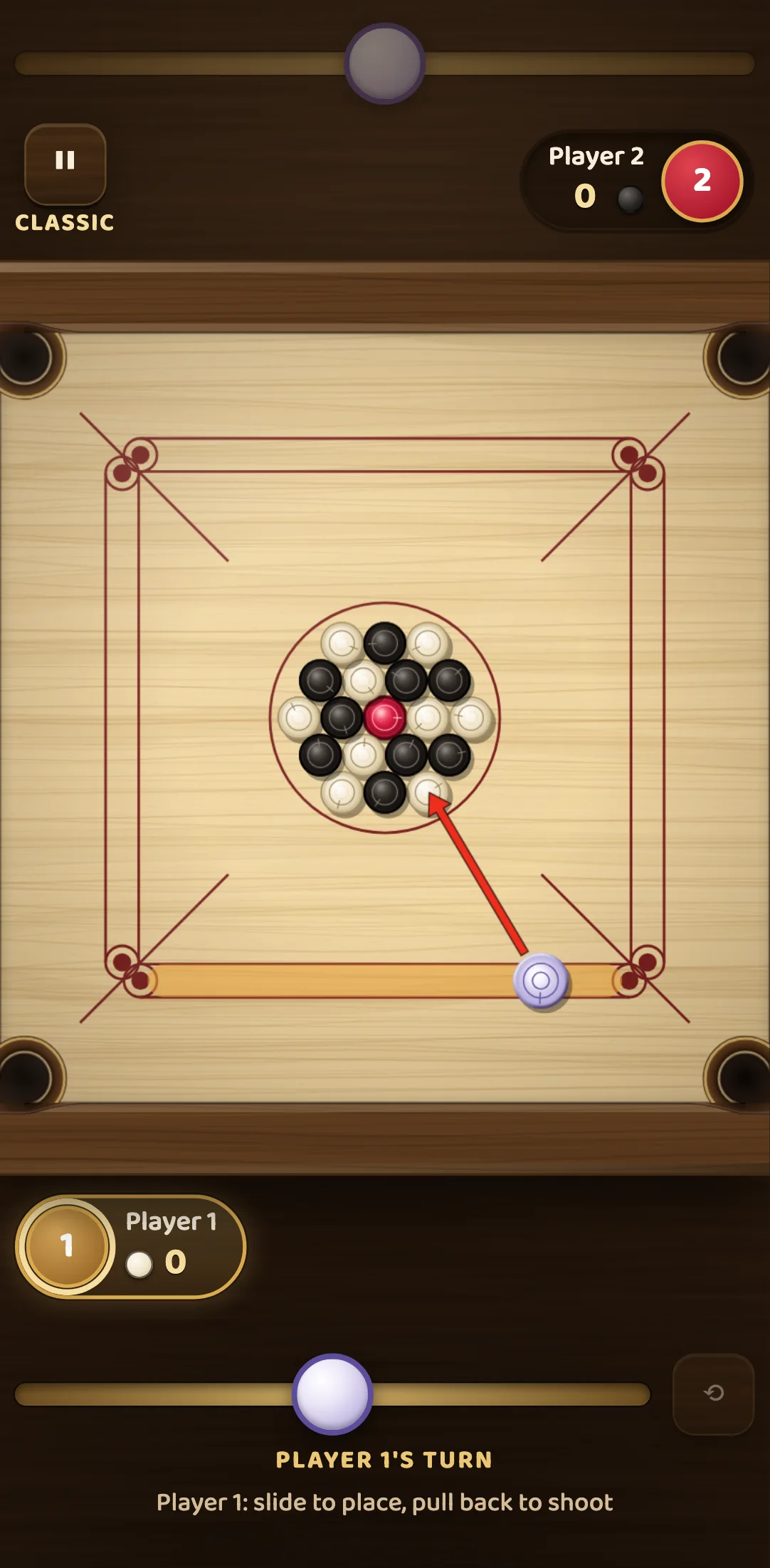
Look closely at the side of the rack facing you. In the game’s layout, the outer coin straight in front of the breaker is a black coin, and the whites in the outer ring sit on the diagonals either side of it. The queen is buried two layers deep. That detail matters more than it seems: a straight shot up the middle meets an opponent’s coin first, and nothing you hit can reach the queen directly.
Who breaks, and what the rules say
In Classic, the player with the white coins breaks. In the 29 Game the break moves round the table: each new board is broken by the player after the last breaker, and whoever breaks plays white for that board.
There is no special rule for the break. The first stroke is judged like any other:
- Pot one of your own coins and you shoot again.
- Pot an opponent’s coin and it stays down and counts for them. It is not a foul, but your turn ends.
- Pot the queen and you must cover it on your next stroke by potting one of your own coins. A coin that drops in the same stroke as the queen does not cover it.
- Pot the striker or knock it off the board and it is a foul: the coins you potted with that stroke come back. On the break you have no coins yet, so there is nothing more to pay.
- Miss everything and the turn passes.
You may place the striker anywhere along your baseline, up to about 21 cm either side of centre, as long as it does not overlap a coin and does not cover the corner arrow. It may cover the end circle.
What 12,000 breaks taught us
We tried five striker spots (the centre, and 4, 9, 15 and 21 cm to one side), three aim points (the centre of the rack, or 1.4 cm or 3 cm across it), and four power levels (40%, 60%, 80% and full). Each combination was fired 200 times with a little random wobble in aim and power, the kind of error a steady hand still makes. These are simulations on the game’s own physics, not records of real matches.
1. The break rarely pots anything. At 40% and 60% power, almost nothing went down. At 80%, about one break in a hundred dropped a coin, and it was always the opponent’s. Even at full power, we averaged one own coin every 25 breaks or so, and one opponent’s coin every ten. The rack in this game is tight and the pockets are small, so a pot on the break is a bonus, not a plan.
2. Full power often helps the other side more than you. Across all the full-power breaks, black coins went down more than twice as often as white. Some setups were worse: one off-centre aim potted roughly one black coin every two breaks and never a white. The rack’s layout is a likely reason: the coin in front of you, and the ones your striker meets first, are often black.
3. The queen did not drop once. Not in 12,000 strokes. The rack protects it, so forget about a queen on the break.
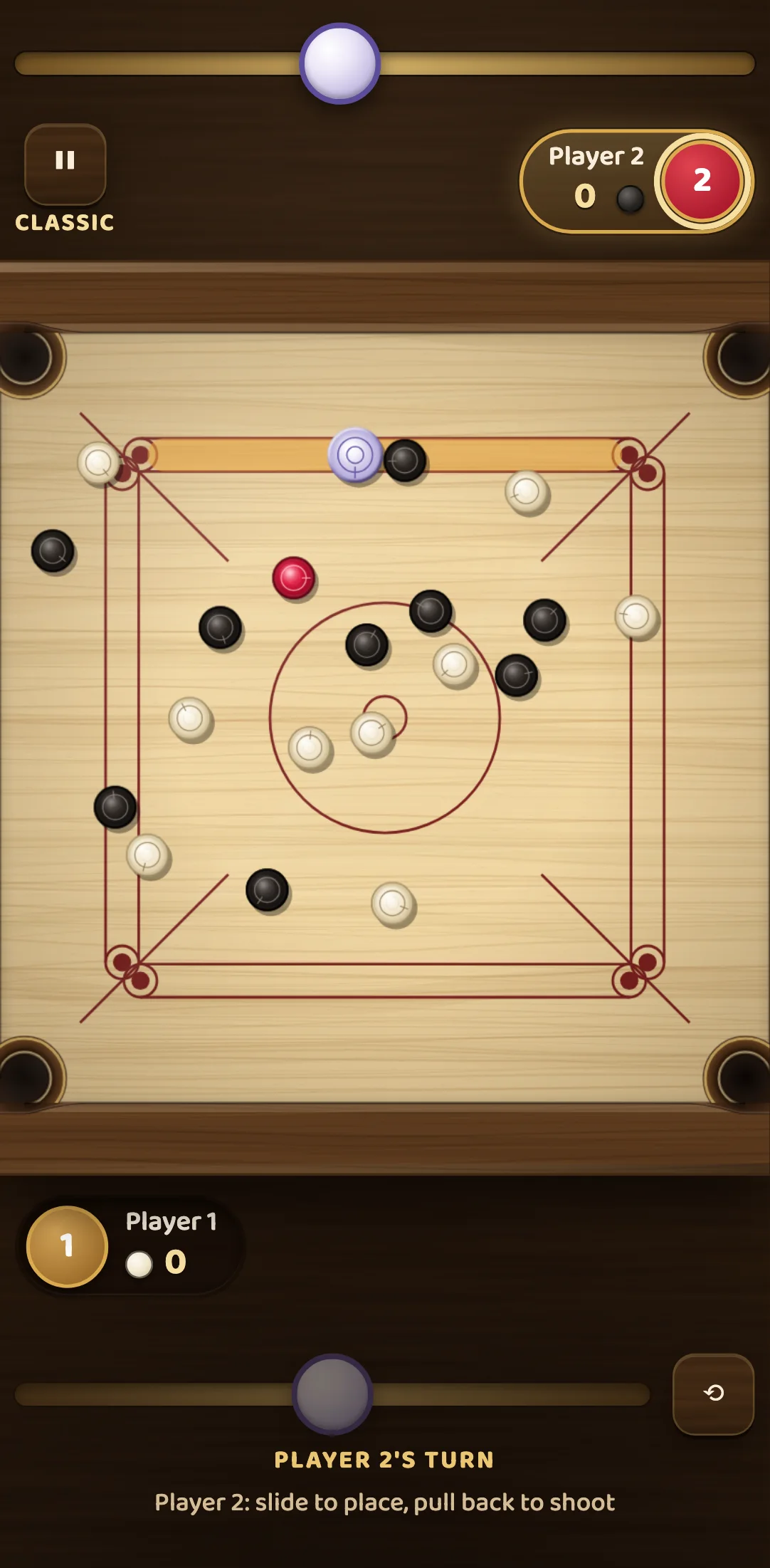
4. Power decides how open the board is. At the start, the pieces sit on average about 6 cm from the centre. After a 40% break they averaged about 9 cm; after full power, about 20 cm, which is most of the way to the baselines. That spread is the real result of your break.
5. Nobody fouled. None of the 12,000 breaks pocketed the striker or sent it off the board. The cushions keep it in.
So what should you aim for?
Since a pot is unlikely, the useful question is: what will the board look like for my opponent?
Hit hard if you want an open game
A full-power break scatters everything. Coins end up near all four pockets, including the ones your opponent will shoot at. That favours whoever pots better from open positions. Against a weaker opponent, or a bot on Easy, an open board is usually good for you.
Hit soft if you want a closed game
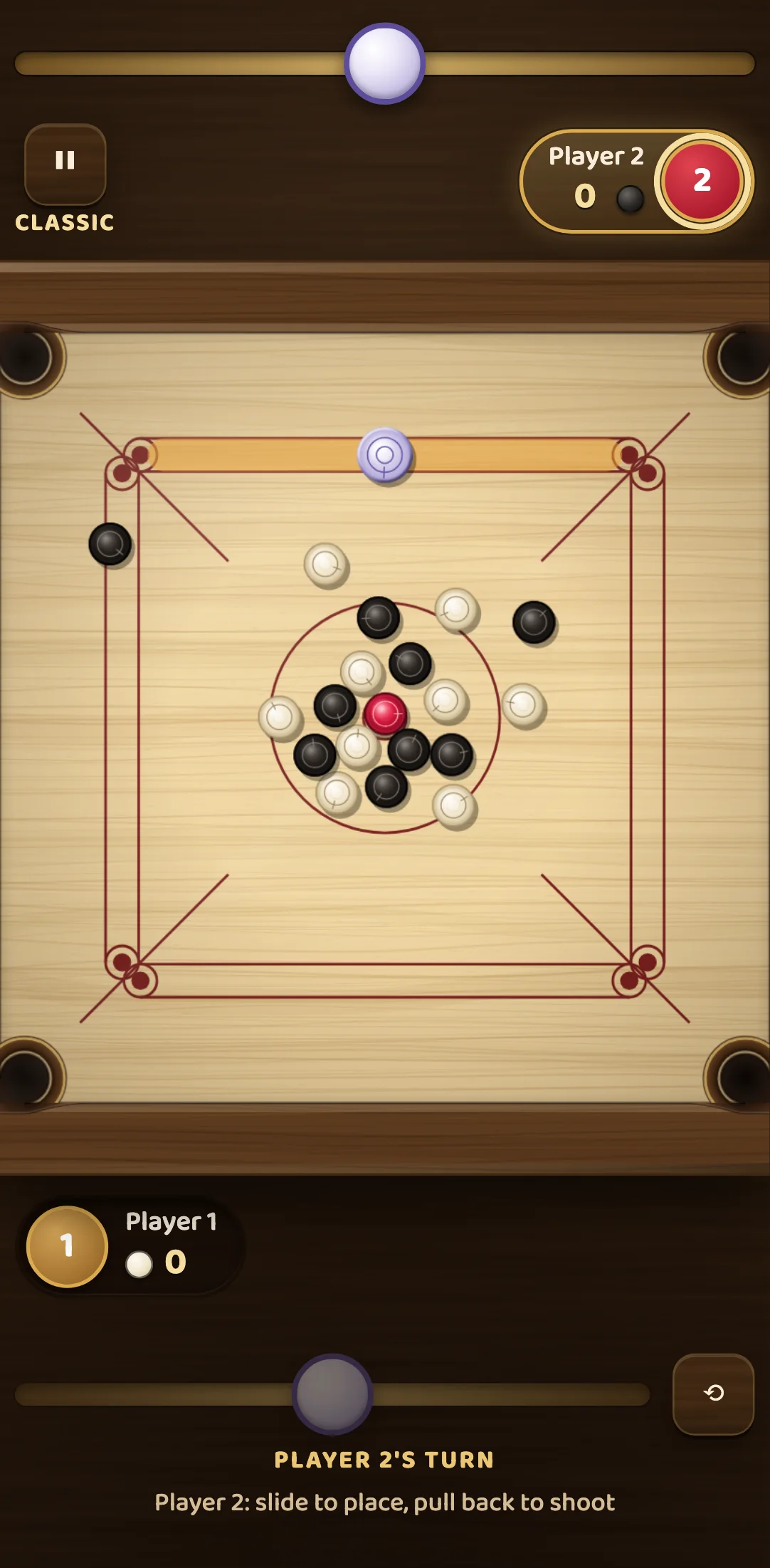
A soft break barely opens the rack. In the screenshot below, a 40% stroke straight up the middle left most coins bunched in the centre circle. Your opponent then has to break it up for you, with little to pot. This is a defensive choice, and it suits careful players.
Move off the centre line
The most obvious full-power break did worst: straight up the middle at the centre of the rack, it potted nothing at all. The best own-coin results came from wide spots. From 15 cm to the side, aimed at the rack’s centre, a white coin dropped in about one break in eight, with no black coins at all; from the far end of the baseline, aimed a little across the rack, it was close to one in four. Small changes in aim moved these numbers a lot, so treat them as a direction to explore, not a fixed recipe.
Don’t fear a quiet break
If your break pots nothing, you have lost nothing except the turn, and the rack is still mostly in the middle. A break that drops two black coins is worse than a break that drops nothing.
How the computer players break
The bots in Carrom by 22Softwares make the same choice in their own way. On Easy, Medium and Hard there is no special break routine: alongside their pot attempts, every bot always considers a few firm “spread” strokes aimed at the middle of the pieces from several baseline spots. On a fresh rack, where clean pots are rare, those firm strokes are the break they have.
Expert does have a dedicated opening. On a fresh rack it adds hard breaks from spots near the middle of its baseline, aimed at the rack’s centre or a little to either side, and simulates each one along with its other options. Because a break is chaotic, it rechecks only its top two choices before picking one.
A short practice routine
- Start a pass-and-play Classic game and play only the break, then start again.
- Try three spots: the centre, halfway to the corner, and as wide as the baseline allows.
- At each spot, try a soft break and a full-power break, and watch where the black coins end up.
- Pick the break that leaves your opponent the fewest easy pots, and use it in your next match.
The break will not win a board on its own. But if you know which kind of board you want to play on, it is the one stroke that lets you choose.
Facts checked with the Carrom by 22Softwares team against the game’s rules engine.