
A carrom board looks simple: a square of wood, four holes and some red lines. But every line is there for a reason, and once you know what each one does, you start to see shots you used to miss. This guide walks round the board one marking at a time, with the real numbers from Carrom by 22Softwares, the free game we build.
Board markings are much the same everywhere, but measurements and house rules vary between clubs and countries. The numbers here are the ones the game uses.
The playing surface
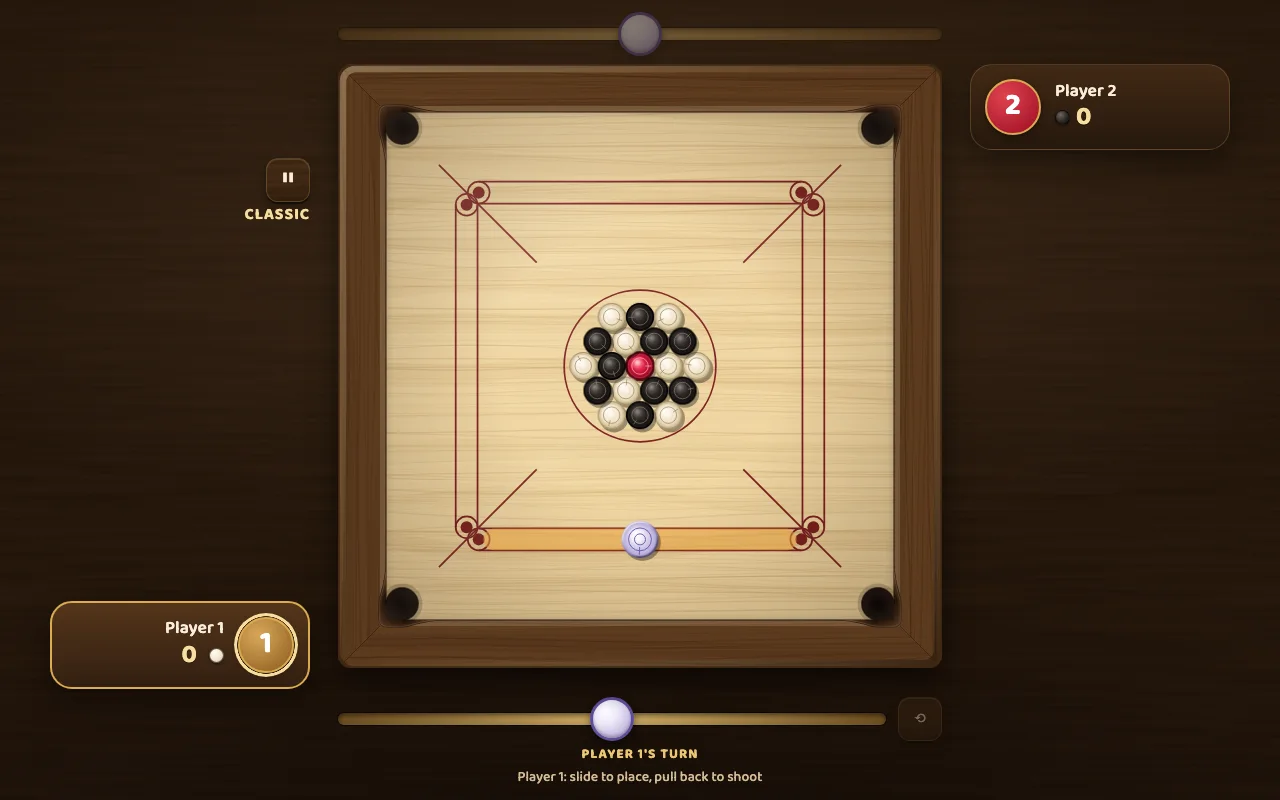
The playing surface is a square 74 cm on each side, the size of a tournament board, with a wooden frame drawn around it. Everything in the game is measured from the exact centre, which is where the queen starts.
The pieces and the centre circles are drawn 1.3 times larger than the regulation sizes. Real carrom pieces look tiny on a phone screen, and a coin you can barely see is a coin you cannot aim at. So a coin in the game is about 4.1 cm across instead of 3.18 cm, and the striker is about 5.4 cm across instead of 4.13 cm. The board itself and the baselines stay at regulation size.
The centre circles: where the game starts
There are two circles in the middle. The small one is the size of a coin, and it marks the spot for the queen. The large one, about 22 cm across in the game, holds the starting layout.
What starts inside depends on the game type:
- Classic, the 29 Game and Freestyle: the red queen in the middle, a ring of six coins touching her, and an outer ring of twelve. The colours alternate, so each side has nine.
- Disc Pool: the same layout without the queen.
- Tal Gach: all 19 pieces stacked in one tower in the middle.
The Daily Challenge is the exception: it sets out its own puzzle position each day.
The centre matters later as well. If the queen goes into a pocket and is not covered, she goes back to the exact centre. When a coin is returned to the board after a foul, it goes onto the line through the centre, about 12 cm out from the middle, and the next returned coin goes on the other side. So a returned coin always lands in open space, and often within reach of both players.
The baselines: where you shoot from
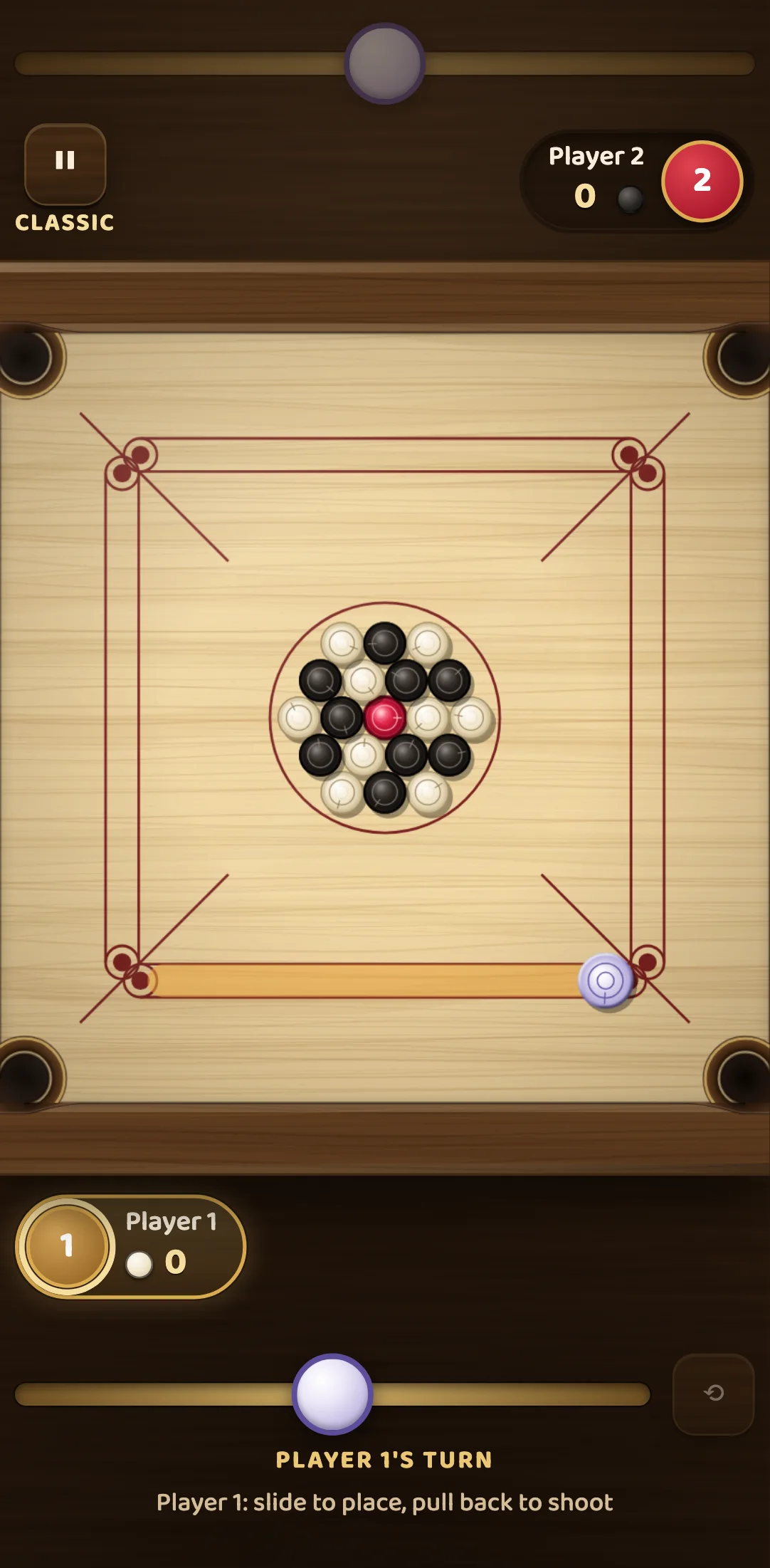
Along each side there are two parallel lines 47 cm long, 3.18 cm apart, with a red circle at each end. The outer line is about 10 cm in from the edge of the playing surface. Together the two lines are your baseline: the striker sits between them, and you place it again before every stroke.
Each player shoots from the baseline in front of them (in a two-player game you face each other), and the highlighted strip shows whose turn it is.
You can slide the striker anywhere along the baseline, with two limits. It cannot sit on top of a coin: if it would overlap one, the game moves it to the nearest free spot. And it cannot reach past the end of the baseline.
The end circles and the arrows
The red circle at each end of a baseline is about 3.2 cm across, the width of the gap between the two lines, and the striker is allowed to cover it. What it may not touch is the diagonal arrow line beyond it. In the game the striker’s centre can travel about 21 cm either side of the middle of the baseline, and it stops just before its edge would reach the arrow.
The ends are worth using: the furthest spot on your baseline often gives the best angle to a coin near the side cushion.
The four arrows run along the diagonals from just outside the big circle towards each corner pocket. They are guides, not rules for the coins. A coin can cross an arrow freely. But they are a handy reference for aim: a coin sitting on an arrow line is lined up straight with the corner pocket at the end of it. To send it in, the striker has to push it along the arrow, so the spot to hit is on the arrow line, just behind the coin.
The pockets: tighter than you think
There is a pocket in each corner, and in the game every pocket is 4.7 cm across, in every game type. A coin is about 4.1 cm across. That leaves only around 6 mm to spare.
This is tighter than a regulation board. With regulation sizes, the pocket is about 1.4 times as wide as a coin. In the game it is about 1.14 times as wide. Hitting the pocket dead centre is not enough on its own: the coin also has to arrive slowly enough to drop. A coin that arrives fast can catch the edge and bounce out.
The striker is too big to fit. At about 5.4 cm across it can never drop into a pocket: it rolls over the hole to the back of the pocket and stops. The rules still name the foul for potting the striker, but in this game it cannot happen.
The pocket jaws: why a near-miss can still drop
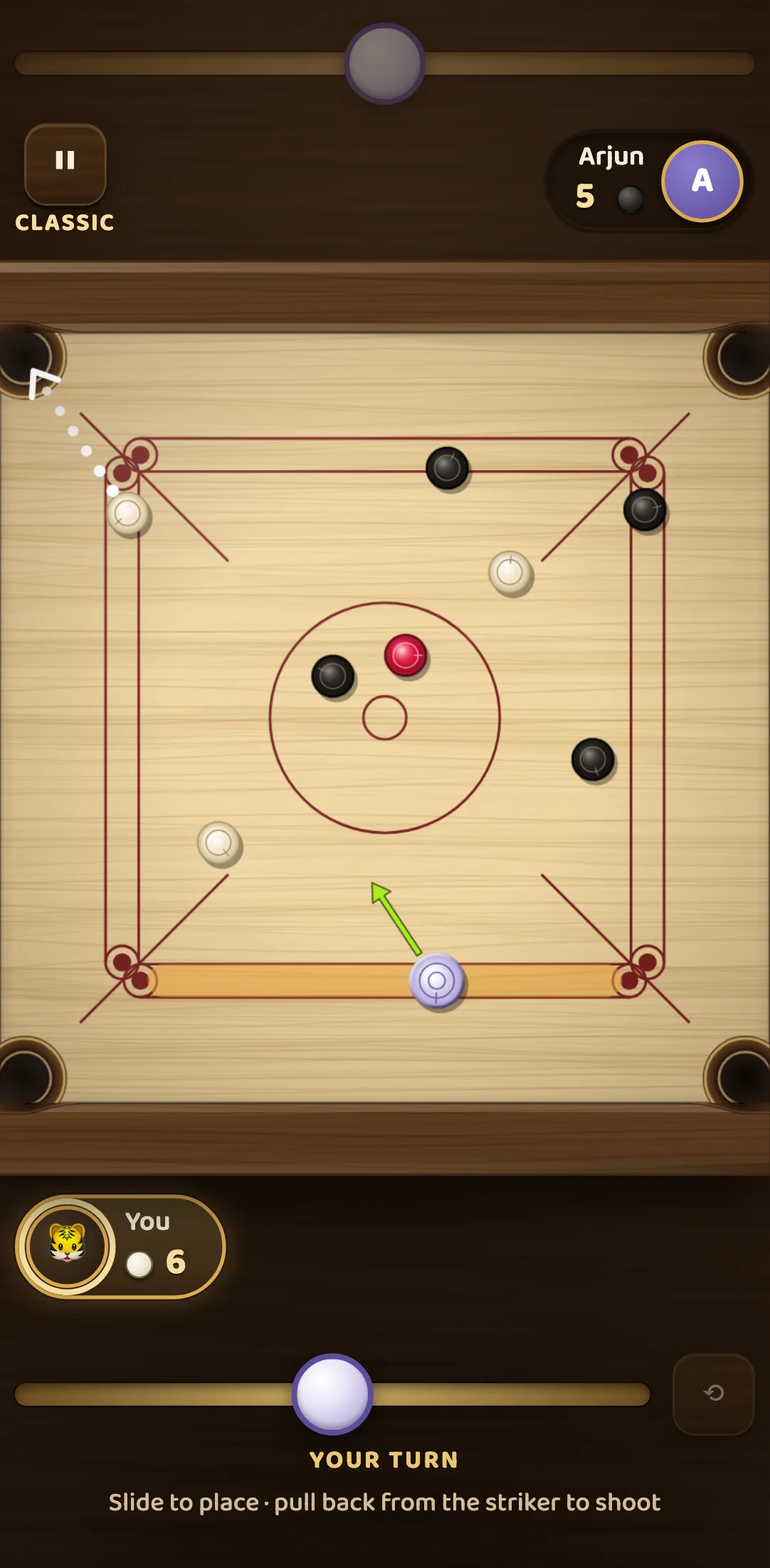
Where each cushion meets a pocket, the straight edge stops about 7 cm short of the hole and curves away into the frame. These curved sections are the jaws, and they are lined with leather.
The jaws are “dead”: a piece that hits one keeps only about a third of its speed. So a coin that arrives a little wide of the pocket does not ricochet back into the middle of the board. It loses most of its speed on the jaw, and either drops or stops close to the hole.
So a soft shot slightly off line is often still a good shot: if it misses, the coin usually waits at the mouth of the pocket.
The cushions: lively, but not too lively
The four straight cushions between the jaws are wood, and they behave like wood: the faster a piece hits, the less of its speed comes back. Measured straight into the cushion, a slow coin bounces back with about 72 percent of the speed it hit with, and a coin hitting at close to full power with about 60 percent.
The cushion also grips the piece a little, so a coin comes off spinning, and not quite at the perfect mirror angle. Treat a cushion shot as a good estimate, and keep it soft so a small error does not matter much.
Weight and friction: how far things travel
In the game the striker weighs twice as much as a coin: 15 g against 7.5 g. Regulation coins weigh about 5.5 g, but players found them too light (they flew off at a touch), so the game’s coins are heavier and the striker keeps more of its speed through them.
The surface plays like a powdered board: fast pieces lose speed quickly and slow ones glide on, and a full break settles in two to three seconds. At half power the striker moves at about 95 cm per second and takes under a second to cross the board, so half power is already a strong shot, and many pots need less.
Putting it together: a quick board check before each stroke
- Find your coins that sit close to a pocket, or on an arrow line.
- Slide the striker along the whole baseline, including the far ends, and look for the cleanest line.
- Pick a soft power. The pocket is tight, and a gentle coin either drops or stops at the jaw.
- If a coin is in the way, look for a cushion shot, and play it softly.
- Remember the centre: a returned coin or an uncovered queen comes back there.
Facts checked with the Carrom by 22Softwares team against the game’s rules engine.