
Most carrom boards are decided in the last few strokes, when each side has a coin or two left and the queen is still somewhere awkward. The endgame has its own rules and traps, and players who know them win boards they look like losing.
This guide is about Classic carrom as it is played in Carrom by 22Softwares. Every rule below is checked against the game’s own rules code, so this is how the app decides, not a house rule from somebody’s living room.
The one rule that shapes every endgame
In Classic, you win the board when all nine of your coins are down and the queen is covered. It does not have to be you who covered it. If your opponent covered the queen earlier, you only need your nine.
What matters most is the other half: nobody can finish while the queen is still in play. If you pot your ninth coin while the queen is on the board (or waiting for a cover), that coin comes straight back. The same goes for your opponent’s ninth coin. So in Classic every endgame is really a race to settle the queen. Coins come first, but the queen decides when the board can end.
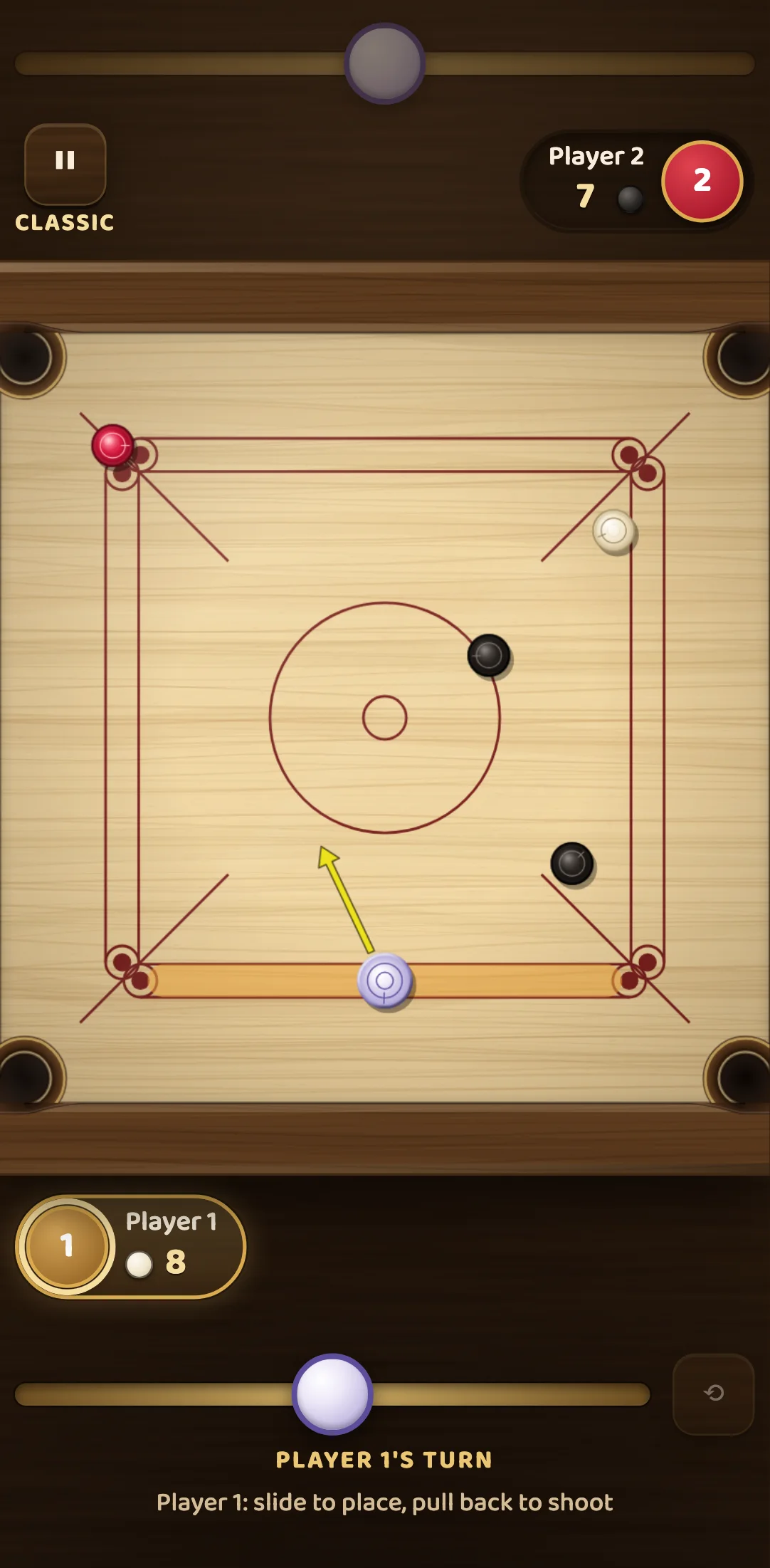
In the position above, Player 1 has eight coins down and one left, near the top-right corner. It is tempting to pot it. It would also be useless: the coin would come back and the turn would pass. The right target is the queen, sitting next to the top-left pocket.
Your last coin, potted too early
Here is what happens if you ignore the queen and pot the last coin anyway.
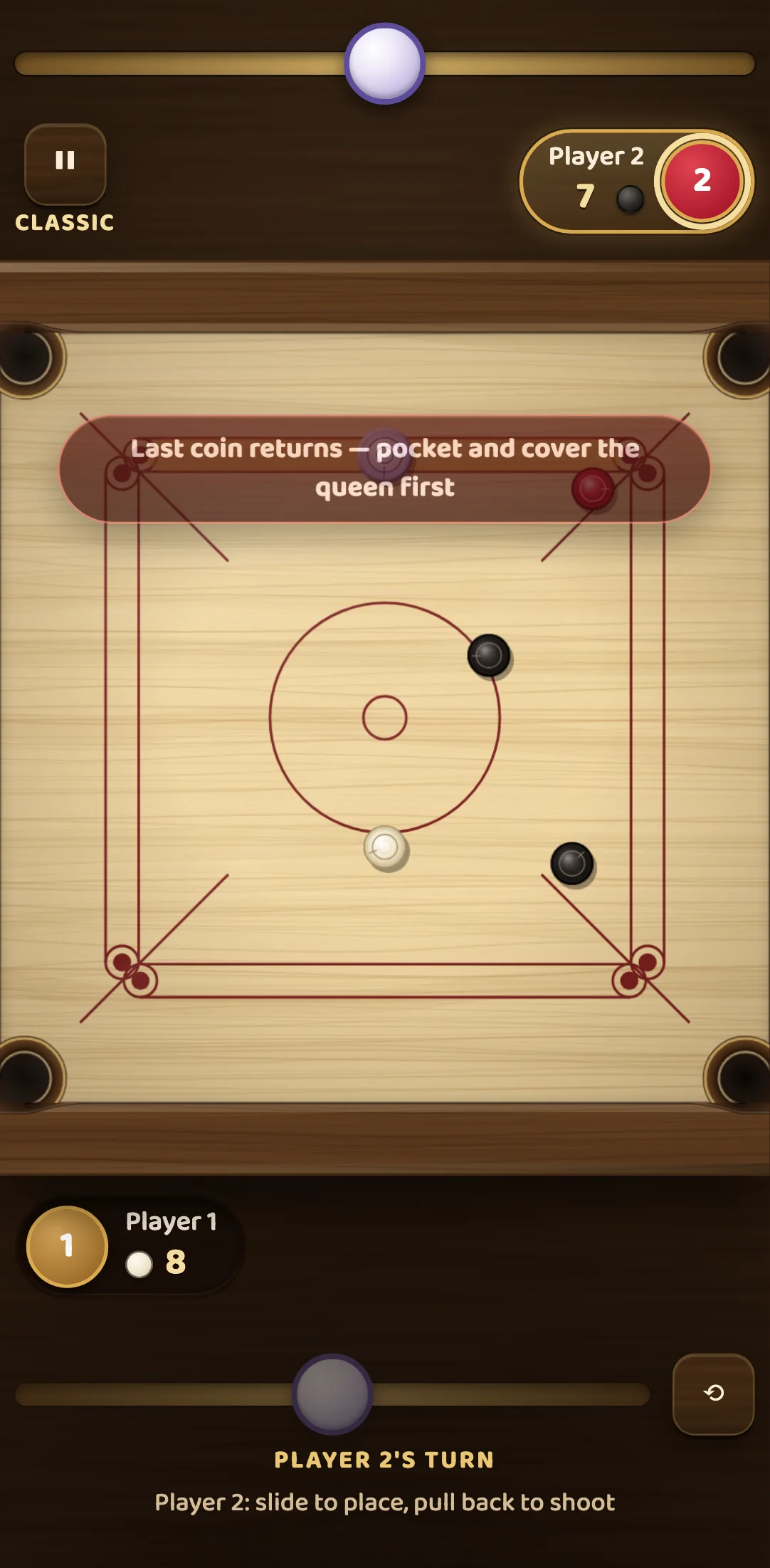
The game shows “Last coin returns — pocket and cover the queen first”. There is no penalty: none of your other coins are taken away. But the coin does not count, and because no coin was credited, your turn ends. You have spent a turn and handed your opponent the board.
Returned pieces go back on a line through the centre of the board. The queen always goes to the exact centre spot; a returned coin goes a short way off it, about 12 cm, and further coins step out alternately on either side. In the picture, the white coin now sits just below the centre circle, which is easier to reach from the baseline than its old spot in the corner. That is worth remembering when you are the opponent: a coin that comes back often comes back somewhere friendlier.
Three ways to finish
With eight coins down, there are three ways to win the board:
- The queen is already covered. Pot your last coin and the board is yours.
- Pot the queen, then the coin. Pot the queen and you keep your turn. On the very next stroke you must pot a coin of your own to cover it. If that coin is your ninth, it covers the queen and wins the board in one go. If you miss, or foul, the queen goes back to the centre.
- Pot both in the same stroke. Normally a coin pocketed in the same stroke as the queen does not cover it; you still need a coin on the next stroke. Your last coin is the exception: queen and last coin together cover the queen at once and finish the board.
Option 2 is the one you will use most. It means you should plan the queen and your last coin together. Before you pot the queen, look at where your last coin is. If the queen goes in but your coin is buried behind the baseline, your cover attempt is a long shot, and a failed cover puts the queen back in the middle.
The trap: potting your opponent’s last coin
A coin of your opponent’s that you pot stays down and counts for them. Early in the board that is a nuisance. In the endgame it can lose the board.
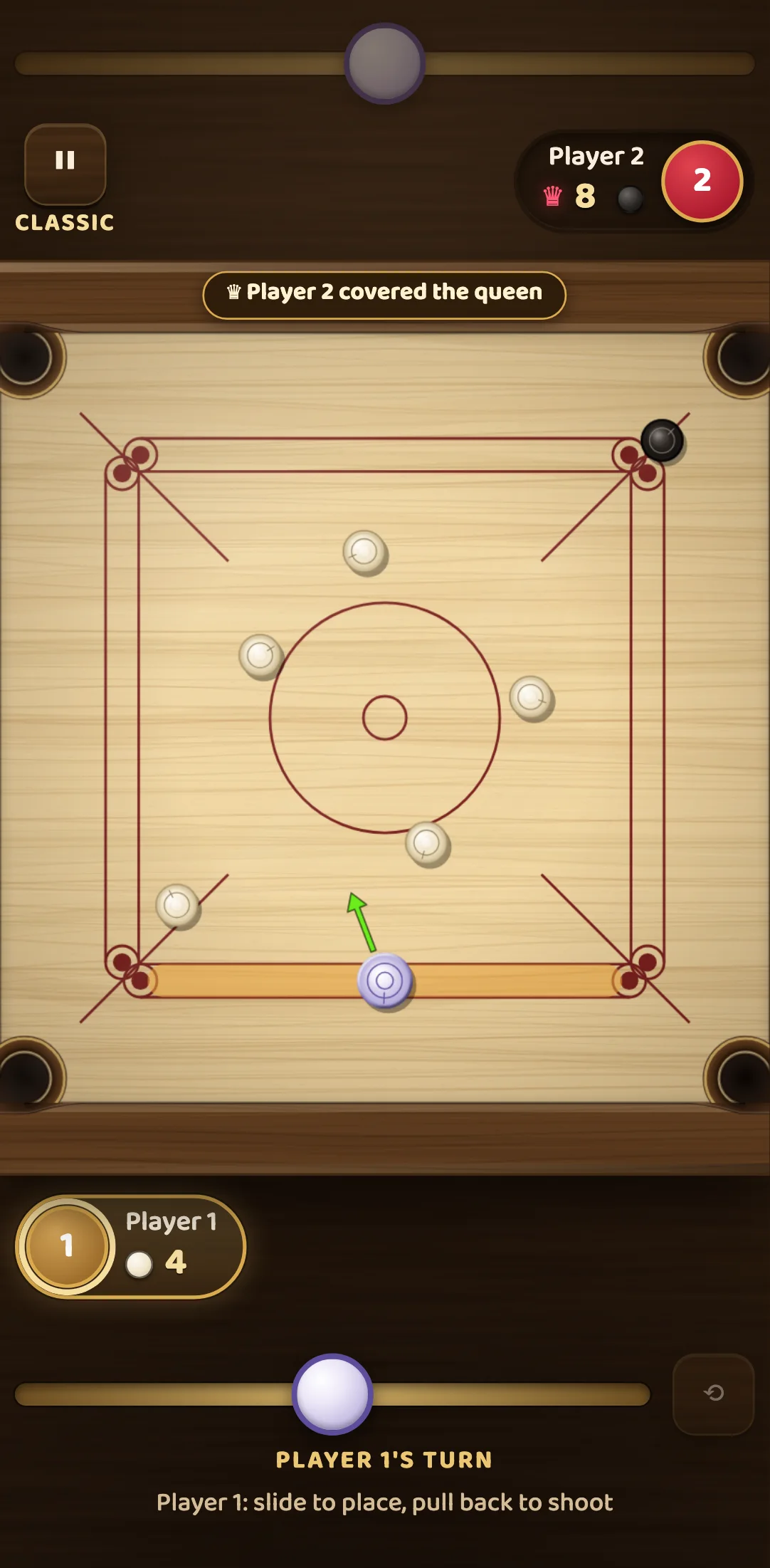
In this position Player 2 has covered the queen and has eight coins down. Their last coin is sitting in the mouth of the top-right pocket. If Player 1 knocks it in, Player 2 wins the board, even though it was not their turn. That is why Player 1 is playing a soft stroke away from that corner, at one of their own coins on the left.
While the queen is still in play, the game protects you a little: an opponent’s ninth coin that you pot goes back on the board, just like your own. Once the queen is covered, there is no protection.
There is one sneaky case worth knowing. Suppose you cover the queen, and the same stroke also drops your opponent’s ninth coin. The queen counts as covered before the board is checked, so their coin stays down, and the board goes to them. The only way that stroke still wins for you is if it also brings you to nine, because your own finish is checked first.
Fouls hurt more at the end
A foul is always bad, but late in the board it costs more than a turn. If your striker goes into a pocket or off the board:
- every coin you pocketed with that stroke goes back,
- a cover attempt fails, and the queen returns to the centre,
- one of your coins that was already down comes back to the board.
On eight coins, that sends you back to seven, with two coins to clear instead of one. In doubles, the penalty comes from your team: if you have nothing down, your partner’s coin comes back instead. A stroke that touches nothing is gentler: it ends your turn and nothing else.
So in the endgame, keep the stroke clean. Soft, accurate strokes are worth more than heroic ones.
A short endgame checklist
- Count the queen first. Is it covered? If not, nobody can finish. Your plan should include it.
- Look at your last coin and the queen together. Pot the queen only when your next coin is a reasonable cover.
- Do not waste a turn on your ninth coin while the queen is still on the board.
- Stay away from your opponent’s last coin once the queen is covered. Move it along a cushion or back towards the centre, never towards a pocket.
- Play soft. A foul on eight coins hands a coin back.
- You can shoot in any direction, unless Tournament aiming is switched on in Settings. A sideways or backward stroke is often the safest way to reach the queen.
How the bots handle the endgame
The Easy, Medium and Hard bots have no special endgame mode. They simulate each candidate stroke with the game’s real physics, run it through the same rules you play under, and score it: a big bonus for a stroke that wins the board, a bonus for covering or potting the queen, a penalty for sending it back. A stroke that only returns their last coin earns nothing, so they go for the queen instead. The Expert bot has its own deeper search, built on the same rules.
A note on the 29 Game
The 29 Game uses Classic’s boards with one change at the end. If you pot your last coin while the red queen is still on the board, the coin is held out and you play on for the queen. Pot the queen and the coin comes back to the centre for you to cover it with. Miss, and the coin comes back and the turn passes. When a board ends, the side that cleared its coins scores a point for every opposing coin still on the board, plus 5 for the queen if it covered it (only while it has 23 points or fewer). That makes a fast, clean finish worth even more.
Carrom scoring: the 29 Game and Tal Gach explained
Facts checked with the Carrom by 22Softwares team against the game’s rules engine.