
An opening is only useful if you know why the moves are played. chessGM’s opening courses are written around that: every move comes with its reason, and you watch a line, play it yourself, then take a quiz. The catalogue has 40 opening courses today: 28 fully explained courses, which are the ones on the Openings page with their variations, traps, key ideas and quiz, and 12 line-practice courses (“Learn 5 new lines” style) for gambits and Sicilian systems such as the Englund, Danish and Evans Gambits, the Smith-Morra, the Alapin and the Sveshnikov.
Who this is for
Players who have learned the opening principles and now want a repertoire. The opening courses start at about level 900 (the London System and the Italian Game) and go up to about 2100 (the Sicilian Najdorf).
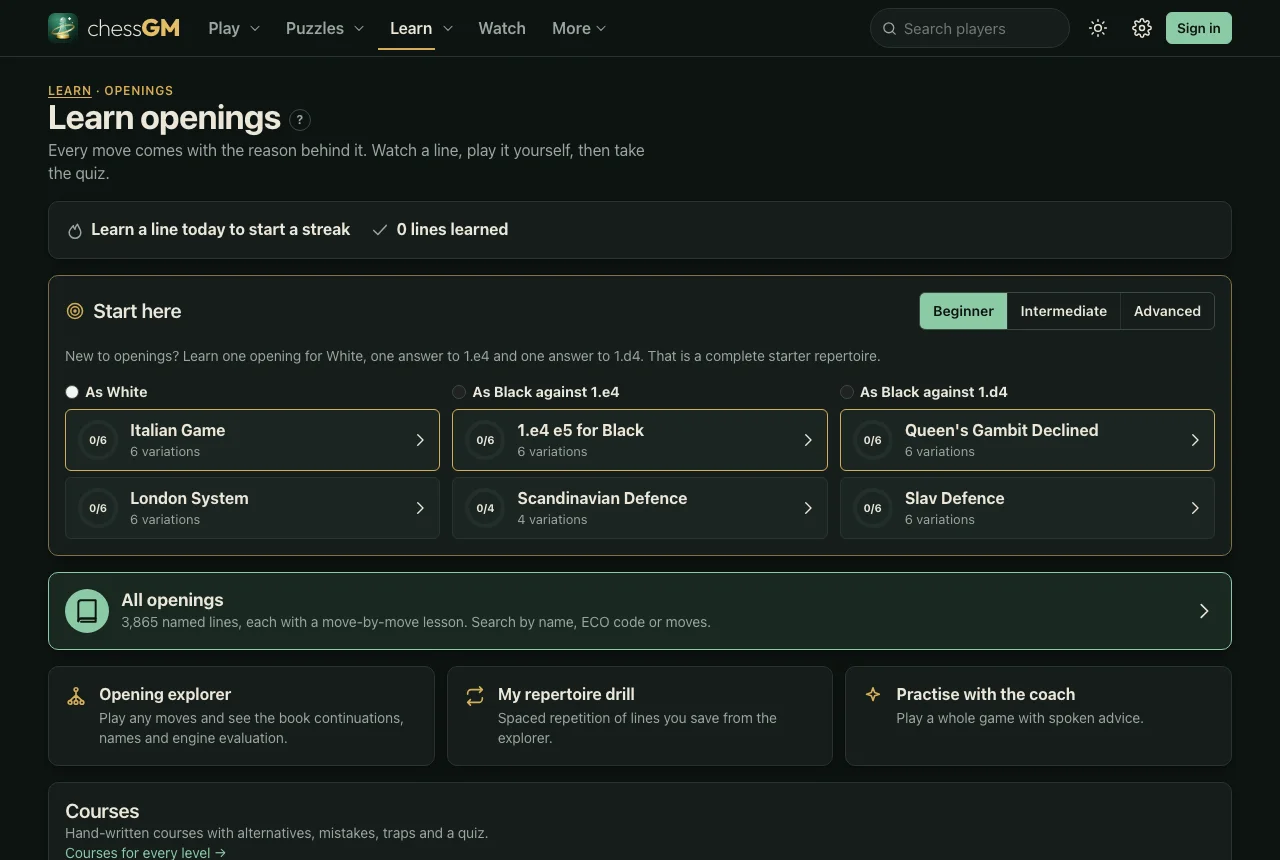
A first repertoire
The Openings page recommends one opening as White, one answer to 1.e4 and one answer to 1.d4. For beginners it lists the Italian Game and the London System as White, the 1.e4 e5 defence and the Scandinavian Defence against 1.e4, and the Queen’s Gambit Declined and the Slav Defence against 1.d4. You do not need all six: pick one in each of the three groups.
What an opening course looks like
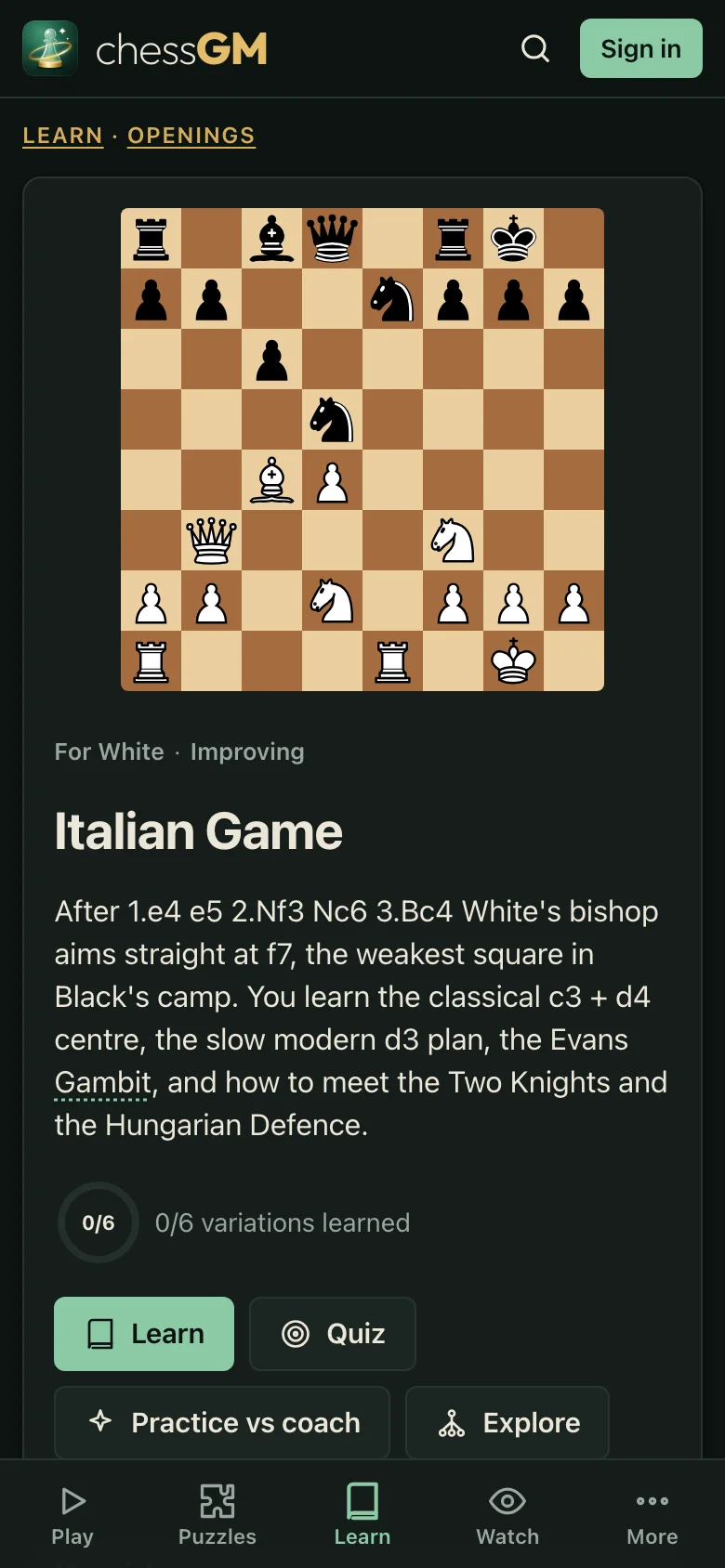
Take the Italian Game as an example. The course page gives a short description (White’s bishop aims at f7, the weakest square in Black’s camp), a list of key ideas, and then the main lines. The Italian Game course has six variations, three traps and 138 moves, and each line is a lesson of about 24 moves, of which about half are for you to find.
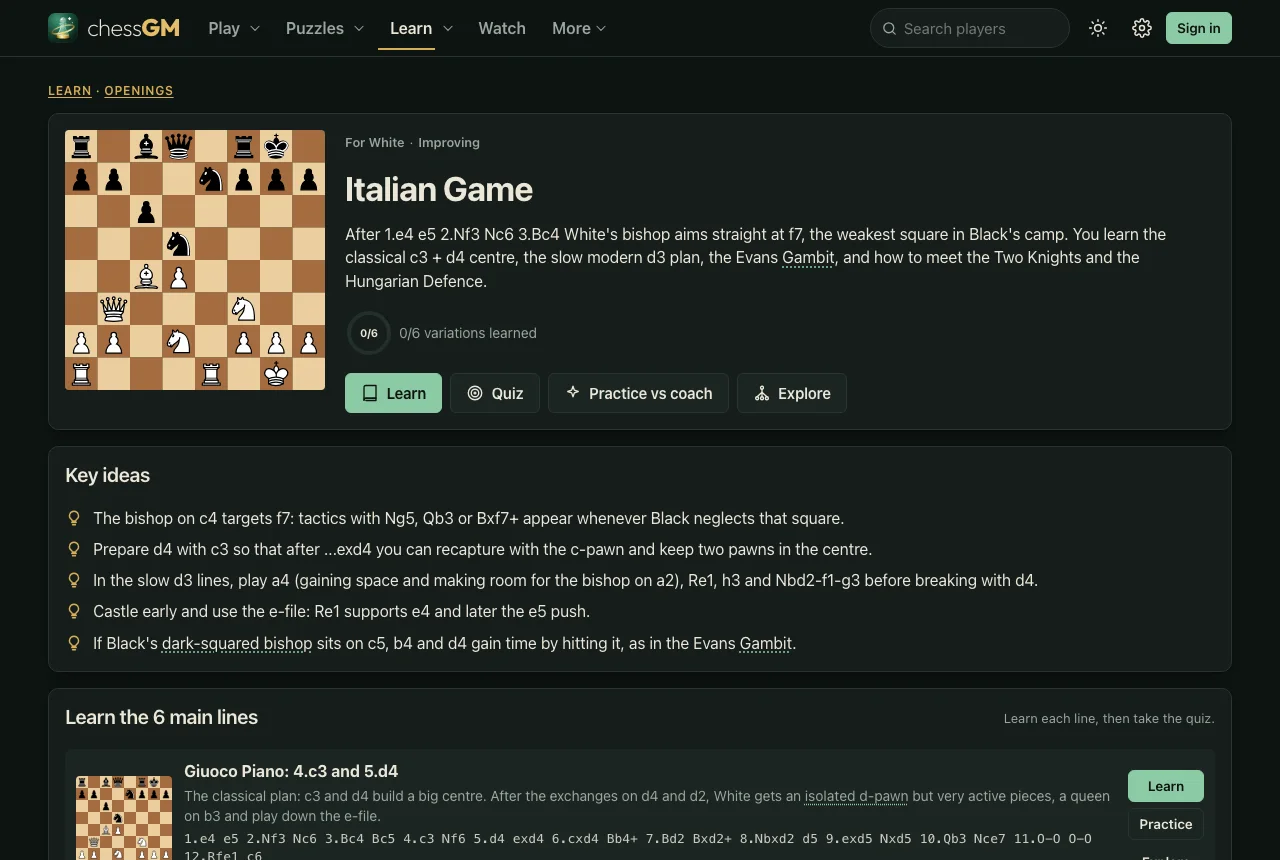
- Read the key ideas first. They are the plans in a few sentences: what the bishop on c4 aims at, why you prepare d4 with c3, when to play a4.
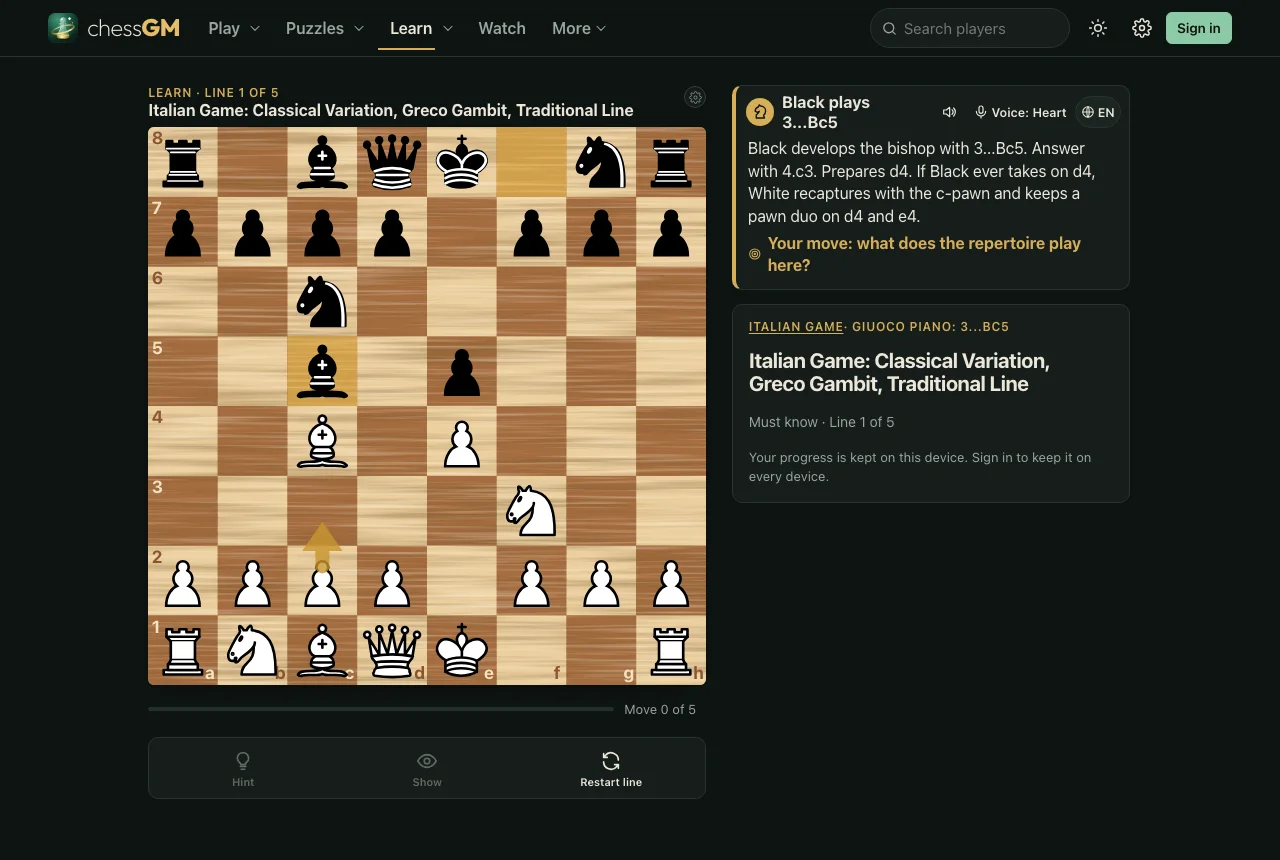
- Open a line and use Learn: the line is played move by move with an explanation of each, and from some points you have to find the move yourself.
- Look at the traps. Each course has a few, with the position and why it works.
- Take the quiz to see what stayed.
- Use Practice vs coach to play the line against the coach, or Explore to open the position in the explorer.
The explorer and the full list
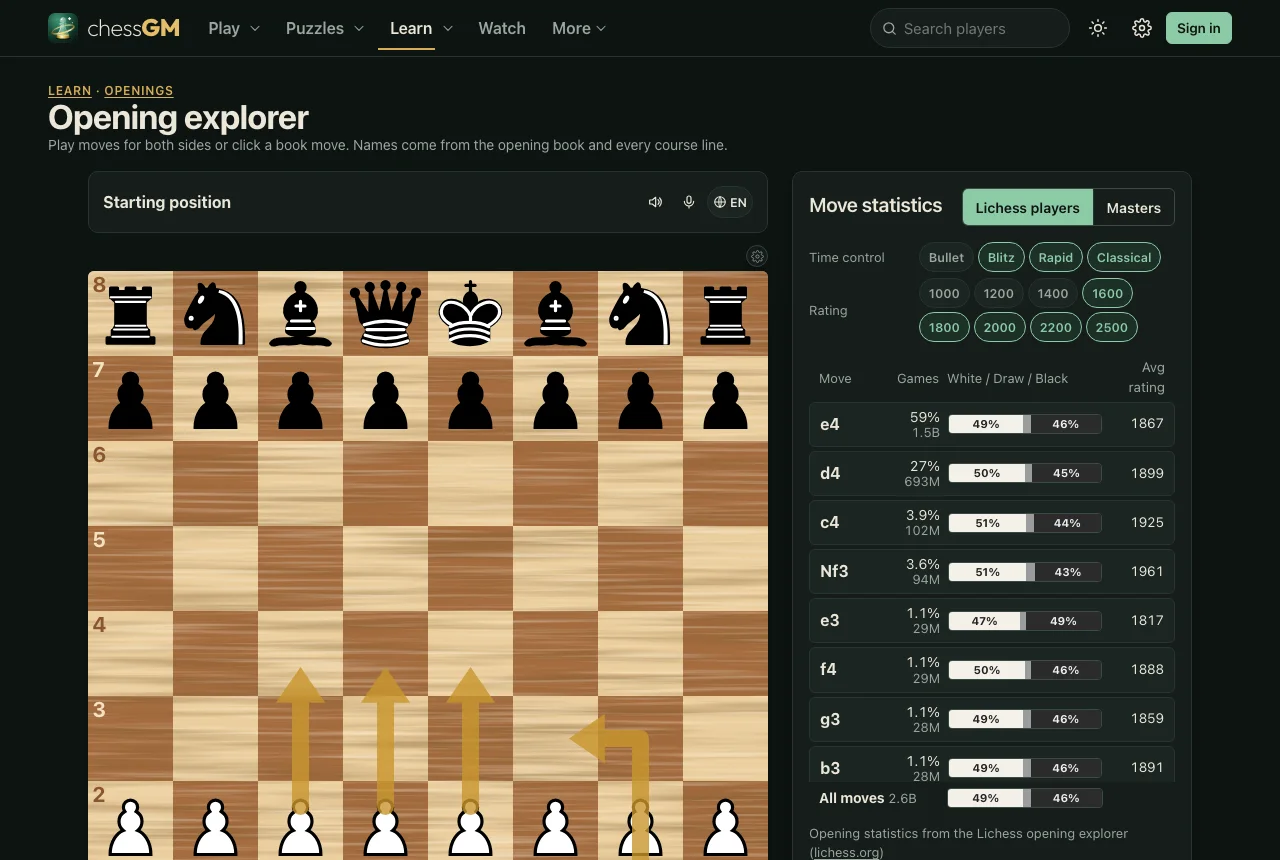
Beside the hand-written courses, the openings page has an All openings list with 3,865 named lines, each with a move-by-move lesson, which you can search by name, opening code or moves. The Opening explorer lets you play any moves and see the book continuations, their names and the statistics for them: the screenshot shows games from Lichess players and masters, with how often each move was played and how it scored.
There is also an opening review that uses spaced repetition for the lines you have learned, and a repertoire drill for lines you save from the explorer. Both are useful once you have a few openings.
How to choose
- Open, tactical positions: the Italian Game, the Scotch Game, the Vienna Game or the gambits in the list.
- Quiet, solid positions: the London System (the same setup against almost anything) or the Slav Defence.
- A sharp defence for Black: the Sicilian family. The list has the Dragon and the Najdorf as fully explained courses, and line-practice courses for the Accelerated Dragon, the Taimanov and Kan, the Classical and Scheveningen and the Sveshnikov, so you can start with one and move on.
- Choose what you enjoy. You will play it hundreds of times.
A realistic plan
- Learn one line a day, about ten minutes. Do not add a new opening until you can play the last one from memory.
- After a game, check which line you left and look it up. Your own games show which lines you need.
- Use the quiz and the review, not just the lesson. Looking at moves is not the same as remembering them.
- Keep to the plan behind the moves. When your opponent leaves the book, you are alone, and a plan beats a memorised move.
Common mistakes
- Learning ten openings. Learn one deeply.
- Memorising moves without the idea behind them. Read the key ideas first.
- Playing a sharp gambit before you know the traps from the other side.
- Never reviewing. A line you learned two weeks ago and never looked at again is mostly gone.
Our guide to building an opening repertoire
Screenshots and credits
Screenshots were taken as a guest on the live chessGM website on 22 October 2026 and show the real pages, not edited. The chess pieces in the lesson boards are by Colin M.L. Burnett (CC BY-SA 3.0), as credited on chessGM.
Written from the live chessGM site and its course catalogue on 22 October 2026. The course counts, names and lesson numbers are read from the catalogue; the study plans are general guidance, not coaching.