
If you have never played chess, the chessGM “Absolute beginner track” takes you from an empty board to your first checkmates, and on to a blunder check and a first repertoire, in thirteen short courses and 38 lessons. This article walks through them in order, says what each one teaches and explains how to use them.
Who this is for
Anyone who has not played, or who knows how the pieces move but forgets the special moves, stalemate or what a good trade is. The courses are marked “New to chess” and “Beginner” and are written for people meeting chess for the first time.
The thirteen courses
- The chessboard (3 lessons): the 64 squares, files and ranks, how every square gets its name, and where each piece starts.
- How the pieces move (6 lessons): the rook, bishop, queen, king, knight and pawn, one lesson each, collecting stars on the board.
- Capturing pieces (3 lessons): taking pieces, spotting a free piece, and why you should not grab a protected piece with your queen.
- Check, checkmate and stalemate (4 lessons): what check means, the three ways out of check, checkmate, and the stalemate trap.
- Safe pieces: protect, escape and check (3 lessons): short drills for your first games, on what to do when a piece is attacked, the three ways out of check, and how to give a check without losing the checking piece.
- Castling, promotion and en passant (3 lessons): the three special moves.
- Piece values and good trades (2 lessons): pawn 1, knight 3, bishop 3, rook 5, queen 9, and how to use the points.
- Basic checkmates (3 lessons): the two-rook ladder, mate with king and queen, and mate with king and rook.
- Stalemate and other draws (3 lessons): how stalemate turns a won game into a draw, how it can save a lost one, and the other ways a game is drawn.
- Opening principles (2 lessons): take the centre, develop your pieces, castle early, and the Scholar’s Mate and how to stop it.
- Scholar’s mate and quick traps (2 lessons): the fast checkmates and traps beginners meet in their first games, such as Fool’s mate, Scholar’s mate and the Fried Liver, and how to stop each one and how to punish it.
- The blunder check (2 lessons): a one-minute habit for every move. Is anything hanging, and what does my move allow?
- Your first repertoire (2 lessons): one small, complete set of openings for a new player, with the full course to take next named at each step.
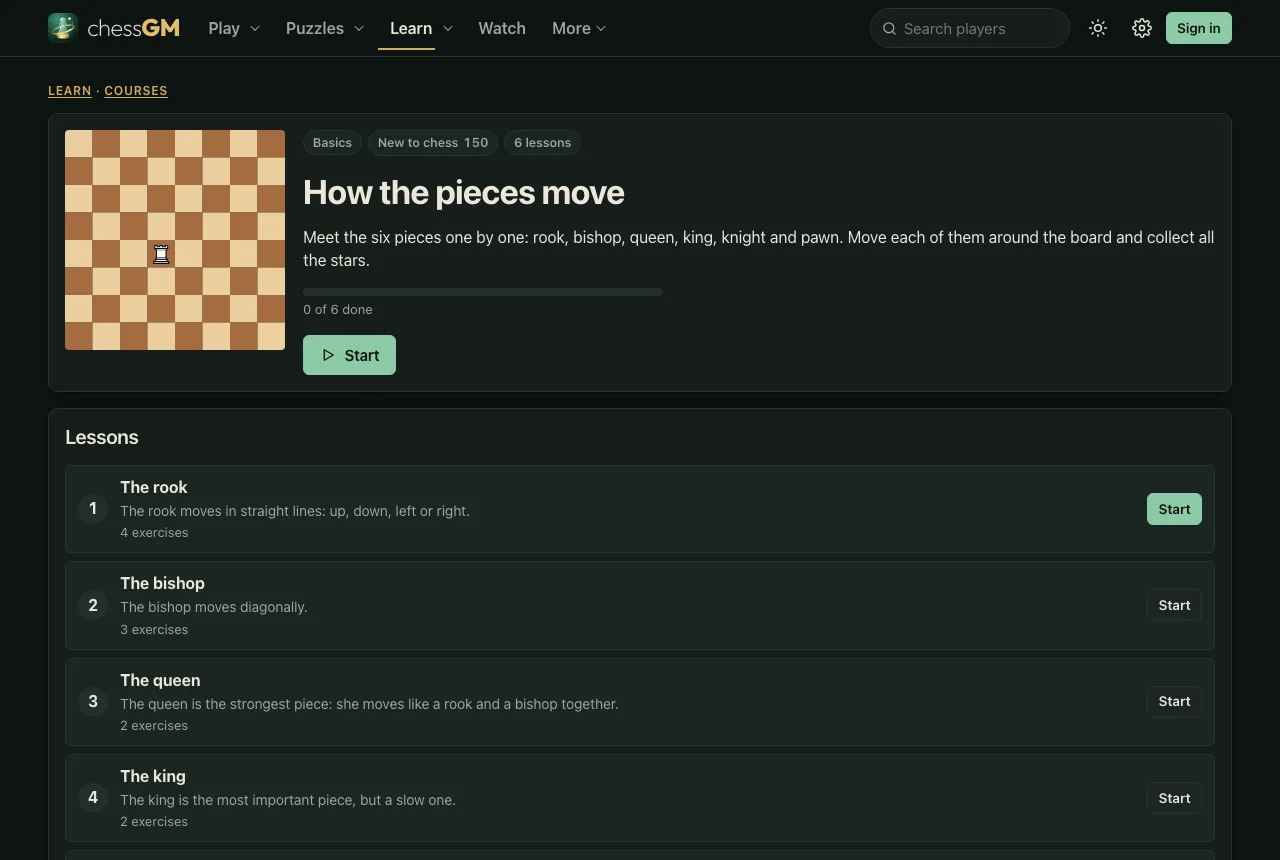
How the first lessons work
Open a lesson and the board shows the piece you are learning about. In the king lesson, for example, the squares the king can go to are shaded, the card on the right says that the king moves one square in any direction and that if your king is trapped you lose, and the steps list says what you will do: walk the king to the star, then collect all the stars. Diagonal steps save time.
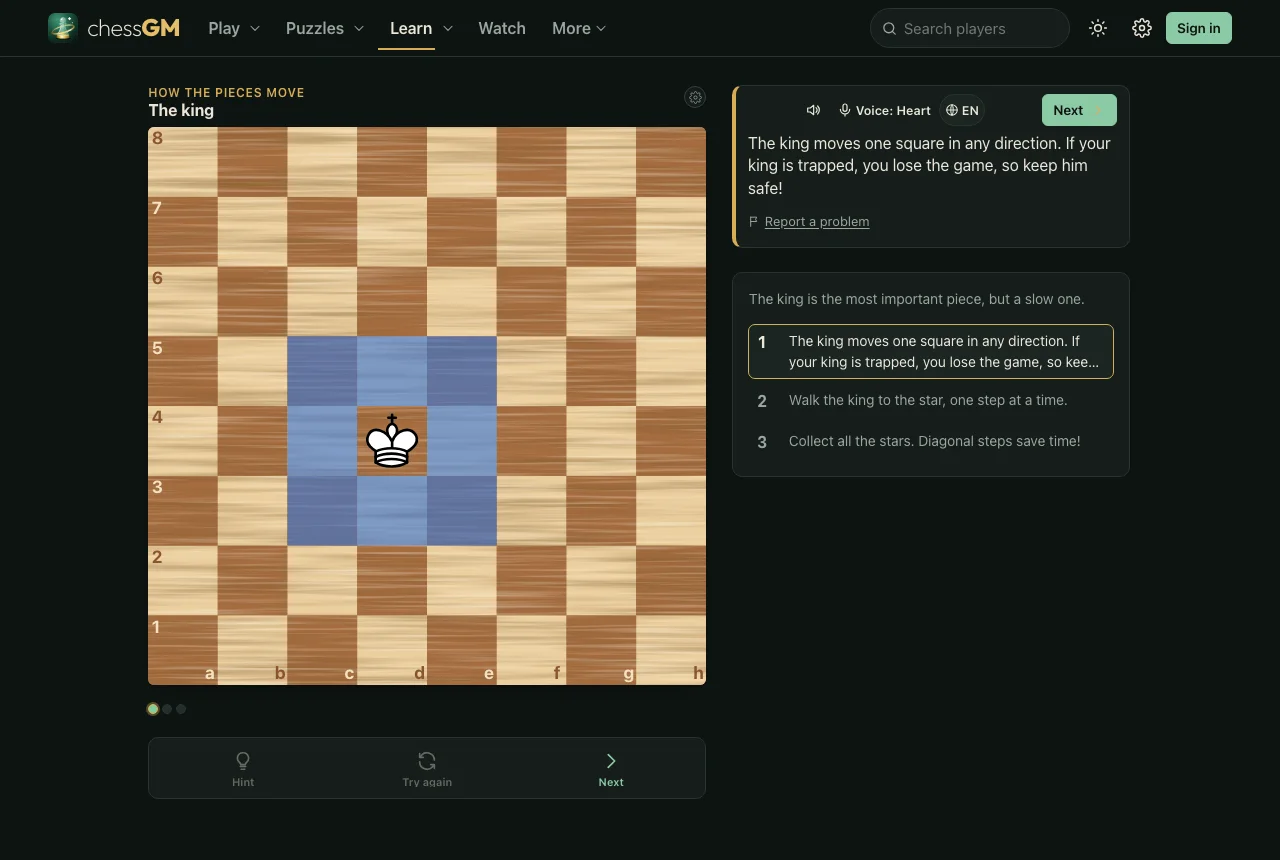
Each lesson has two to five exercises. You make the move on the board, and the lesson tells you if it was right. If you are unsure there is a hint, and you can try again as often as you like.
Why these courses are in this order
- The first three courses teach where things are, how they move and how they are taken, which is all you need to play a legal game.
- Check, checkmate and stalemate comes next because the aim of the game is checkmate, and stalemate is the first way beginners throw away a won game.
- The special moves are short and are best learned once the basics are not new any more.
- Piece values come after that because they only make sense once you know how the pieces fight.
- Basic checkmates teach you to finish a won game with a queen or a rook, which every player needs.
- Opening principles come next with three rules that give you a decent start in almost any game: centre, develop, castle.
- Scholar’s mate and quick traps teaches the fast checkmates that catch beginners, so that they stop working against you.
- The blunder check gives you a one-minute habit for every move, which saves more games than any opening trick.
- Your first repertoire closes the track with one small, complete set of openings and names the full course to take next.
A realistic first month
- Week 1: The chessboard, How the pieces move and Capturing pieces. One lesson a day, about ten minutes. Play on the board with a friend, or against the bots, as soon as you know the moves.
- Week 2: Check, checkmate and stalemate, then Safe pieces and Castling, promotion and en passant. Redo any lesson you found hard.
- Week 3: Piece values, Basic checkmates and Stalemate and other draws. Practise the queen and rook mates until you can do them without stalemating.
- Week 4: Opening principles, then play a few slow games and review them. If you want a next step, start an opening course and the first tactics courses.
Some players will go much faster and some much slower. That is fine. What matters is that you come back often and that you play real games as soon as you can.
Common mistakes at this level
- Moving the same piece again and again in the opening instead of developing. The opening principles lesson is about this.
- Bringing the queen out early to attack f7. The Scholar’s Mate lesson shows how to stop it.
- Taking a protected piece with a valuable piece. The captures course has a lesson on protected pieces.
- Stalemating a lone king when you are winning. Always leave the king a move until you can mate.
- Forgetting the special moves exist, in particular en passant and castling rights.
The first three mistakes cost many games. The best cure is to look for the unprotected pieces on every move, yours and your opponent’s, before you decide what to do.
After the beginner track
When you can mate with a queen and a rook, play a few games, and know the opening principles, you are ready for the next steps: the real-game tactics ladder (which starts with free pieces and mate in one), the forks and pins tactics courses, and a first opening. The hub article shows the whole path.
Check, checkmate and stalemate
Screenshots and credits
Screenshots were taken as a guest on the live chessGM website on 22 October 2026 and show the real pages, not edited. The chess pieces in the lesson boards are by Colin M.L. Burnett (CC BY-SA 3.0), as credited on chessGM.
Written from the live chessGM site and its course catalogue on 22 October 2026. The course counts, names and lesson numbers are read from the catalogue; the study plans are general guidance, not coaching.