
Tactics are short forcing sequences that win material or checkmate, and most games below master level are decided by them. chessGM teaches them in ten courses with 78 lessons, one theme at a time, and every theme is repeated on more positions before the course ends with a mixed lesson.
Who this is for
Players who can play a game and want to stop losing pieces and start winning them. The first tactics course is rated 1300 in chessGM’s own scale and the courses start with a few easier ones, such as mating patterns at about 700, so you can start earlier than 1200. There are also quick-practice courses for forks, pins and skewers and for discovered attacks if you want a short refresher.
The ten courses
| Course | Lessons | What it teaches |
|---|---|---|
| Forks | 8 | One move, two targets: knight, pawn and queen forks, and double attacks by bishops and rooks. |
| Pins and skewers | 8 | Pin a piece to its king or to something bigger and win it; skewer the king or the queen and take what stands behind. |
| Discovered attacks | 6 | Unmask a bishop, rook or queen while the moving piece makes a threat of its own: discovered attacks, discovered checks and the double check. |
| Back-rank mates | 6 | The king shut in behind its own pawns: drive off or exchange its guards with checks and sacrifices, then mate it on the back rank. |
| Deflection and decoy | 9 | Drag defenders away from their duties, lure pieces onto fatal squares, remove the defender and exploit overloaded pieces. |
| Sacrifices on the king | 7 | Sacrifices on the h-file and other blows against the king’s shelter, each ending in mate or a winning attack. |
| Defensive moves | 8 | Tactics for the side under pressure: the only move that meets a threat, counterattacks, saving draws and perpetual check. |
| Quiet moves | 8 | Winning moves that are not checks or captures, and in-between moves instead of automatic recaptures. |
| Mating patterns I | 9 | Smothered, Arabian, Anastasia’s and Boden’s mates: recognise the picture and the mate follows. |
| Mating patterns II | 9 | Lolli’s, Damiano’s and hook mates, and mates in two and three. |
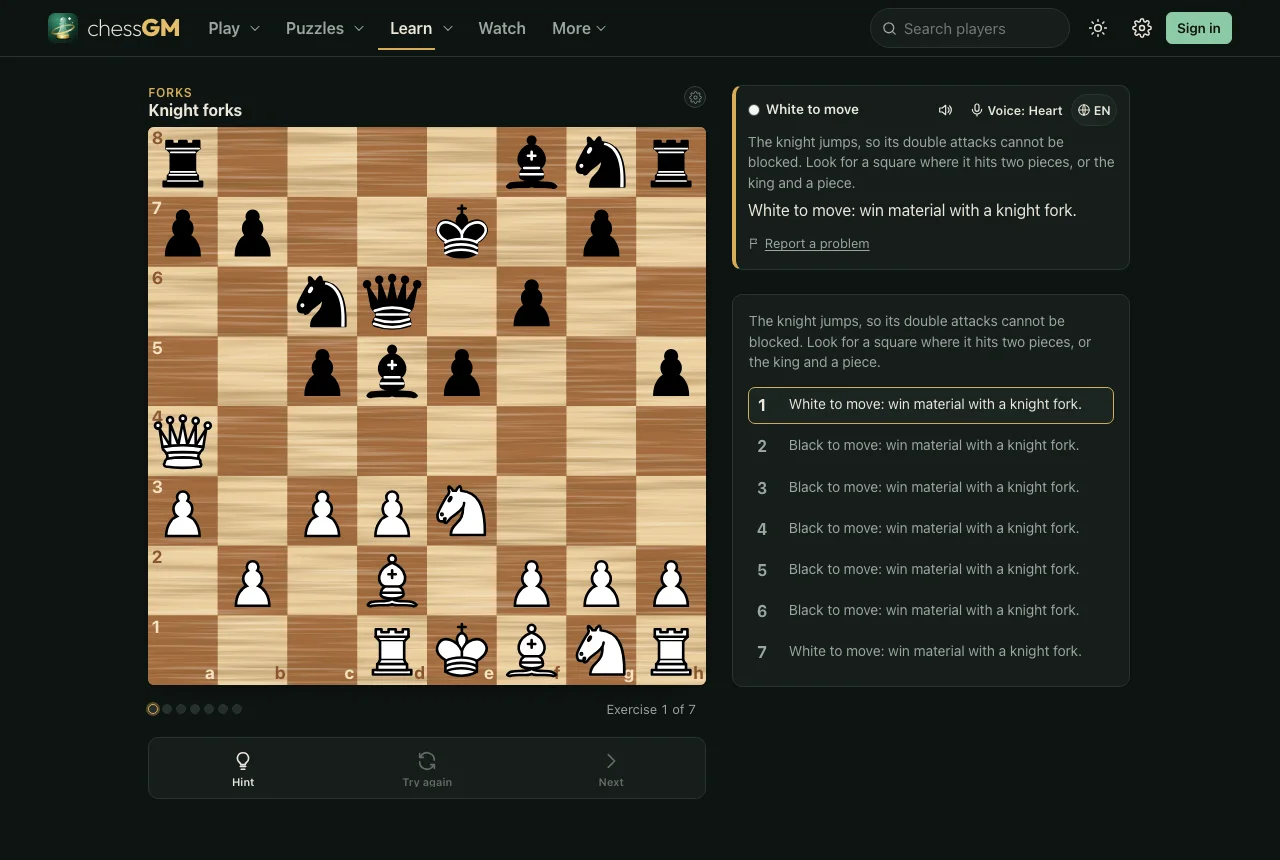
How a tactics course works
- The lesson opens with the idea in one or two sentences, for example “The knight jumps, so its double attacks cannot be blocked. Look for a square where it hits two pieces, or the king and a piece.”
- You get a position and the task: “White to move: win material with a knight fork” or “mate in one”. You play the move on the board.
- If you are wrong you can try again, or use the hint. The next positions in the same lesson are of the same type.
- A theme usually comes back as “part 2”, “part 3” and so on with more positions, a little harder each time.
- The course ends with a mixed lesson: all the ideas of the course together, with no theme named, as in a real game.
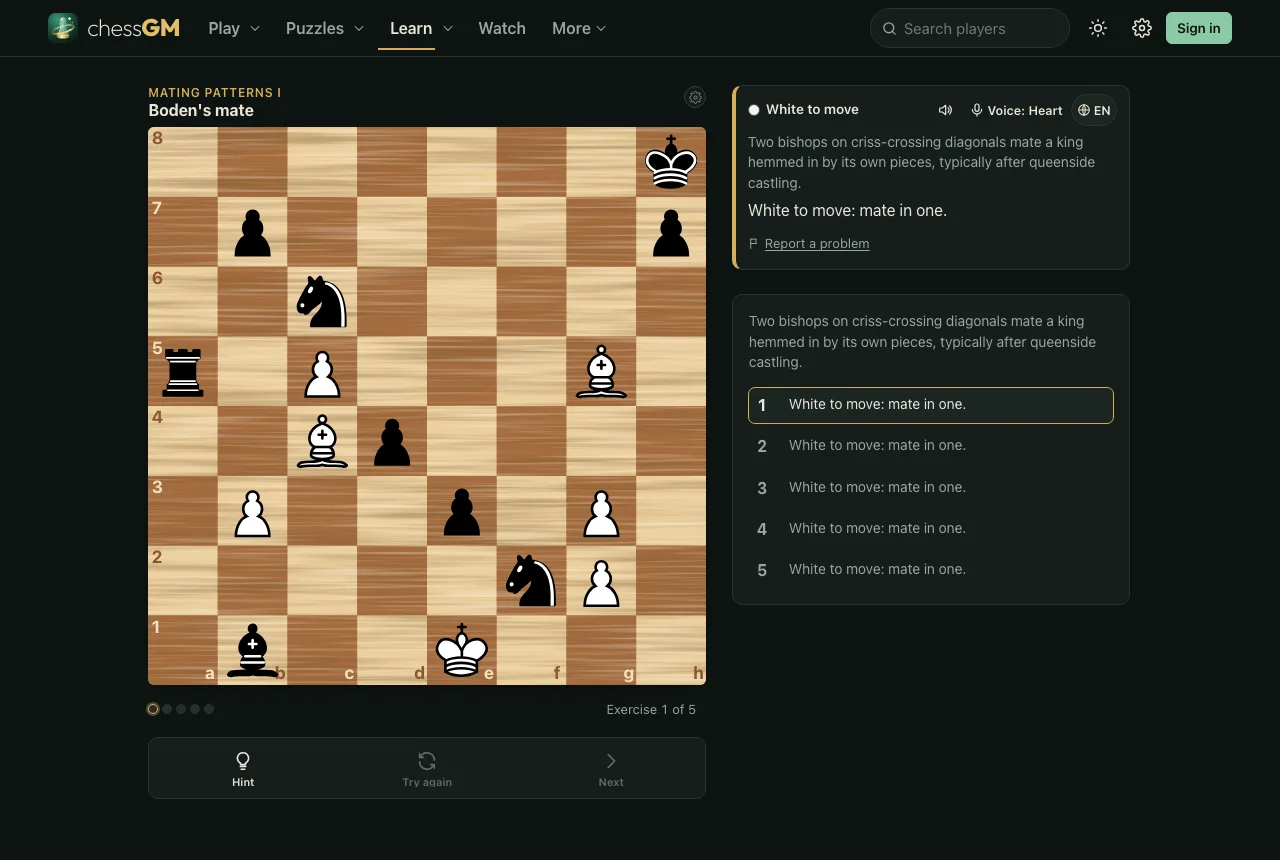
A good order
- If you are new to tactics: Mating patterns I (a good first look at what checkmate looks like), then Forks, then Pins and skewers.
- Next: Discovered attacks and Back-rank mates. Back-rank mates alone has six lessons with about ten exercises in each of the first five.
- Then: Deflection and decoy, Sacrifices on the king, Defensive moves and Quiet moves, which are the courses where you start to calculate, not just recognise.
- Finish with Mating patterns II and then the real-game tactics ladder for mixed positions.
A realistic study plan
- Fifteen minutes a day: one lesson, slowly. Read the idea, then solve.
- Do not rush the exercises. If you click a move fast and are wrong, you learn the wrong picture.
- Come back to a finished course a week later and redo the mixed lesson. Recognising a pattern the second time is the point.
- Once or twice a week, look at your own games for a tactic you missed, and name it: fork, pin, back rank. Then take the course that matches.
Common mistakes at this level
- Looking only at your own move and not at the reply. Always ask what the opponent can do after your move.
- Starting with a sacrifice because it looks brilliant. Count what you get back before you give anything up.
- Forgetting the defence. The defensive moves course is there because stopping a tactic is as useful as playing one.
- Solving by guessing. If you cannot see why the move works, press hint and read the explanation before you move on.
Screenshots and credits
Screenshots were taken as a guest on the live chessGM website on 22 October 2026 and show the real pages, not edited. The chess pieces in the lesson boards are by Colin M.L. Burnett (CC BY-SA 3.0), as credited on chessGM.
Written from the live chessGM site and its course catalogue on 22 October 2026. The course counts, names and lesson numbers are read from the catalogue; the study plans are general guidance, not coaching.