
In short
- chessGM has 92 courses today: 52 skill courses with 280 lessons (the rules, checkmates, tactics, real-game tactics and endgames) and 40 opening courses (28 fully explained courses plus 12 line-practice courses).
- They are grouped by level, from “New to chess (0–400)” up to “Expert (2000+)”, and the courses page recommends four to start with for the level you choose.
- Every lesson is on a real board with a short explanation first and exercises after it, with a hint button and a “try again” button. Lessons work in English, Bangla and Hindi.
- You can try them as a guest. Your progress is kept on the device you use, and signing in keeps it for you.
- This article is the map. The other five articles in the series go course by course: the beginner path, tactics, openings, endgames, and the real-game tactics ladder.
chessGM is our free chess site, built by 22Softwares. This series describes how its courses work and how we would suggest using them. We do not promise a rating or a time to reach one: improvement depends on how often you play, review and practise, and these courses are one part of that.
The courses page
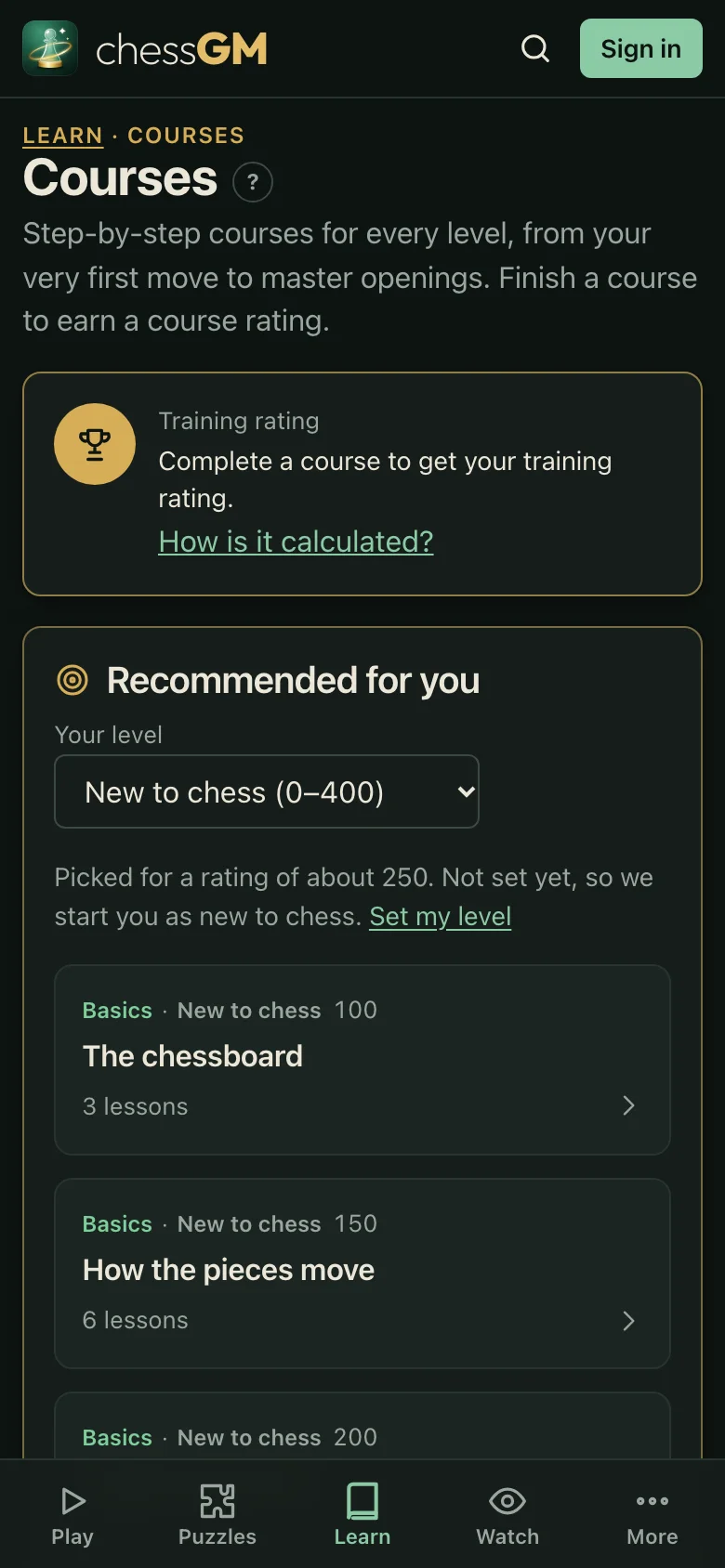
Open Learn, then Courses. The page opens with a short note that you earn a course rating by finishing a course, a “Recommended for you” row, and then the tracks: an absolute beginner track, a ladder of real-game tactics, and the rest of the courses grouped by what they teach.
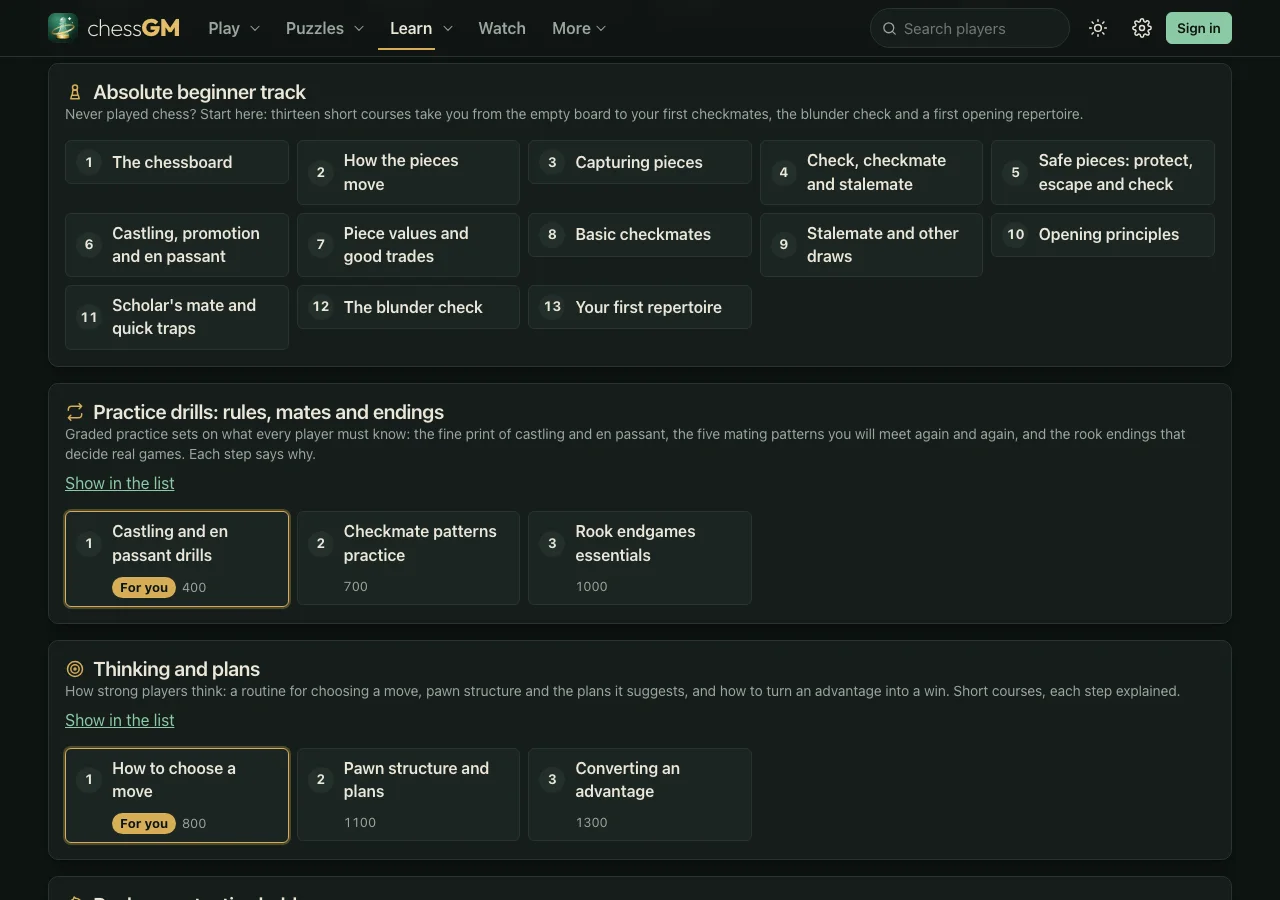
The level menu offers six bands: New to chess (0–400), Beginner (400–800), Improving (800–1200), Intermediate (1200–1600), Advanced (1600–2000) and Expert (2000+). If you have not set a level it starts you as new to chess, and you can set your own with “Set my level”. The numbers are course levels in chessGM’s own scale, which is a way to order the courses, not a promise about a rating on any other site.
What is in the catalogue
| Level band | Courses |
|---|---|
| New to chess (0–400) | 6 |
| Beginner (400–800) | 13 |
| Improving (800–1200) | 21 |
| Intermediate (1200–1600) | 29 |
| Advanced (1600–2000) | 14 |
| Expert (2000+) | 9 |
These are the counts of courses by band in the course catalogue on 22 October 2026. Counts change as courses are added, so treat them as a snapshot.
- The absolute beginner track: 13 short courses, 38 lessons, from the empty board to your first checkmates, safe pieces, stalemate and other draws, the opening principles, the blunder check and a first repertoire.
- Practice drills: 3 short courses, 7 lessons, on the fine print of castling and en passant, five mating patterns and the rook endings that decide real games.
- Thinking and plans: 3 short courses on how to choose a move, pawn structure and converting an advantage.
- Tactics: 10 courses, 78 lessons, one theme at a time, from forks and pins to mating patterns.
- Real-game tactics: 10 courses, 82 lessons, mixed positions taken from real games, from first tactics at about level 600 to very long calculation at 2400.
- Endgames: 10 courses, 61 lessons, from basic mates and king-and-pawn endings to rook endings and the hardest pawn endings.
- Opening courses: 40, made of 28 fully explained courses (from the Italian Game and the London System to the Sicilian Najdorf and the Grünfeld, each with explained lines, traps and a quiz) and 12 line-practice courses.
- Three quick-practice courses: forks, pins and skewers; king and pawn; and discovered attacks and mates.
How a lesson works
A course is a list of lessons. A lesson opens on a board. A card at the top right gives a short explanation, with a speaker button and a language button, and under it the steps of the lesson are listed so you can see where you are. After the explanation come exercises on the board: you are told what to find (for example “White to move: win material with a knight fork”) and you play the move.
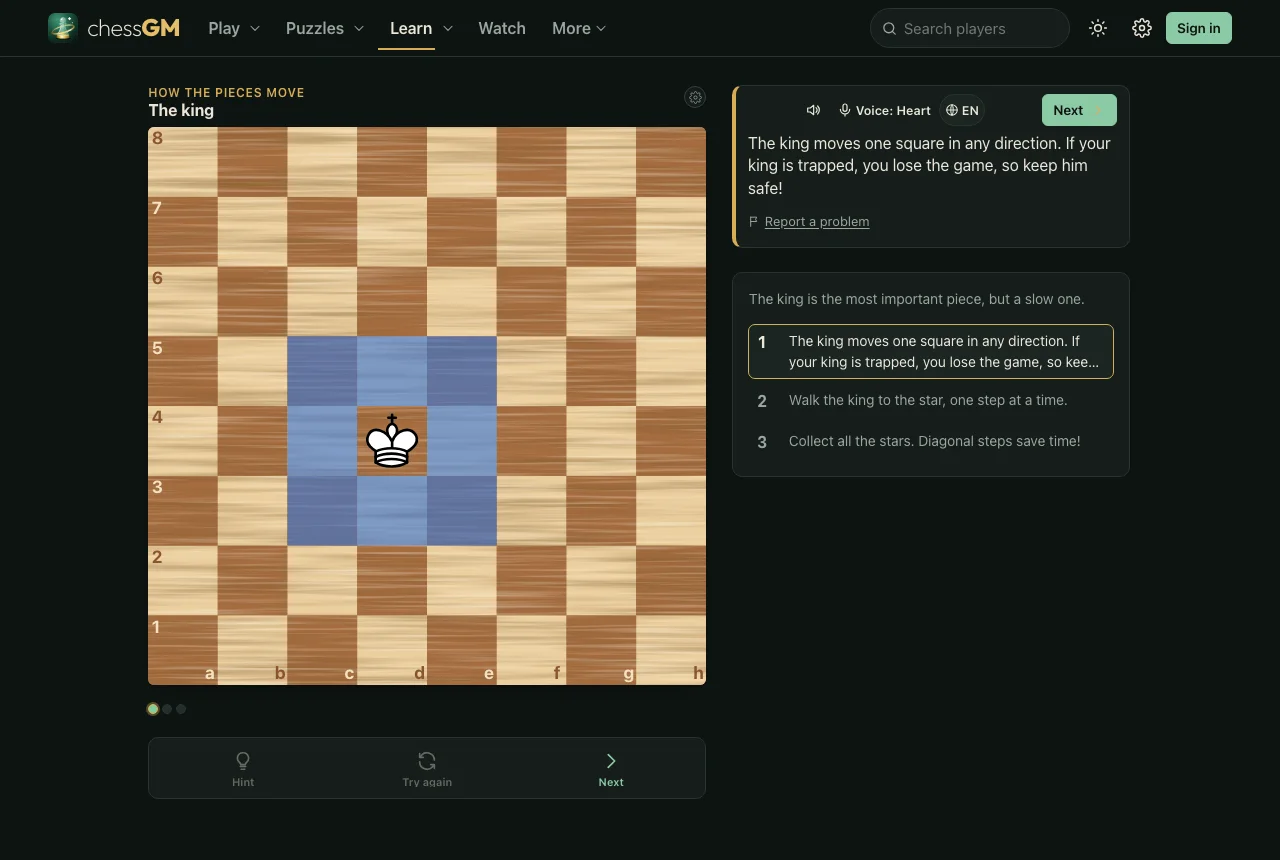
If you are wrong you can try again, and if you are stuck the hint button helps. Each lesson’s exercises get a little harder, and many tactics courses repeat a theme in “part 2”, “part 3” and so on with more positions, then finish with a mixed lesson where you have to find the idea without being told which one it is.
The order we would take them in
- New to chess: the beginner track, one course at a time, in order. See the beginner article for what each course teaches.
- Learn one opening for White, one answer to 1.e4 and one answer to 1.d4. The openings page itself suggests exactly this as a complete starter repertoire.
- From the 400 to 800 level, add the real-game tactics ladder and the first tactics courses (forks, pins and skewers, discovered attacks, back-rank mates).
- Add endgames from about 800 and keep going: a few endgame lessons early save a lot of half points later.
- From 1200, use the specific tactics courses (deflection, sacrifices on the king, quiet moves) and the endgame courses that cover rook endings, and keep adding to your openings one at a time.
- From 1600, the long-calculation courses, the harder endgames and the deeper opening courses.
A realistic way to study
Ten to twenty minutes a day beats a long session once a week, because a lesson is short and the ideas stay with you when you meet them again soon. A simple rhythm is one lesson a day, one set of exercises from an earlier course a few days later, and a game or two a week where you try to use what you learned. After each game, look at where it went wrong and pick the course that fits.
Do not skip the easy lessons. The first lessons of each course are short for a reason: they teach the picture that the harder ones build on, and the time spent there is small.
Three languages
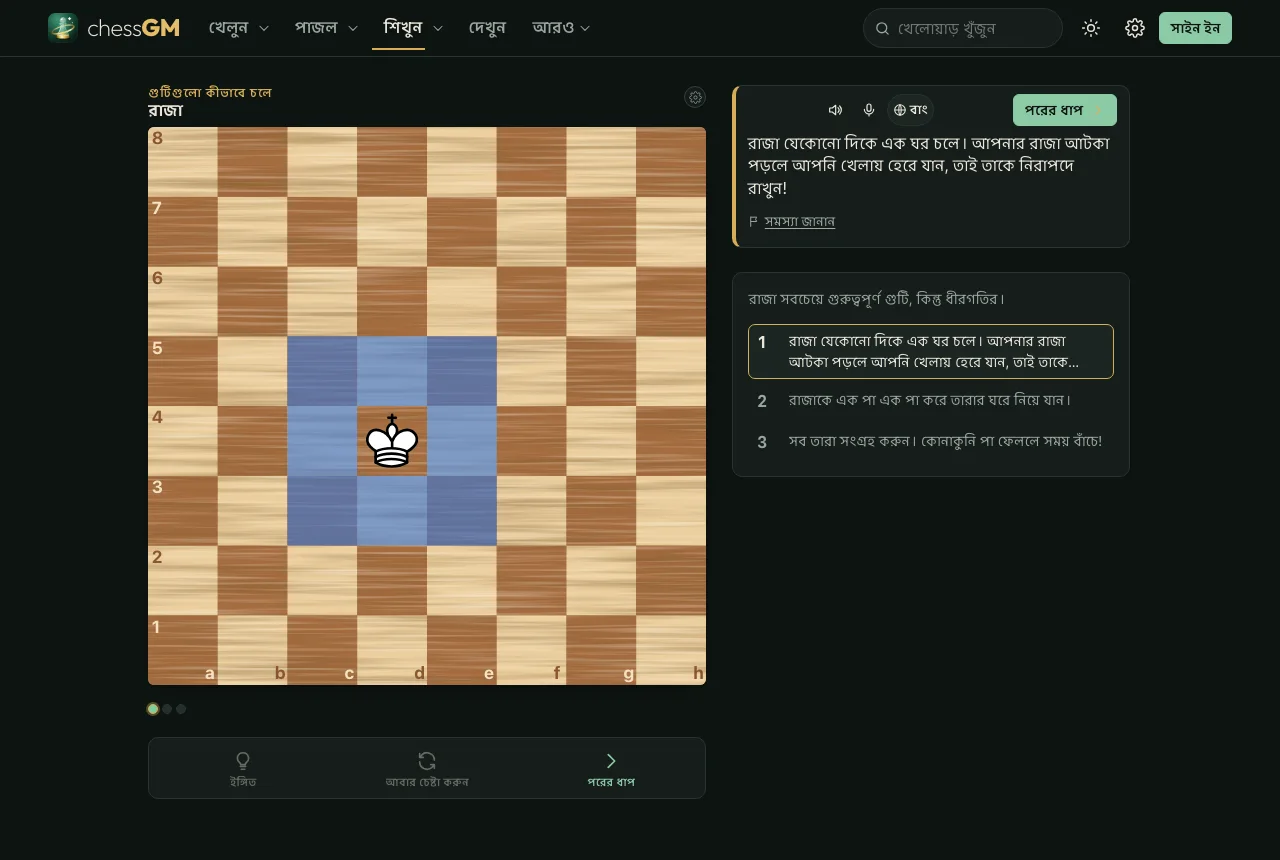
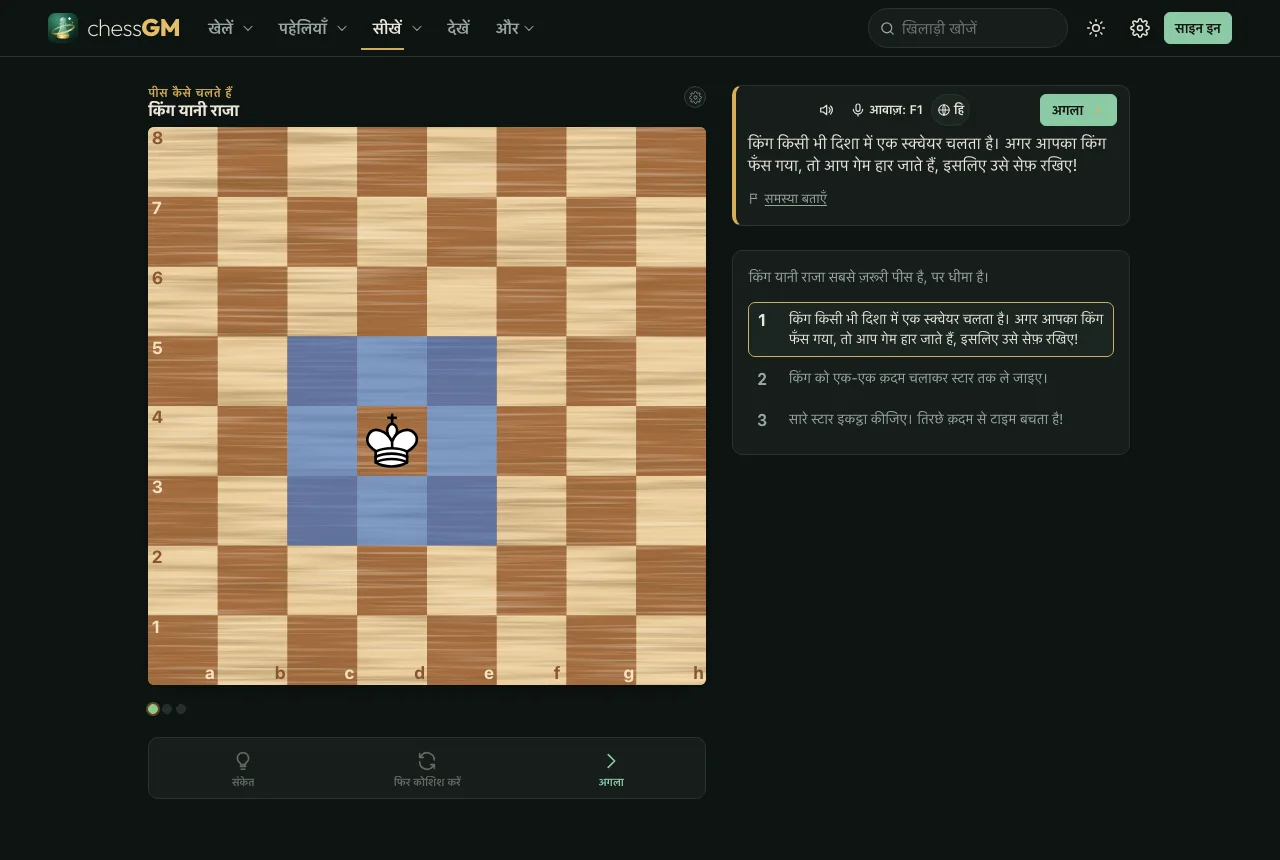
The app can be switched to English, Bangla or Hindi in Settings, and the coach’s comments and voice can follow it or use a language of their own. Moves stay in chess notation. The two screenshots below are the same lesson in Bangla and Hindi.
On a phone
The rest of the series
- Beginner courses: rules and first lessons, from the board to checkmate.
- Tactics courses: forks, pins, mating patterns and more.
- Opening courses: how to pick and learn an opening with explained lines.
- Endgame courses: ten courses of endgames, step by step.
- Real-game tactics: ten courses of positions from real games, for players who want harder problems.
New on chessGM: thinking, plans and your first repertoire
Our weekly improvement plan from 800 to 1600
Screenshots and credits
Screenshots were taken as a guest on the live chessGM website on 22 October 2026 and show the real pages, not edited. The chess pieces in the lesson boards are by Colin M.L. Burnett (CC BY-SA 3.0), as credited on chessGM.
About the authors
22Softwares is a software company in Thessaloniki, Greece and Dhaka, Bangladesh. We build and run chessGM and Carrom by 22Softwares. This series was written by the 22Softwares team with the chessGM team. Questions and corrections are welcome at info@22softwares.com.
Written from the live chessGM site and its course catalogue on 22 October 2026. The course counts, names and lesson numbers are read from the catalogue; the study plans are general guidance, not coaching.