
The theme-by-theme tactics courses teach you the patterns one at a time. The real-game tactics courses mix them, the way they come up in a game: ten courses, 82 lessons, with positions from real games and a ladder of levels from 600 to 2400. Each line is checked by the engine and ends in a concrete gain.
Who this is for
Players who know the basic tactics and want to find them without being told the theme, and stronger players who want long calculation practice. The courses are listed as Tactics (the first ones are for beginners) and go up to “Expert”.
The ladder
| Course | Level | Lessons | Focus |
|---|---|---|---|
| Real-game tactics 1: Free pieces and first tactics | 600 | 7 | Take what is undefended, mate in one and two, back-rank mates and your first forks: positions from real games, each ending with a clear gain. |
| Real-game tactics 2: Forks, pins and skewers | 800 | 7 | The three basic weapons of tactics, plus discovered attacks and mates in two. |
| Real-game tactics 3: Discovered attacks, deflection and decoys | 1000 | 8 | Pieces that unmask attacks, defenders dragged away from their posts, kings lured into the open. |
| Real-game tactics 4: Removing the defender and sacrifices | 1200 | 8 | Take out the key defender, sacrifice to break through and find quiet moves that win. |
| Real-game tactics 5: Attacking the king | 1400 | 7 | Sacrifices against the castled king, longer mates and the first saving defences. |
| Real-game tactics 6: Combinations and quiet moves | 1600 | 9 | Three-move combinations, quiet killers, rooks on the 7th and exchange sacrifices. |
| Real-game tactics 7: Calculation and defence | 1800 | 9 | Long forcing lines, saving resources and pawn breaks: see further than your opponent. |
| Real-game tactics 8: Deep combinations | 2000 | 9 | Expert positions: four-move combinations, quiet moves in the middle of a line and precise defence. |
| Real-game tactics 9: Master calculation | 2200 | 9 | Master-level positions where only one long line works and every reply must be seen. |
| Real-game tactics 10: Grandmaster calculation | 2400 | 9 | The hardest positions in our collection: very long lines, quiet moves and only-move defences. |
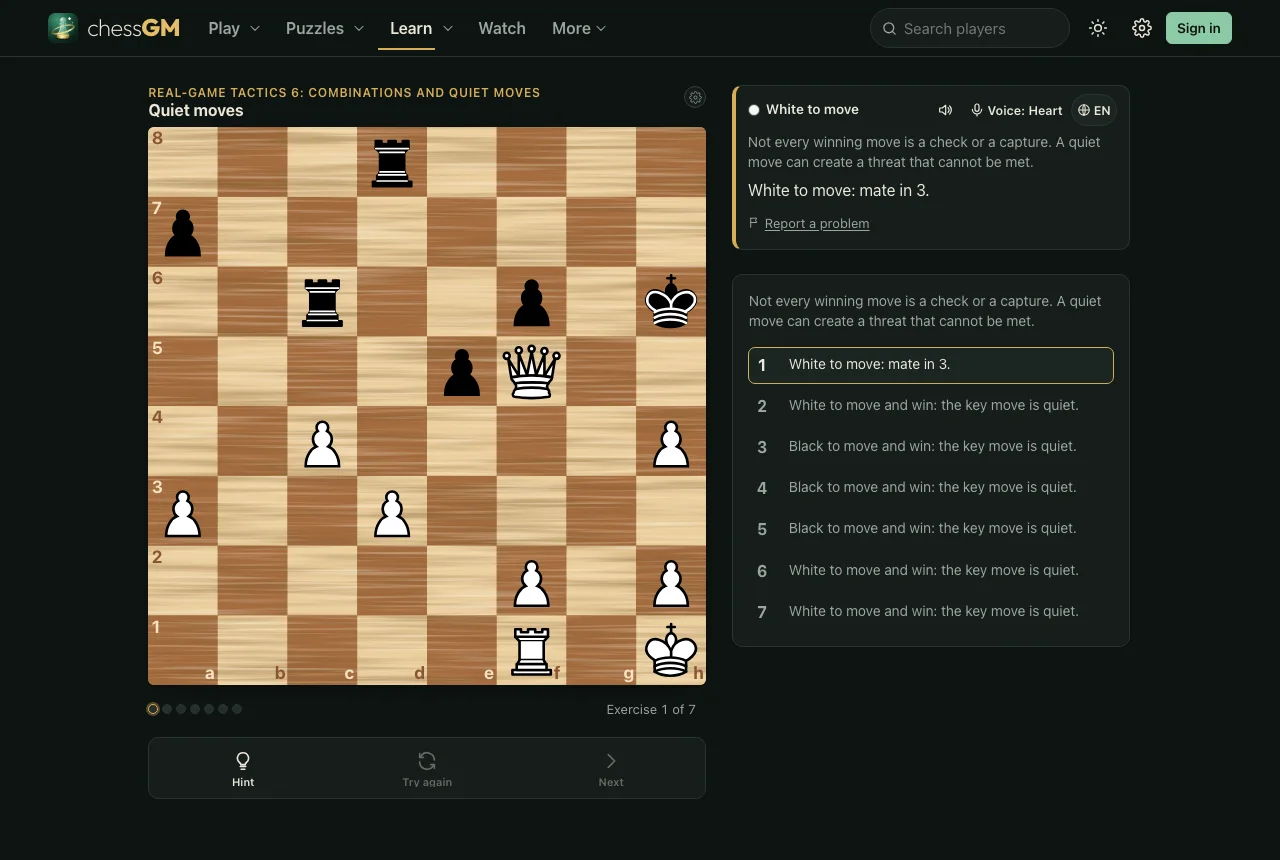
How the lessons work
Each lesson has a theme (for example “Calculation: three moves deep”, “Deflection”, “Saving defence” or “Mate in three or more”) with a short explanation and seven or so positions from real games. You play the move on the board. A key difference from the theme courses is that the positions are less obviously a “fork position” or a “pin position”: they come from games, and the answer may be a quiet move or a defence.
What each stage trains
- 600 to 1000: seeing what is free, mate in one and two, forks and pins. The habit is “look for what is undefended”.
- 1200 to 1400: removing defenders, sacrifices that win, and attacking the king. The habit is “count the attackers and defenders”.
- 1600 to 1800: three-move combinations, quiet moves, the exchange sacrifice, calculation and defence. The habit is “see the whole line with the opponent’s best replies”.
- 2000 to 2400: deep combinations and very long lines, with quiet moves and only-move defences. The habit is to picture the board after every move.
How to study without guessing
- Look at the position for a minute before you touch a piece. Write down, in your head, the checks, captures and threats for both sides.
- Decide on a line and calculate it to the end, including your opponent’s best answer, before you play the first move.
- If you are wrong, do not just try the next move. Read what the lesson says, then find why your line failed.
- Do a lesson at a time. Seven positions, done carefully, are worth more than thirty done fast.
A realistic plan
- Fifteen to twenty minutes a day: one lesson, and a second one only if you still feel fresh.
- Start at the course that is just below your level, so the first lessons are easy and the later ones stretch you.
- Once a week, redo a lesson from a course you have finished and see if you solve it faster.
- Keep playing slow games. Tactics training gets its value when you use it in a game.
Common mistakes
- Looking only for checks and captures. Quiet moves are a lesson on their own in these courses.
- Stopping the calculation one move too early. Many of the later lessons need four moves or more.
- Skipping the defence lessons. Saving a draw with the only move is a skill.
- Taking a course far above your level and getting discouraged. Go back one step.
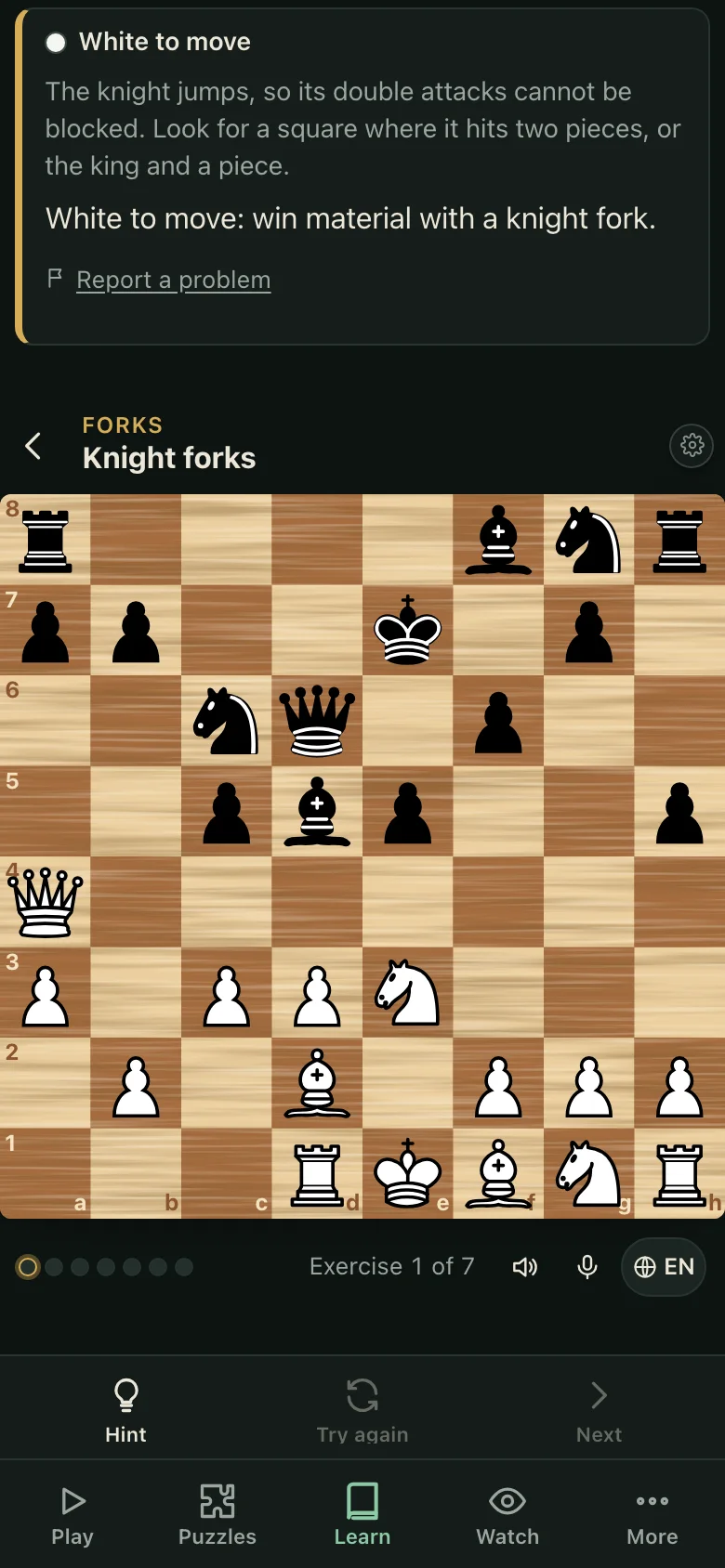
Screenshots and credits
Screenshots were taken as a guest on the live chessGM website on 22 October 2026 and show the real pages, not edited. The chess pieces in the lesson boards are by Colin M.L. Burnett (CC BY-SA 3.0), as credited on chessGM.
Written from the live chessGM site and its course catalogue on 22 October 2026. The course counts, names and lesson numbers are read from the catalogue; the study plans are general guidance, not coaching.