
Most people learn carrom the hard way: in a match, against someone who punishes every miss. That is fun, but it is a slow way to get better, because each mistake costs a turn and you rarely get to try the same shot twice.
Carrom by 22Softwares has two places to learn without that pressure. The Tutorial teaches the controls with one coin and one pocket. Practice gives you the whole board with no opponent, no clock and no stroke limit. This guide explains exactly how both work and then gives you five drills that turn a quiet practice session into better results in real games.
The Tutorial: one coin, one pocket
The first time you open the game, the Tutorial starts on its own. If you skipped it, or want to see it again, tap Tutorial on the home screen.
The board is almost empty. There is a single white coin, 8 cm out from the top-left pocket, sitting on the pocket’s diagonal. Your striker is on your baseline at the bottom. A small coaching hand shows you what to do, in three steps:
- Place the striker. Slide it along the baseline with your finger, or drag the slider under the board.
- Pull back. Press the striker and drag backwards, like a slingshot. The further you pull, the longer and redder the power arrow gets.
- Aim and let go. A short white arrow starts at the coin and shows which way it will travel when the striker hits it. Turn your aim until it points into the top-left pocket, then release.
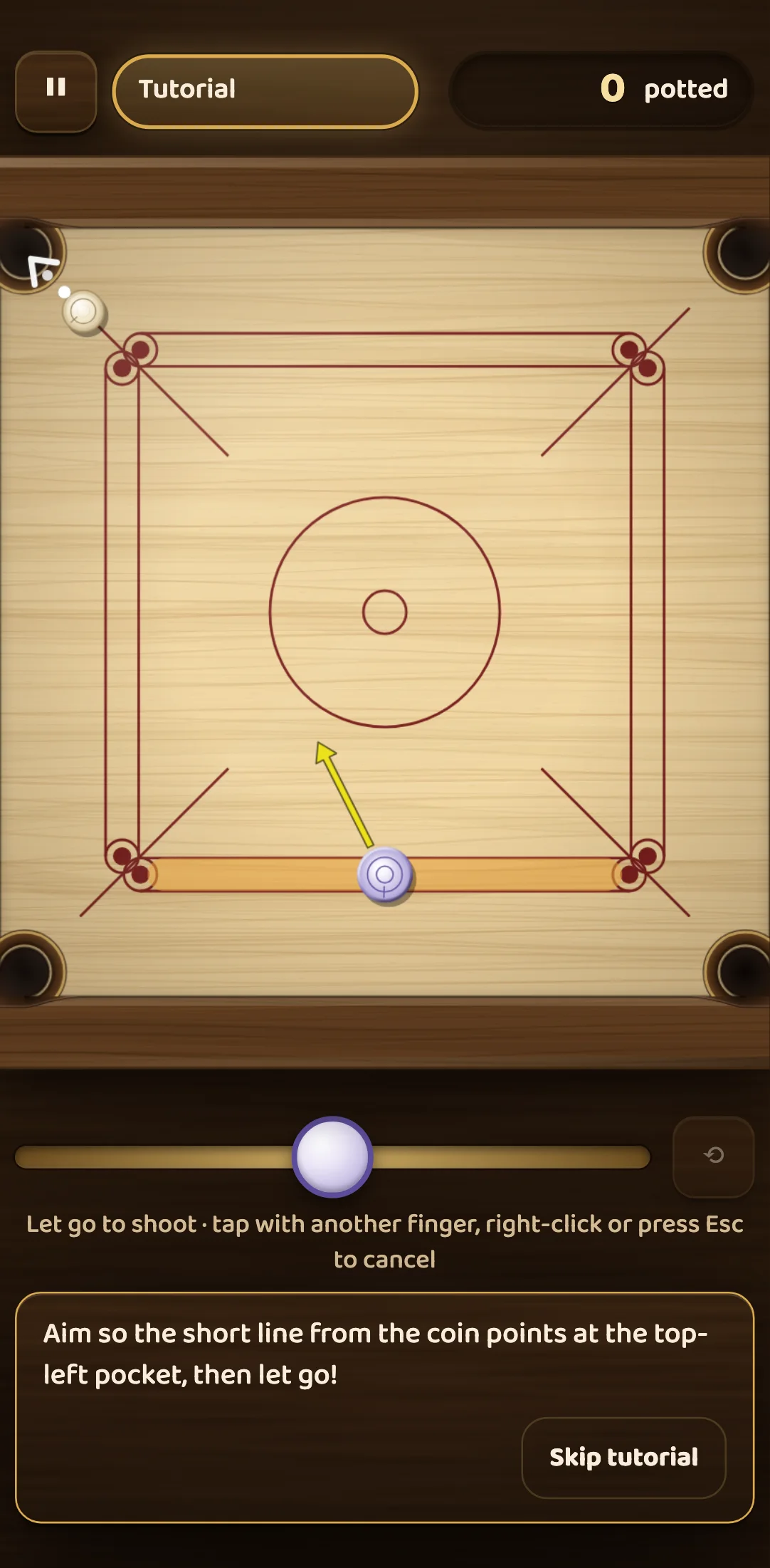
The coin is placed so that, from the middle of the baseline, it is a gentle cut rather than a dead-straight pot. That is deliberate: you learn from the very first stroke that you aim the striker at a point beside the coin, not at the coin itself.
If you miss, nothing bad happens. The coin goes back to its spot and the coach suggests pointing the line at the pocket and pulling back a bit harder. When the coin drops, the game congratulates you, reminds you of the Classic goal (pot your nine coins, then the red queen, and cover the queen by potting another of your coins straight after), and offers Play vs Bot or Menu. Skip tutorial is always there if you already know how to play.
Practice: the whole board, just for you
Practice lives on the Play vs Bot screen (on the home screen, choose vs Bot, then Choose bot). Below Start match there is a second button: Practice solo — free play, no opponent.
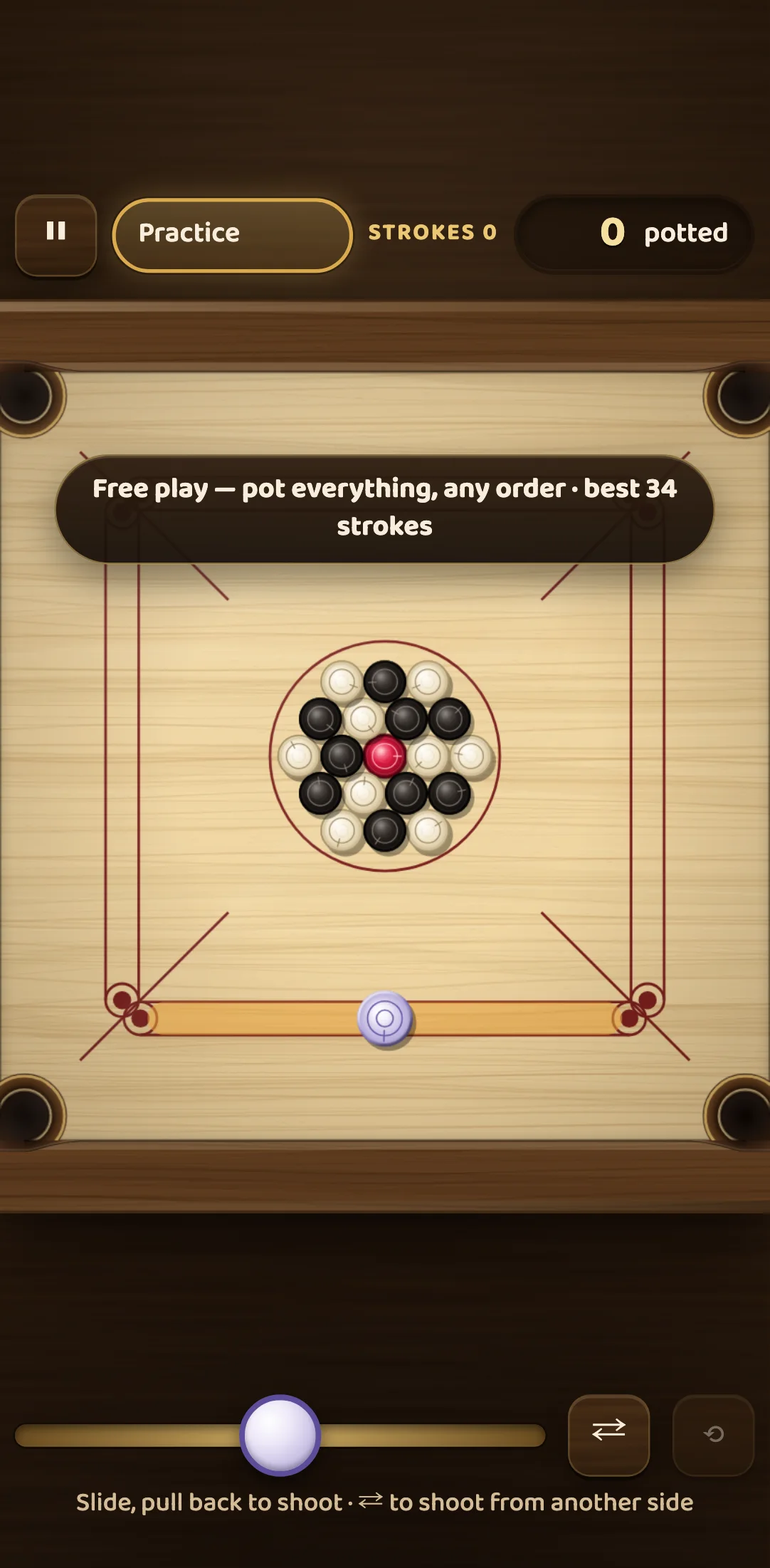
You get the full Classic rack of 19 pieces: nine whites, nine blacks and the red queen. The rules are simpler than any match:
- Every piece counts. Whites, blacks and the queen all score for you, in any order. The queen needs no cover.
- The turn never passes. There is no opponent, so you shoot again whether you pot or not.
- There is no stroke limit. The counter at the top shows how many strokes you have used. The game ends when the board is empty.
- One kind of foul still matters. If the striker leaves the board, the pieces you potted on that stroke come back onto the line through the centre. (The striker cannot fall into a pocket: the pockets are smaller than it is.)
Every stroke adds one to your count, including one where the striker touches nothing at all. So the real challenge in Practice is the same as the message at the start says: pot everything, in as few strokes as you can.
When you clear the board, the results screen shows your stroke count and either New best! or your best so far. That best number is the only thing Practice records. It pays no coins, and its strokes do not go into your Stats or count towards awards. That is a feature, not a gap: you can try silly shots and fail as often as you like.
If you leave halfway, the game keeps your board. The home screen offers Continue match, with a line such as “Practice · 9/19 potted · 12 strokes”, so a practice session can be spread over a few short breaks.
Shooting from any side
In a match you always shoot from your own baseline. In Practice you don’t have to. The button with two arrows beside the slider (or the R key on a keyboard) moves your striker round to the next baseline: right, top, left, and back to the bottom. The board itself stays still; only your seat moves.
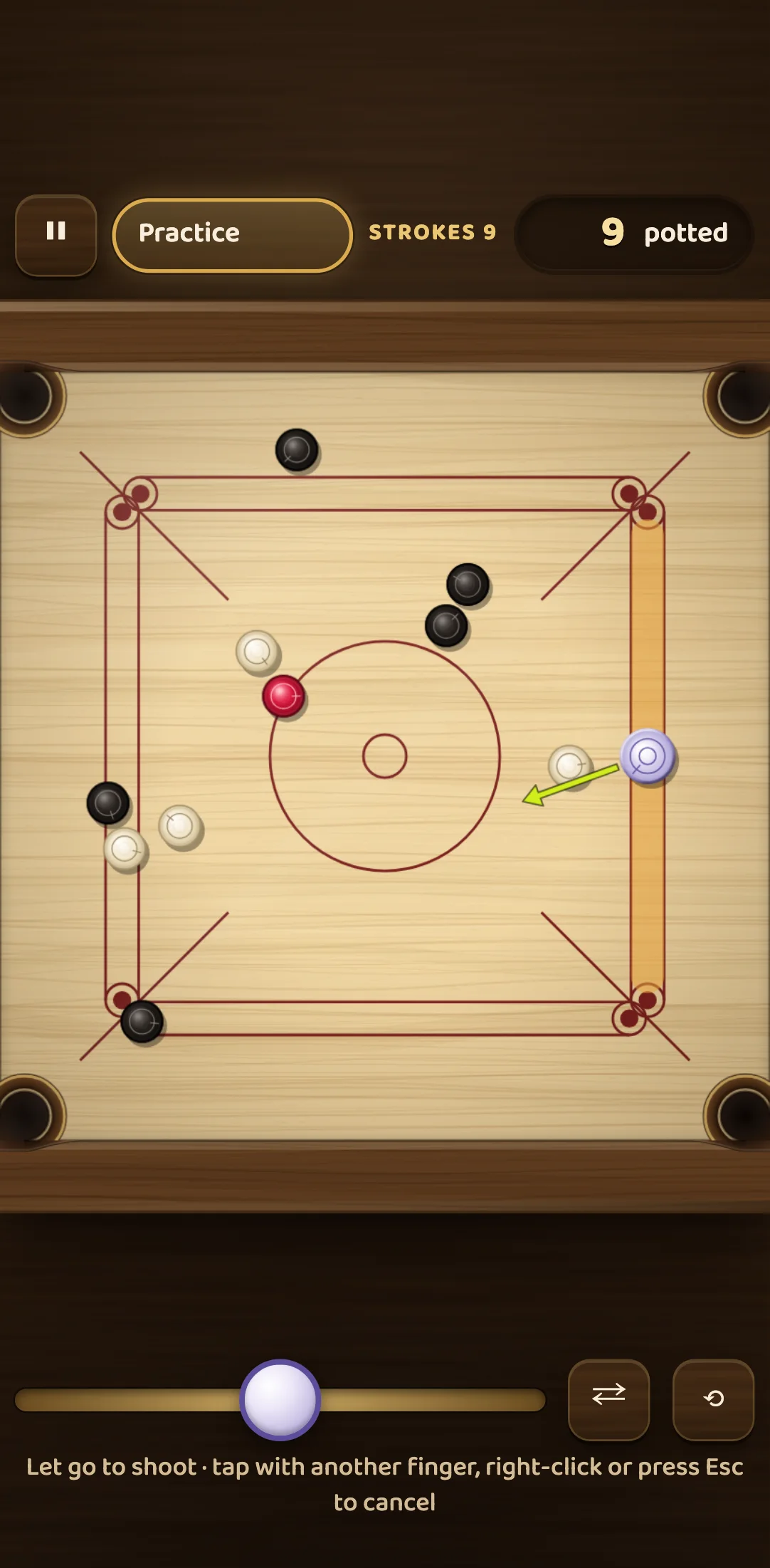
This matters more than it looks. Halfway through a board, coins drift into corners and against cushions that are awkward or impossible from the bottom. Changing side lets you play them from a sensible angle, so a good stroke count depends as much on choosing the right side as on aiming well. The same button works in the Daily Challenge.
One more difference from bot matches: Practice shows no white arrow from the coin. You see only the power arrow, as you do in online games. That makes Practice the closest thing to aiming in a real online match, where you have to see the angle yourself.
Five drills that carry into real games
A free board is easy to waste by shooting at whatever looks nice. These drills give each session a purpose.
1. One pocket only. Pick a pocket and pot only into it for the whole board, changing side as often as you need. It forces you to find the angle for every coin instead of taking the easy ones, and you learn how each corner plays.
2. Soft strokes only. Keep the power arrow in the green for an entire board. A coin has to be moving slowly enough to drop, and a coin hit straight into a pocket at full power can rattle back out. Most players hit too hard; this drill fixes it quickly.
3. The cut ladder. Find a coin a short way from a pocket. Pot it first nearly straight, then slide the striker along the baseline and pot similar coins at steeper and steeper angles. Picture the spot beside the coin where the striker must arrive. A thin cut passes on only part of the striker’s speed to the coin, so watch how far each one travels and adjust your power as you go.
4. Use Replay. The button with the circular arrow replays your last stroke. After a miss, watch it again before shooting. Was the line wrong or the power wrong? Fixing the right one is half of improving.
5. Beat your number. Once you can clear the board, play for your best stroke count. Now every stroke is a small plan: which coin, from which side, and where the striker and the other coins will end up. That is exactly the thinking that wins matches.
From practice to matches
The Tutorial teaches the controls in a minute. Practice is where your aim gets better. A good routine is a short Practice board before your bot or online games: no pressure, no score that matters, and a number at the end that tells you honestly whether you are improving. When the soft cuts start dropping in Practice, take them into a match against a bot on a level that challenges you.
Facts checked with the Carrom by 22Softwares team against the game’s rules engine.