
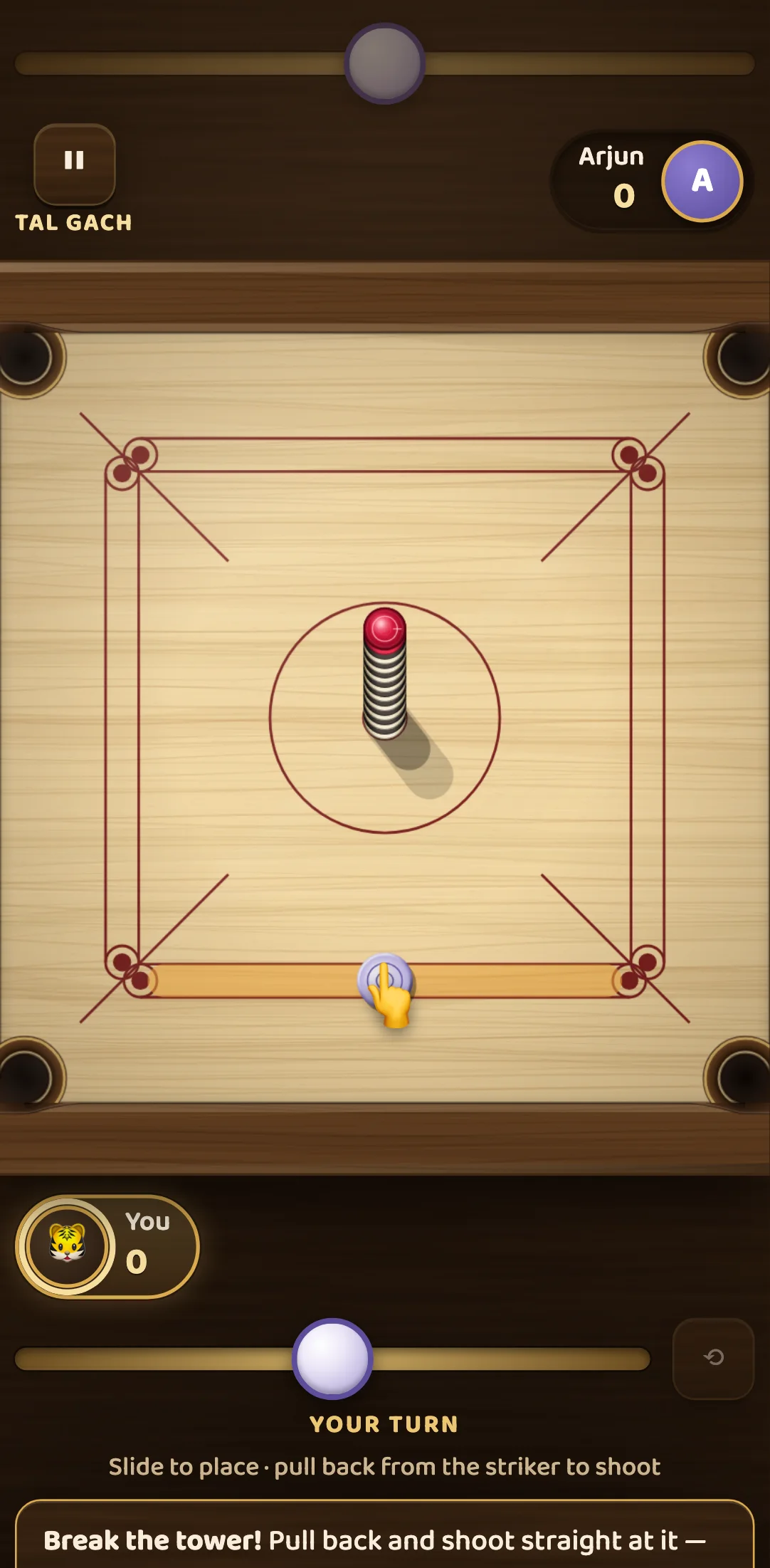
Most carrom games start from a neat rosette of coins around the queen. Tal Gach starts from something much more fun to look at: all nineteen pieces stacked into a single column in the centre of the board, the red queen balanced on top. Before anyone can score, somebody has to knock it down.
This guide explains what happens when your striker meets that tower in Carrom by 22Softwares, why hitting it as hard as you can does not always do what you expect, and how to pick the right break for the position you want to leave behind.
A quick reminder of the rules
The tower is built from the bottom up in a fixed order: a white coin, then a black coin, alternating all the way up, with the queen at the very top. That gives 9 whites, 9 blacks and the queen.
In Tal Gach nobody owns a colour. Any piece you pocket scores for you: 20 points for a white, 10 for a black and 50 for the queen, which counts the moment it drops (no cover needed). The board holds 320 points in total, so the first side to reach 170 wins straight away. Pocket anything on a clean stroke and you shoot again. The pockets are smaller than the striker, so the striker itself can never fall in.
The break is just the first stroke of the game, played under these same rules. If it pockets something, you keep going. If it pockets nothing, the turn passes, and your opponent plays on whatever you left.
Two ways a tower can come apart
Until something touches it, the game treats the standing tower as one heavy object, as heavy as all its coins together. What happens next depends on one number: how fast the striker is moving into the tower at the moment of contact, measured along the line between their centres. A glancing hit counts for less than a straight one at the same speed, because less of the striker’s movement points into the tower.
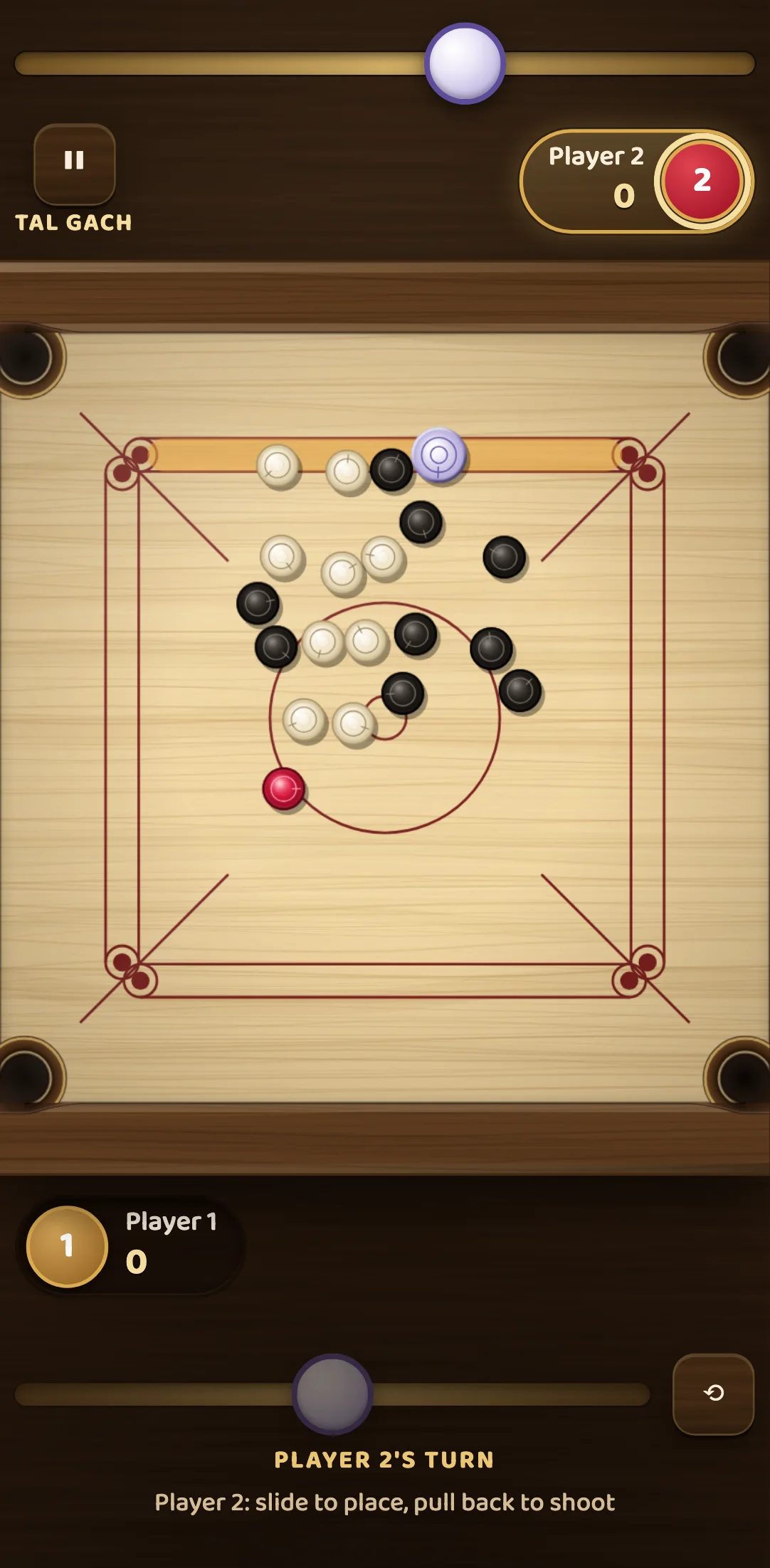
Below about 70 percent of the fastest possible stroke, the whole tower falls. The bottom coins take the hit and travel forward along the line of the stroke. The higher a coin sat in the column, the more it slips and tumbles as it drops: its path is turned further to the side, and the top pieces can go almost any direction, even back towards you, and more slowly than the coins from the bottom. The result is a spray of pieces fanning out ahead of the striker.
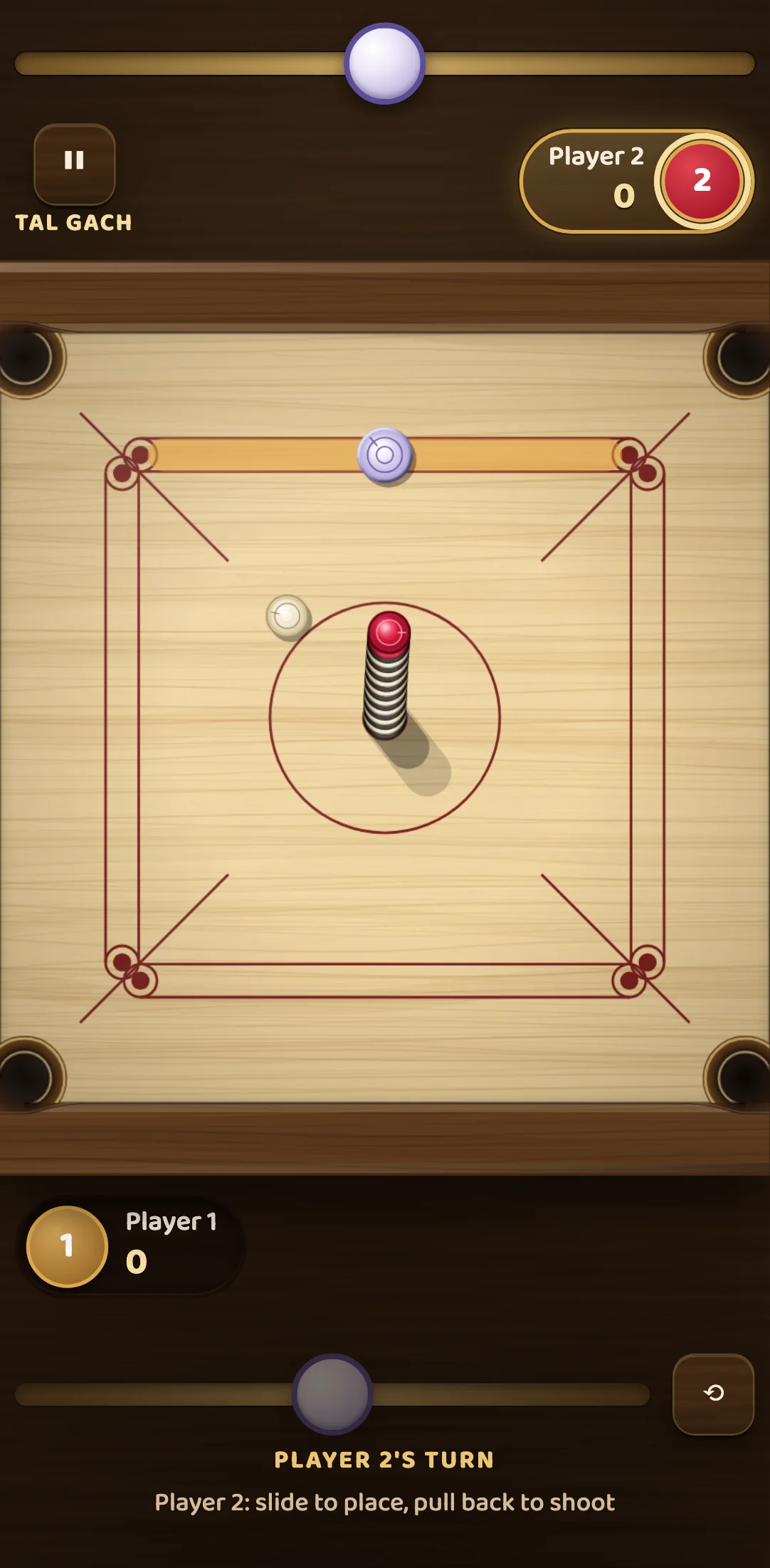
From that speed upward, the game does something different. Nine times in ten, a hard hit punches out only the bottom coin or two. They shoot away from under the stack, and the rest of the column drops onto the board and keeps standing, leaning a little. The tenth time the whole tower goes over, and a hard topple may throw one or two coins from the top up into the air. A thrown coin can sail clean off the board; when that happens it is put back on a free spot, so nothing is lost.
None of this is luck in the usual sense. Which way the tower breaks is decided from the stroke itself, so the same stroke always produces the same break, and in an online game both phones see exactly the same thing.
What a “hard” break means on your power arrow
The striker is slower when it reaches the tower than when it left your finger, so a stroke has to start well above 70 percent power to arrive above the line. We ran the game’s own physics without a screen on the opening position on 23 October 2026: 480 breaks from thirty spots along the baseline, aimed at the centre of the tower and slightly off it.
- From 40 up to about 85 percent power, the whole tower fell every single time. None of those 240 breaks pocketed anything.
- From about 90 percent to full power, the column was still standing when everything stopped in a little over half of the breaks (105 of 186), with around 17 or 18 pieces still in it. Only a handful of these hard breaks pocketed a piece.
That is lower than “nine in ten” because a glancing hit counts for less, and because each contact with the tower is decided on its own: if anything touches the shortened column again during the same stroke, it can still come down.
So, in practice, the long red end of the power arrow is the knock-out zone, and anything below that is a topple.
Picking your break
There is no single best break; there is the break that suits what you want to happen next.
The topple: open the board for yourself, or for them. A firm, straight hit that stays below full power reliably spreads the pieces. That is great when it is your turn afterwards, but on the break it usually is not: in our test, toppling breaks almost never pocketed anything, so your opponent plays first on the board you just opened. A softer topple leaves the pieces in a tighter group nearer the centre and gives away fewer easy shots near the pockets.
The knock-out: hand over a problem. A near-full-power break that leaves the column standing gives your opponent a tower to break again, now with a coin or two loose nearby. The remaining column follows exactly the same rules when it is hit on a later stroke. This is a reasonable way to avoid opening the board for the other side, but you give up any real chance of scoring on the break.
Off-centre hits. Aiming a little to one side of the tower’s middle turns the spray, so the pieces fan out more towards one half of the board. It also takes a little force out of the hit, which can drop a near-full stroke below the knock-out line.
Placement. You can break from anywhere along your baseline. A break from near the middle sends the bottom coins straight up the board; from further out, they cross the board at an angle instead.
How the bots break
The bots in Carrom by 22Softwares do not use a canned break. On their first stroke they look at several spots along the baseline (the middle, and 3, 7 and 12 cm either side), each aimed squarely at the tower or just to one side of it. They play each of those through the same physics you play with, and choose the one with the best expected result.
What differs between difficulties is how hard they hit. Easy breaks at 55 percent power and Medium at 70 percent. Both always topple the whole tower. Hard breaks at 85 percent, which arrives just under the knock-out line, so the small wobble in its power occasionally carries it over. Expert breaks at 95 percent, firmly in the knock-out zone, so against Expert you will often find a shortened column waiting for you.
Practise on a smaller tower: Friday’s Daily Challenge
Every Friday the Daily Challenge is a tower day. Instead of nineteen pieces, you get a small tower of five to seven (with the queen on top in most of them) standing somewhere in the far half of the board, and three strokes more than there are pieces to break it and clear it. It is a low-stakes way to see how different break strengths spread a stack.
Quick summary
- The tower is white at the bottom, then alternating black and white, with the queen on top.
- Below about 70 percent of top speed on arrival (roughly 85 percent on the power arrow from the baseline), the whole tower falls and fans out ahead of the striker.
- Above it, nine hits in ten knock out just the bottom coin or two and leave the column standing.
- Breaks rarely pocket anything, so think about what you leave your opponent.
Facts checked with the Carrom by 22Softwares team against the game’s rules engine.