
Most carrom advice is about the line, and our guide to aiming and the ghost spot covers it. But pace matters just as much. Two strokes on exactly the same line can end very differently: one coin drops quietly, the other hits the back of the pocket and comes flying back down the board.
This guide is about that second half of every shot. Instead of rules of thumb alone, we measured it. Carrom by 22Softwares runs on its own exact physics simulation, and we fired thousands of test strokes through it to see which powers pot a coin and which do not. The numbers below come straight from those runs.
What the power setting really does
In the game you press the striker and pull back like a slingshot. The further you pull, the more power, and a power arrow grows out of the striker, changing from green through yellow to red. A full pull is about a quarter of your screen's shorter side, so on a phone it is a short, comfortable movement.
Power is not linear. The game squares it, so the bottom half of the pull gives you fine control over soft strokes and the top half adds speed quickly. This is how far a striker or coin glides on its own across the powdered surface at each setting, before it stops:
| Power | Launch speed | Glide on its own |
|---|---|---|
| 20% | 36 cm/s | about 22 cm |
| 40% | 70 cm/s | about 54 cm |
| 50% | 95 cm/s | about 79 cm |
| 60% | 125 cm/s | about 111 cm |
| 80% | 204 cm/s | about 197 cm |
| 100% | 304 cm/s | about 309 cm |
The playing surface is 74 cm across, and your baseline is about 25 cm from the centre. So half power already carries a lone striker more than the full length of the board. Anything above that is spent on collisions, cushions and, quite often, mistakes.
Where the speed goes when the striker hits a coin
The striker in this game is twice as heavy as a coin. On a full, straight hit, the coin leaves at about 1.2 times the speed the striker arrived with, and the striker carries on behind it at about 40 percent of its speed. That is why a straight hit feels so lively: the coin always moves faster than the striker that hit it.
On a cut, less of the speed passes to the coin. The thinner the cut, the more power you need for the same distance. In our tests, a straight shot from the baseline into a corner pocket needed about 40 to 45 percent power to drop. A cut of around 55 degrees needed 53 percent, and a thin cut of about 70 degrees needed 65 percent. When you play a thin cut, add power. When you play a full ball, take some away.
Why harder is not safer
Many players hit hard "to make sure". It feels like insurance. In carrom it usually is not, for three reasons.
1. The pocket can throw the coin back
The pockets in this game are tight: a coin only just fits. A coin drops when almost all of it is over the hole and it is moving slowly enough to fall. If it arrives too fast, it hits the back of the pocket and bounces out.
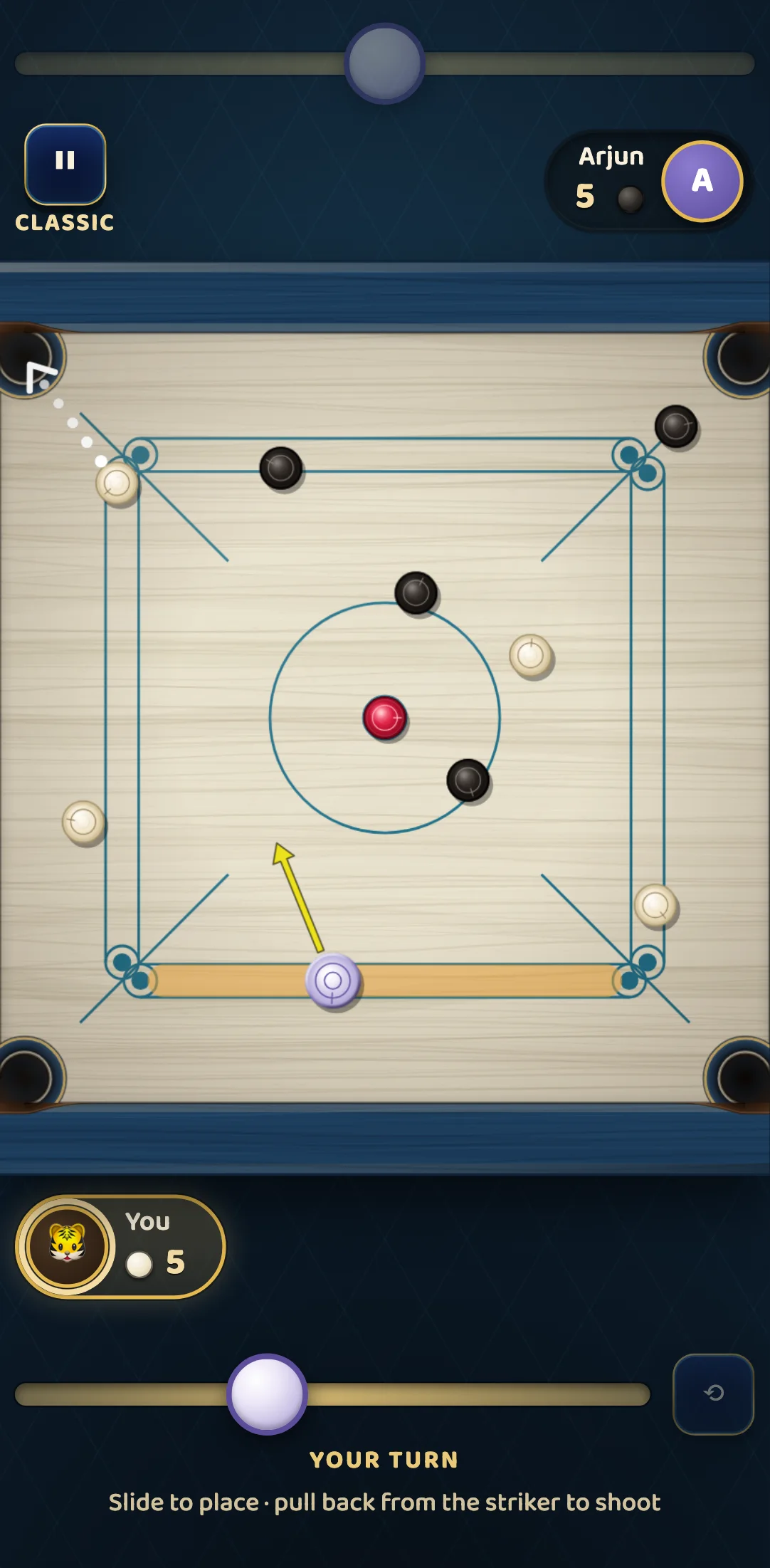
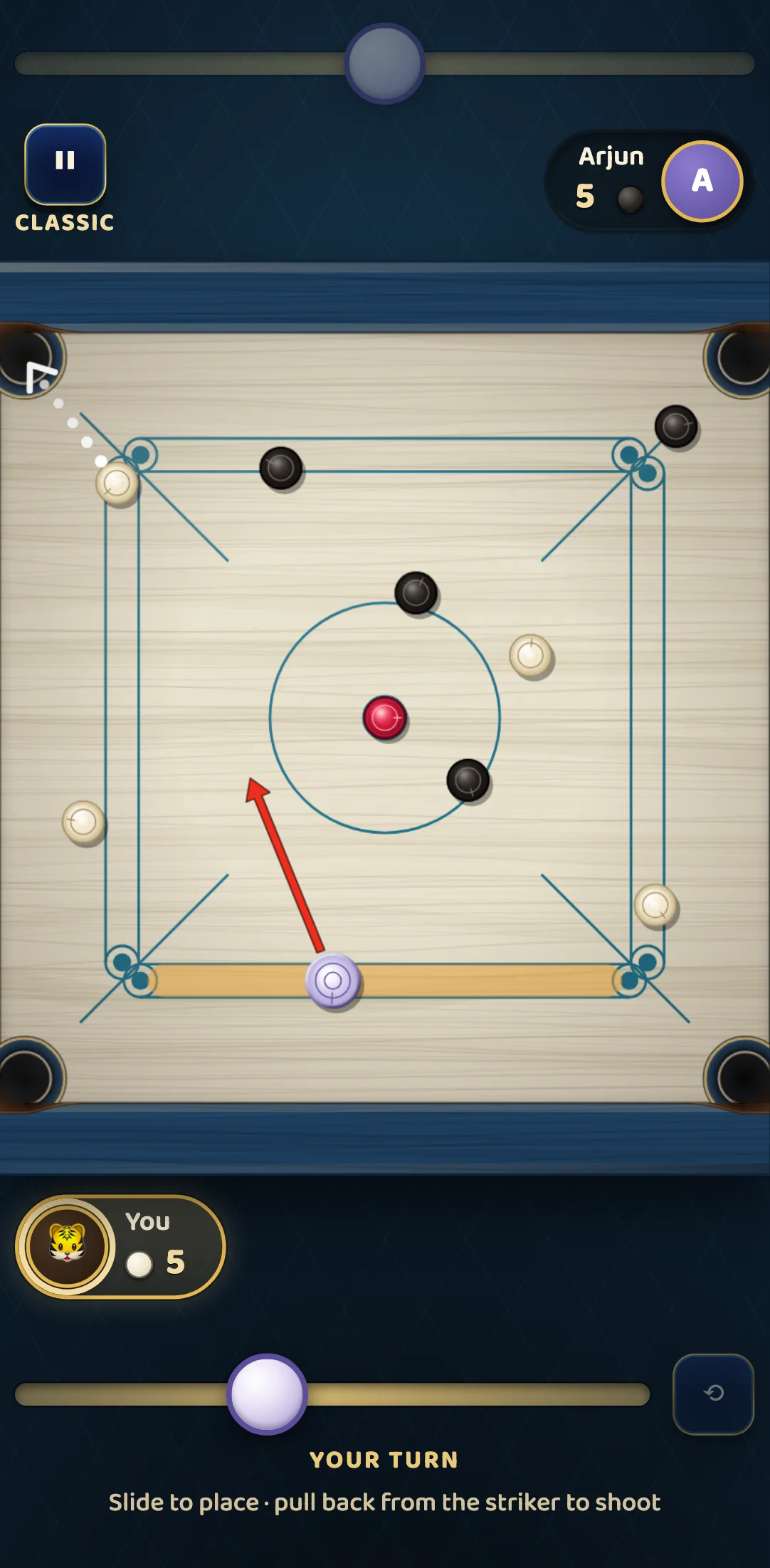
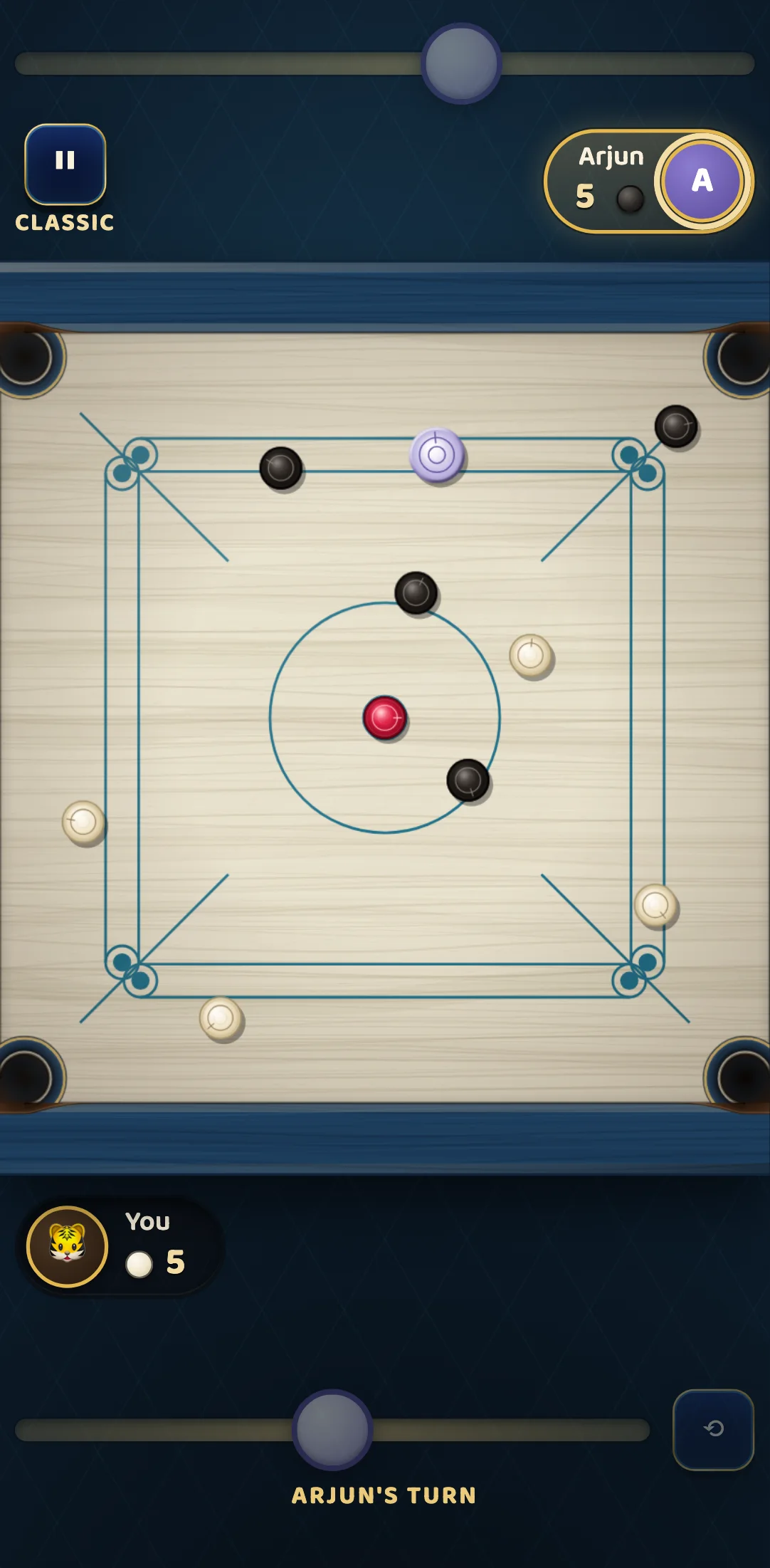
We took the shot in the pictures, a short cut into the top-left pocket, and swept the power from 1 to 100 percent. It potted at every power from 42 to 90 percent. Above that, the coin reached the pocket at close to 300 cm/s, struck the back of it, came out, and ran all the way down the board. Straight shots are a little more tolerant than cuts here, but the lesson is the same: the very top of the power range can turn a pot into a miss.
2. Hard strokes shrink your margin for error
This was the most useful thing we measured. We fired the same pot over and over, each time turning the aim a little off the perfect line, and counted how wide the "window" of aims that still potted was.
For a coin 15 cm from the pocket, played straight, the window was about 3.4 to 3.5 degrees at powers between 45 and 70 percent. At 85 percent it shrank to 2.7 degrees, and at full power to 2.2 degrees. A slight cut showed the same pattern: about 3 degrees at medium pace, 1.7 at full power. A firm, controlled stroke gave the best results every time. The physics explains why: a slow coin that is only partly over the hole gets tipped in by the hole's edge, while a fast one that clips the pocket mouth hits the leather-lined jaw and stays out.
There is a bottom limit too. For a longer pot, a coin 30 cm from the pocket, the window at 45 percent was tiny, only half a degree, because the coin barely had enough speed to get there. At 55 to 70 percent it was nearly 2 degrees. "Soft" means just enough to reach, with a little to spare. It does not mean as little as possible.
3. Hard strokes rearrange the board
A hard stroke sends the striker and every coin it touches bouncing off the cushions, and you cannot plan where they stop. A medium pot leaves the rest of the board roughly where it was, so you can plan your next shot while you take this one.
A simple way to choose your pace
- Judge the distance the coin must travel, not the distance to the coin. A coin on the lip of a pocket needs only a touch, however far away your striker is.
- Add power for cuts. The thinner the cut, the more you need.
- Aim to have the coin arrive slowly, still rolling into the pocket rather than slamming it. If you picture it dying in the pocket mouth, you have the pace about right.
- Keep full power for jobs that need it: the opening break, a bank off a far cushion, or a deliberate scatter when you are stuck.
- Repeat what works. The arrow's colour and length are your gauge. Learn what "light yellow" does on your device.
How the computer players choose their pace
The bots work on the same idea, which shows it is not just style. Easy, Medium and Hard plan each pot so the coin is still moving gently, at about 12 cm/s, as it reaches the pocket. They then work back from that to the striker speed they need. Their personalities adjust it: the Aggressive bot hits about 18 percent harder than that, the Defensive one about 8 percent softer.
Expert goes further. For each direct pot it chooses an arrival speed at the pocket: a "touch" of 6 cm/s, a normal 18 cm/s or a firm 50 cm/s. For a coin within 14 cm of a pocket it tries the touch and the normal pace, because a fast coin that close tends to rattle out. For a coin further away it tries normal and firm. It then simulates each option and picks the one that works best. Even the strongest bot in the game plans every pot around how slowly the coin arrives, not how hard the striker leaves.
Only the opening break is different. Bots break at 55 percent (Easy) up to 95 percent (Expert), because spreading a tight rack is the one stroke where speed is the goal. Our guide to the opening break covers that.
A ten-minute drill
- Start a Practice game, so there is no opponent and no pressure.
- Find a coin near a corner pocket and pot it at the softest power you think will get it there. Note the arrow's colour.
- Each time you find a similar shot, play it a little harder than last time, until a coin rattles out. Now you know your upper limit for that kind of shot.
- Do the same with coins in the middle of the board and with thin cuts.
After a few sessions you will stop asking "how hard?" before each shot, and that feel is what makes a good aim pay off.
Facts checked with the Carrom by 22Softwares team against the game’s rules engine.